

What CEOs Need From a Trusted Advisor?
Being a CEO can be surprisingly isolating.
Even experienced leaders eventually face decisions where there is no obvious answer: Should we expand? Should we hire? Is it time to change the leadership team? Should we pursue an acquisition? Are we ready for the next stage of growth?
At those moments, CEOs don’t necessarily need another person telling them what to do.
They need perspective.
A trusted advisor can help a CEO step outside the day-to-day pressure, examine assumptions, identify risks, and think through decisions from a broader strategic perspective.
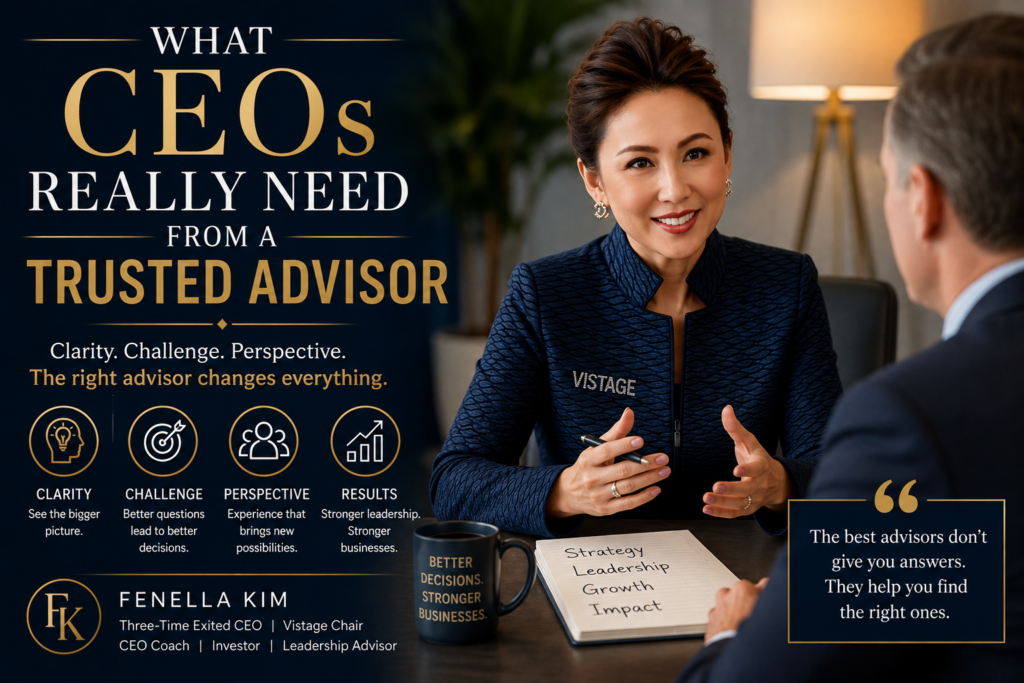
For Fenella Kim, this perspective comes from experience as a three-time exited CEO, entrepreneur, investor, and Vistage Chair. After nearly three decades of building, scaling, and exiting businesses, she understands that the most valuable advisors aren’t necessarily the people with the longest resumes.
They’re the people who know when to challenge, when to listen, when to ask a better question, and when to tell a CEO something they may not want to hear.
Advisor vs. Consultant vs. Coach: What’s the Difference?
CEOs often use the words advisor, consultant, and coach interchangeably. They aren’t always the same.
A consultant is typically brought in to solve a specific business problem and may provide recommendations, expertise, or implementation support.
A coach focuses primarily on the leader—their thinking, behavior, communication, performance, and development.
A trusted advisor can operate at a broader strategic level. The relationship is built around perspective, judgment, experience, confidentiality, and honest conversation.
For CEOs, the value often comes from having someone who can look at the situation from outside the organization while understanding the complexity of leading it.
This is also why confidential CEO peer advisory can be powerful: leaders gain perspective from people who understand the pressures of leadership firsthand. Research and leadership discussions around advisory relationships also highlight the importance of perspective, experience, and trusted relationships when leaders are navigating complex decisions. Harvard Business Review has also explored how leaders can recognize when they have outgrown an existing trusted-advisor relationship.
9 Qualities CEOs Should Look for in a Trusted Advisor
1. Relevant Leadership Experience
A strong advisor should understand the level of decisions a CEO is making.
Experience matters because leadership decisions often involve competing priorities, incomplete information, financial consequences, people considerations, and long-term implications.
An advisor who has actually sat in the leadership seat can bring a different perspective than someone who has only studied leadership from the outside.
Fenella’s own experience building and exiting companies is central to the way she approaches leadership advisory work.
2. The Courage to Challenge Your Thinking
A trusted advisor shouldn’t simply agree with everything a CEO says.
Sometimes the most valuable contribution is a difficult question:
- What are you missing?
- What assumption are you making?
- What happens if you’re wrong?
- Is this actually the problem?
- What would you do if you weren’t afraid of the outcome?
A CEO doesn’t need another yes-person.
They need someone who can respectfully challenge their thinking without turning the conversation into a competition.
3. Strategic Perspective
CEOs can become consumed by immediate problems.
A customer issue needs attention. A senior employee resigns. Revenue misses expectations. A major opportunity appears unexpectedly.
A trusted advisor helps the leader zoom out.
Instead of asking only:
“How do we solve this problem?”
They can help the CEO ask:
“What does this decision mean for the business three years from now?”
This type of strategic thinking becomes particularly important during periods of rapid growth, transformation, succession, or transition.
4. Honest, Unfiltered Feedback
One of the most valuable things an advisor can provide is honest feedback.
Not criticism for the sake of criticism.
Not negativity.
Truth delivered with context and respect.
CEOs often have people around them who depend on them for their jobs, compensation, opportunities, or business relationships. That can make completely candid conversations difficult.
A trusted advisor can provide a confidential environment where difficult subjects can be discussed openly.
5. Confidentiality and Trust
Advisory relationships only work when leaders can speak honestly.
A CEO may need to discuss:
- Leadership weaknesses
- Employee problems
- Financial pressure
- Succession concerns
- Acquisition opportunities
- Partnership conflicts
- Growth challenges
- Exit considerations
Without trust, those conversations remain superficial.
Confidentiality isn’t a bonus feature of an advisory relationship. It is part of the foundation.
6. Strong Questions—not Just Answers
The best advisor doesn’t always provide an immediate answer.
Sometimes they ask the question that helps the CEO discover the answer.
For example:
Instead of:
“You should replace this executive.”
A better conversation might be:
“What evidence tells you this person is the problem rather than the system around them?”
That distinction matters.
Good questions can expose assumptions, clarify priorities, and help leaders make decisions they can own.
7. A Long-Term Perspective
An advisor should help a CEO think beyond today’s problem.
A decision that improves this quarter’s numbers could create problems next year.
A leadership hire that solves an immediate gap might not support the company’s next stage.
A growth opportunity might look attractive but distract the organization from its core strategy.
Trusted advisors help leaders consider both the immediate decision and the longer-term consequences.
8. Perspective From Other Leaders
CEOs can learn from people outside their own industry.
In fact, cross-industry perspective can be extremely valuable because another leader may have already faced a similar challenge in a completely different context.
This is one of the principles behind CEO peer advisory groups.
The goal isn’t simply networking.
It’s creating a confidential environment where leaders can compare experiences, challenge assumptions, and gain perspective from peers who understand the responsibility of leadership.
9. The Ability to Strengthen the Leader—not Create Dependence
The ultimate goal of good advisory work isn’t to make a CEO dependent on an advisor.
It is to make the CEO better equipped to think, decide, and lead independently.
The advisor should strengthen the leader’s:
- Decision-making
- Strategic thinking
- Confidence
- Self-awareness
- Leadership judgment
- Ability to navigate uncertainty
That is where advisory relationships create lasting value.
What Fenella Kim Brings to the Advisor Relationship
Fenella Kim approaches leadership advisory from firsthand experience.
She is a three-time exited CEO, entrepreneur, investor, and Vistage Chair who has spent nearly three decades building, scaling, transforming, and exiting businesses.
That experience shapes her philosophy:
Leaders don’t always need another answer. Sometimes they need the right room, the right questions, and someone willing to challenge their thinking.
Through Leader Transcend, Fenella works with CEOs, founders, and senior executives through confidential leadership experiences designed to provide perspective during important stages of growth and transition.
Leaders can explore CEO coaching when they need individualized leadership support, or explore the CEO Advisory Board for a confidential peer environment built around high-level leadership conversations.
When Should a CEO Consider Working With an Advisor?
You don’t have to wait until something is going wrong.
A trusted advisor can be particularly valuable when a CEO is:
- Preparing for significant business growth
- Entering a new leadership role
- Building or restructuring an executive team
- Considering an acquisition
- Preparing for succession
- Navigating organizational change
- Preparing for an eventual exit
- Dealing with a high-stakes strategic decision
- Feeling isolated by the responsibility of leadership
- Looking for perspective outside their immediate organization
The right time to seek perspective is often before the decision becomes urgent.
FAQs on what CEOs need from a trusted advisor
What does a trusted advisor do for a CEO?
A trusted advisor provides confidential perspective, strategic insight, honest feedback, and thoughtful questions that help CEOs navigate complex decisions and leadership challenges.
Why do CEOs need trusted advisors?
CEOs often make high-stakes decisions with limited information and may not have someone inside the organization who can challenge their thinking objectively. A trusted advisor provides an outside perspective while understanding the realities of executive leadership.
What is the difference between a CEO coach and a trusted advisor?
CEO coaching generally focuses on developing the leader’s capabilities, behavior, decision-making, and leadership effectiveness. A trusted advisor may take a broader strategic perspective, helping the CEO think through business challenges, opportunities, transitions, and important decisions.
When should a CEO work with a trusted advisor?
A CEO can benefit from an advisor during periods of growth, organizational change, succession, leadership transitions, acquisitions, strategic uncertainty, or preparation for an eventual exit. It can also be valuable before a major challenge occurs.
What qualities should CEOs look for in a trusted advisor?
CEOs should look for relevant leadership experience, confidentiality, strategic perspective, honesty, strong listening and questioning skills, the ability to challenge assumptions, and a genuine understanding of executive-level decision-making.
Can a trusted advisor help with strategic decision-making?
Yes. A trusted advisor can help CEOs examine assumptions, evaluate alternatives, identify potential risks, and consider the longer-term consequences of important strategic decisions.
How can CEO peer advisory help leaders?
CEO peer advisory gives leaders a confidential environment to discuss challenges and decisions with other experienced business leaders. The combination of peer perspective and facilitated discussion can help CEOs gain clarity and consider issues from different viewpoints.
The Best Advisors Help CEOs See What They Can’t See Alone
The value of a trusted advisor isn’t measured by how many opinions they provide.
It’s measured by the quality of the thinking they help create.
The right advisor can help a CEO slow down when everything feels urgent, challenge assumptions when confidence becomes certainty, and see opportunities or risks that may be difficult to recognize from inside the business.
Ultimately, CEOs don’t need advisors who simply tell them what they want to hear.
They need people who can bring experience, perspective, candor, strategic thinking, and trust to the conversation.
For Fenella Kim, that philosophy comes from experience—not theory. After building and exiting three companies and now serving as a Vistage Chair, she understands the importance of having a confidential environment where leaders can think through the decisions that matter most.
If you’re looking for that kind of perspective, explore Leader Transcend’s CEO leadership experiences or request a confidential selection conversation with Fenella Kim.