

It’s not always a performance gap. It’s often a perspective gap—and the strongest senior leaders start closing it before the transition happens.
Many senior leaders reach a point where their performance is no longer the question. They have delivered results, managed teams, solved complex problems, handled pressure, built expertise, and earned the trust of their organizations.
Yet when the possibility of becoming a CEO or taking on significantly greater executive responsibility appears, something changes. The skills that made someone successful in their current role may not be enough for the role ahead.
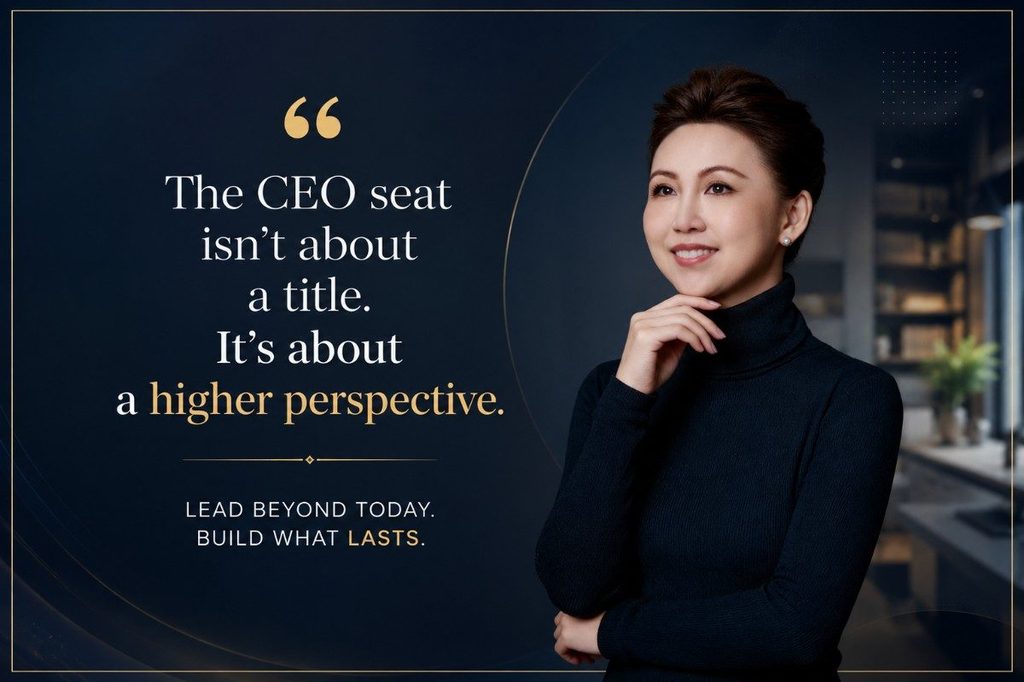
The Gap Between Where You Are and the CEO Seat is often less about capability and more about perspective. Moving toward the CEO seat requires leaders to think beyond their function, make decisions with incomplete information, influence across the organization, and take responsibility for outcomes they cannot directly control.
The best senior leaders understand this before the title changes. They don’t wait until they become CEO to start thinking like one. Instead, they intentionally develop the strategic perspective, executive presence, decision-making capability, and leadership maturity required for the next level.
This is where the right leadership support can make a meaningful difference. At Leader Transcend, Fenella Kim works with CEOs, senior executives, and emerging leaders to help them navigate complex leadership challenges and prepare for greater responsibility. Through Executive Coaching, CEO Coaching, and Leadership Development Coaching, leaders can create space to challenge assumptions, strengthen their leadership capabilities, and develop the perspective required to operate at a higher level.
For leaders preparing for a significant transition, Leadership Assessments can also provide valuable insight into strengths, development opportunities, and potential blind spots.
The goal isn’t simply to earn the CEO title. It’s to become ready for the level of thinking, responsibility, and leadership that comes with it.
The Gap Between Where You Are and the CEO Seat: What Needs to Change?
The Gap Between Where You Are and the CEO Seat is often created by the difference between functional success and enterprise-level leadership. A senior executive may already know how to manage a team, deliver results, and solve operational problems, but the CEO role requires a broader perspective.
At the next level, leaders need to think across the entire organization, connect decisions to long-term strategy, manage competing priorities, and lead through uncertainty. They also need to influence other executives, develop future leaders, and create clarity when there is no obvious answer.
Closing this gap starts with identifying what needs to change before the transition happens. That may involve strengthening strategic thinking, executive presence, decision-making, delegation, communication, and organizational leadership.
Rather than waiting for a promotion to reveal these gaps, senior leaders can proactively seek feedback, leadership assessments, executive coaching, and trusted advisory perspectives. The earlier these capabilities are developed, the more prepared a leader can be when the opportunity for greater responsibility arrives.
Performance Gets You Here. Perspective Helps You Go Further.
High performance matters.
A future CEO needs to understand how to deliver results, manage people, solve problems, and execute strategy.
But executive leadership requires another dimension.
A functional leader might ask:
“How do we improve the performance of my department?”
A CEO needs to ask:
“How does this decision affect the entire organization?”
That shift sounds simple, but it changes almost everything.
The CEO must consider customers, employees, investors, culture, financial performance, competitive positioning, operational capability, leadership succession, and long-term strategy—often at the same time.
This is why moving from functional leadership into enterprise leadership can feel so different.
The leader is no longer responsible only for what happens within their area.
They become responsible for understanding what needs to happen across the organization.
What Is the Perspective Gap?
The perspective gap is the difference between how a leader currently sees the business and the broader way they need to see it at the next level.
A senior executive may be excellent at:
- Managing a department
- Delivering quarterly targets
- Leading projects
- Developing employees
- Solving operational problems
- Managing budgets
- Improving processes
But the CEO role requires additional thinking around:
- Enterprise-wide strategy
- Long-term value creation
- Organizational culture
- Leadership succession
- Capital and resource allocation
- Stakeholder management
- Strategic risk
- Market positioning
- Executive-team alignment
- Decision-making under uncertainty
The transition therefore isn’t simply:
Manager → Executive → CEO
It is also:
Execution → Strategy → Enterprise Leadership
That mental shift needs to happen before the job title changes.
1. Move From Solving Problems to Seeing Patterns
Strong operational leaders are often excellent problem solvers.
When something goes wrong, they investigate the issue, identify the cause, and find a solution.
That skill remains valuable at the executive level.
But CEOs must also recognize patterns.
Instead of asking:
“Why did this problem happen?”
they may need to ask:
“Why does this type of problem keep happening?”
That question moves the conversation from an individual incident to organizational design.
Perhaps the problem isn’t one underperforming employee.
It could be:
- An unclear accountability structure
- Poor communication between departments
- Misaligned incentives
- A leadership capability gap
- An outdated process
- A strategy that has not kept pace with growth
The higher you move in an organization, the more important it becomes to recognize systems rather than isolated events.
2. Expand Your Thinking Beyond Your Function
One of the biggest challenges for future CEOs is moving beyond functional thinking.
A CFO naturally thinks about financial performance.
A COO thinks about operations.
A CMO focuses on customers and market growth.
A CTO considers technology and innovation.
Those perspectives are valuable—but a CEO needs to integrate them.
The CEO must understand how one decision affects multiple parts of the business.
For example, increasing sales may appear positive.
But what happens if operations cannot support the additional demand?
What happens to customer experience?
What happens to cash flow?
What additional leadership capability will be required?
What happens to company culture?
Enterprise leadership means learning to connect these seemingly separate decisions.
3. Develop Strategic Decision-Making
At senior levels, leaders rarely have perfect information.
There may be incomplete data, competing priorities, uncertain markets, and significant consequences.
Waiting for complete certainty is often impossible.
Future CEOs therefore need to become comfortable making high-quality decisions under uncertainty.
This involves asking:
- What do we know?
- What don’t we know?
- What assumptions are we making?
- What are the potential consequences?
- What risks are acceptable?
- What happens if we are wrong?
- What decision best supports the organization’s long-term direction?
Strategic decision-making is not about always being right.
It is about developing the judgment to make thoughtful decisions when there is no perfect answer.
4. Strengthen Executive Presence
Executive presence is often misunderstood.
It isn’t simply about speaking confidently in a boardroom or appearing authoritative.
True executive presence is reflected in how a leader communicates, listens, responds under pressure, and creates confidence in others.
A future CEO needs to be able to:
- Communicate clearly
- Stay composed during uncertainty
- Listen to opposing viewpoints
- Explain difficult decisions
- Challenge assumptions respectfully
- Influence without relying on authority
- Build confidence among stakeholders
The goal isn’t to become someone else.
It is to become more intentional about how your leadership is experienced by others.
5. Learn to Lead Through Other Leaders
One of the most important transitions toward the CEO seat is learning to stop being the person who solves everything.
High-performing leaders often become successful because they are dependable problem solvers.
People bring them difficult situations because they know they will find an answer.
But this can eventually become a limitation.
If every important decision comes back to one leader, that leader becomes a bottleneck.
At the CEO level, leadership must scale.
That means developing other leaders who can:
- Make decisions
- Solve problems
- Take ownership
- Challenge ideas
- Develop their own teams
- Operate without constant executive intervention
The question changes from:
“How can I solve this?”
to:
“Who can I develop to solve this?”
That is a significant leadership shift.
6. Understand That Culture Is a Leadership Responsibility
Future CEOs sometimes focus heavily on strategy and financial performance while underestimating culture.
But culture influences how people make decisions when leadership isn’t in the room.
A CEO helps shape:
- What behaviors are rewarded
- How accountability works
- How people communicate
- How decisions are made
- How conflict is handled
- Whether employees feel safe challenging assumptions
- Whether leaders take responsibility for outcomes
Culture is not simply an HR initiative.
It is shaped every day by leadership behavior.
If executives say they value accountability but consistently tolerate poor performance, employees notice.
If leaders say they value innovation but punish every failed experiment, employees notice that too.
The CEO’s behavior becomes a powerful signal for the rest of the organization.
7. Build the Ability to Think Long Term
Operational leadership often requires immediate action.
CEO leadership requires balancing today with tomorrow.
A CEO may need to decide between:
- Short-term revenue and long-term positioning
- Immediate cost reduction and future capability
- Current performance and leadership succession
- Quarterly targets and strategic investment
There is no universal formula.
The important capability is learning to recognize the difference between urgent and important.
A future CEO needs enough strategic distance to ask:
“If we continue operating this way for the next three years, where will it take us?”
That question can reveal risks and opportunities that aren’t visible when leadership is focused entirely on today’s problems.
8. Get Comfortable With Difficult Conversations
The CEO seat comes with conversations that cannot always be delegated.
These may involve:
- Executive performance
- Organizational change
- Strategic disagreement
- Succession
- Underperformance
- Leadership-team conflict
- Difficult business decisions
Avoiding difficult conversations rarely makes the underlying problem disappear.
In fact, unresolved issues often become more expensive over time.
Strong leaders learn to approach difficult conversations with clarity, preparation, empathy, and appropriate accountability.
The objective isn’t confrontation.
It is progress.
9. Identify Your Leadership Blind Spots
Every leader has blind spots.
The challenge is that blind spots are difficult to see from inside your own perspective.
A leader may believe they are:
- Decisive
while others experience them as dismissive.
They may believe they are:
- Highly involved
while their team experiences them as micromanaging.
They may believe they are:
- Giving people autonomy
while employees experience a lack of direction.
This is where external perspective can be valuable.
A trusted advisor, executive coach, leadership assessment, or experienced peer group can help leaders see patterns they may not recognize themselves.
Leader Transcend’s Leadership Assessments can be a useful starting point for leaders who want deeper insight into their leadership strengths and development opportunities.
Senior Leader vs. CEO-Level Leadership: Closing the Perspective Gap
The transition to the CEO seat often requires a shift in how leaders approach decisions, people, and the organization as a whole. The table below highlights some of the key differences:
| Senior Leader Perspective | CEO-Level Perspective |
|---|---|
| Focuses primarily on their department or function | Considers the entire organization |
| Measures success through team or departmental results | Measures success through overall business performance |
| Solves immediate operational problems | Identifies patterns and addresses systemic issues |
| Focuses on execution | Balances execution with long-term strategy |
| Makes decisions within their area of responsibility | Considers cross-functional and enterprise-wide consequences |
| Personally solves complex problems | Develops other leaders to solve problems |
| Focuses on current priorities | Balances today’s needs with future opportunities |
| Manages their team | Builds and aligns the leadership team |
| Relies heavily on established expertise | Challenges assumptions and seeks broader perspectives |
| Responds to organizational issues | Anticipates risks and opportunities |
| Focuses on performance | Considers performance, culture, people, and long-term sustainability |
| Primarily influences within their function | Influences stakeholders across the organization |
Why Waiting Until You Become CEO Can Be a Mistake
One of the biggest mistakes future executives make is assuming they will develop the necessary capabilities after receiving the promotion.
The problem is that the transition itself can be demanding.
New CEOs may suddenly face:
- Board expectations
- Increased organizational complexity
- Greater stakeholder visibility
- Difficult strategic decisions
- Executive-team dynamics
- Succession questions
- Cultural challenges
- Significant financial responsibility
There may be very little time to “learn on the job.”
That is why leadership development should begin before the transition.
The goal is to arrive prepared—not to receive the title and then begin preparing.
How Executive Coaching Can Help Close the Perspective Gap
One of the most effective ways to challenge established thinking is through structured, confidential reflection.
Leader Transcend’s Executive Coaching provides leaders with a space to examine complex leadership challenges, decision-making, communication, relationships, and organizational dynamics.
Executive coaching isn’t about giving a senior leader a list of instructions.
It can help a leader ask better questions:
- What am I missing?
- What assumptions am I making?
- What does my team need from me at this stage?
- Where am I becoming a bottleneck?
- What should I stop doing?
- What leadership capability does the organization need next?
- Am I operating at the level my role requires?
Those questions can be uncomfortable.
They can also be extremely valuable.
CEO Coaching: Preparing Before the Transition
For leaders already approaching the CEO level, CEO Coaching with Leader Transcend can provide a confidential environment to think through the demands of enterprise leadership.
The value isn’t simply preparation for a title.
It is preparation for a different level of responsibility.
CEO-level thinking requires the ability to step back from operational detail and consider the organization’s direction, leadership team, culture, strategic priorities, and long-term future.
Developing that perspective early can make the eventual transition more intentional.
Leadership Development for the Next Generation of Leaders
Not every future CEO is currently sitting in the C-suite.
Some are senior executives.
Some are functional leaders.
Some are emerging leaders who have demonstrated exceptional performance but haven’t yet had enterprise-level responsibility.
For these leaders, structured Leadership Development Coaching can help develop the capabilities needed for broader leadership responsibilities.
Development may include:
- Strategic thinking
- Communication
- Executive presence
- Emotional intelligence
- Decision-making
- Accountability
- Delegation
- Leadership confidence
- Organizational influence
The objective is not to manufacture a particular leadership style.
It is to help leaders become more effective and intentional in the way they lead.
The Value of Leadership Assessments
Leadership development becomes more effective when leaders understand where they currently stand.
A leadership assessment can provide another perspective on:
- Strengths
- Development areas
- Leadership tendencies
- Communication style
- Interpersonal patterns
- Potential blind spots
Used appropriately, assessments shouldn’t become labels.
They should become conversation starters.
The more accurately a leader understands their current approach, the easier it becomes to determine what needs to change before taking on greater responsibility.
Why Peer Advisory Matters at the Executive Level
Leadership can become increasingly isolated as responsibility grows.
A CEO or senior executive may not have many people inside the organization with whom they can openly discuss difficult decisions.
This is one reason peer advisory can be valuable.
A confidential group of experienced leaders can provide:
- Different perspectives
- Constructive challenge
- Accountability
- Strategic discussion
- Shared experience
- A place to test assumptions
Leader Transcend also provides CEO Peer Advisory opportunities for leaders who value confidential peer perspective and strategic discussion.
The value of experienced peers isn’t that they will necessarily have the answer.
It is that they may ask a question you haven’t considered.
A Practical Test: Are You Already Thinking Like a CEO?
Ask yourself these questions:
1. Do I think beyond my department?
Can you evaluate decisions based on their impact across the entire organization?
2. Can I delegate outcomes, not just tasks?
Are you developing leaders who can make meaningful decisions without you?
3. Can I make decisions without complete information?
Are you comfortable weighing uncertainty and risk?
4. Do I spend enough time on strategic thinking?
Or does operational urgency consume most of your calendar?
5. Can I challenge my own assumptions?
Do you actively seek perspectives that disagree with you?
6. Do I develop other leaders?
Are you building an organization that becomes stronger without depending on you for every decision?
7. Can I think three to five years ahead?
Are you balancing immediate performance with long-term organizational health?
If several of these questions make you uncomfortable, that isn’t necessarily a weakness.
It may simply reveal where your next stage of leadership development needs to focus.
From High Performer to Enterprise Leader
The journey toward the CEO seat isn’t simply about accumulating more achievements.
At some point, the question changes from:
“How much can I accomplish?”
to:
“How much can I enable the organization to accomplish?”
That is a fundamentally different leadership mindset.
The strongest future CEOs understand that their value is no longer measured only by their personal output.
It is measured by their ability to:
- Set direction
- Build leadership capability
- Make strategic decisions
- Align people
- Shape culture
- Allocate resources
- Navigate uncertainty
- Create clarity
- Build an organization that can perform without constant executive intervention
That transition requires perspective.
Frequently Asked Questions About the CEO Leadership Gap
What is the gap between where you are and the CEO seat?
The gap is often a perspective gap rather than a performance gap. Senior leaders may already have strong expertise and results, but the CEO role requires broader strategic thinking, enterprise-wide decision-making, leadership influence, and long-term vision.
What skills are needed to prepare for the CEO seat?
Future CEOs typically need to strengthen strategic thinking, decision-making, executive presence, communication, delegation, emotional intelligence, stakeholder management, and enterprise leadership.
How can senior leaders start thinking like a CEO?
Start by looking beyond your own function. Consider how decisions affect the entire organization, spend more time on long-term strategy, develop other leaders, challenge your assumptions, and become comfortable making decisions with incomplete information.
Can executive coaching help prepare someone for the CEO role?
Yes. Executive coaching can provide a confidential environment for senior leaders to examine leadership challenges, identify blind spots, improve decision-making, and develop the perspective needed for greater executive responsibility.
Why are leadership assessments useful for future CEOs?
Leadership assessments can help leaders better understand their strengths, development opportunities, communication patterns, and potential blind spots. They can provide a useful starting point for creating a focused leadership development plan.
When should a senior leader begin preparing for the CEO role?
Preparation should ideally begin before the transition. Waiting until receiving the CEO title can leave little time to develop the strategic, interpersonal, and organizational capabilities required at the next level.
What is the difference between a senior executive and a CEO?
A senior executive may primarily lead a function or department, while a CEO is responsible for the organization as a whole. CEOs must integrate strategy, people, culture, financial performance, operations, and long-term organizational direction.
How can leaders close the gap before becoming CEO?
Leaders can close the gap by seeking executive coaching, leadership development, assessments, mentorship, and trusted peer perspectives, while deliberately expanding their thinking from functional execution to enterprise-wide leadership.
Final Thoughts: Close the Gap Before You Get the Title
The gap between where you are and the CEO seat isn’t always about experience, intelligence, or performance.
Often, it is about perspective.
The leaders who prepare successfully for greater responsibility don’t wait for the promotion to change how they think. They begin expanding their perspective while they are still in their current role.
They seek feedback.
They challenge assumptions.
They develop other leaders.
They learn to think across the organization.
They invest in strategic development.
And they create space for reflection rather than allowing operational demands to consume every hour of their leadership.
Whether through executive coaching, CEO coaching, leadership assessments, leadership development, or confidential peer advisory, the objective is the same: become capable of seeing the organization from a broader perspective before you are required to lead it from that position.
The CEO seat may be the destination.
But the mindset required to succeed there needs to be developed long before the title arrives.
Leaders preparing for the CEO seat can also explore Harvard Business Review’s Executive insights for additional perspectives on executive leadership, strategic decision-making, and navigating complex organizational challenges.
The best time to start thinking like a CEO isn’t when you become one. It’s when you decide you’re ready to lead at that level.