
Running a business can be exciting, rewarding, and deeply meaningful. It can also mean waking up thinking about revenue, spending the day making decisions, answering employee questions, solving customer problems, and ending the evening wondering whether you made the right strategic call.
So, what is a main reason why entrepreneurs experience daily stress?
One of the biggest reasons is the concentration of responsibility. Entrepreneurs often carry responsibility for revenue, employees, customers, cash flow, operations, growth, and the future of the company—all at the same time. Unlike many employees, they may not have someone above them who can make the final decision or absorb the consequences when something goes wrong.
Research on entrepreneurs has identified workload and financial pressures as important daily stressors, while research on self-employed people also points to long hours, job insecurity, short-notice demands, and supervisory responsibilities as contributors to work-family conflict.
But entrepreneurial stress rarely comes from one source.
It is often the result of many responsibilities converging on one person.
And as a company grows, that pressure can become even more complicated.
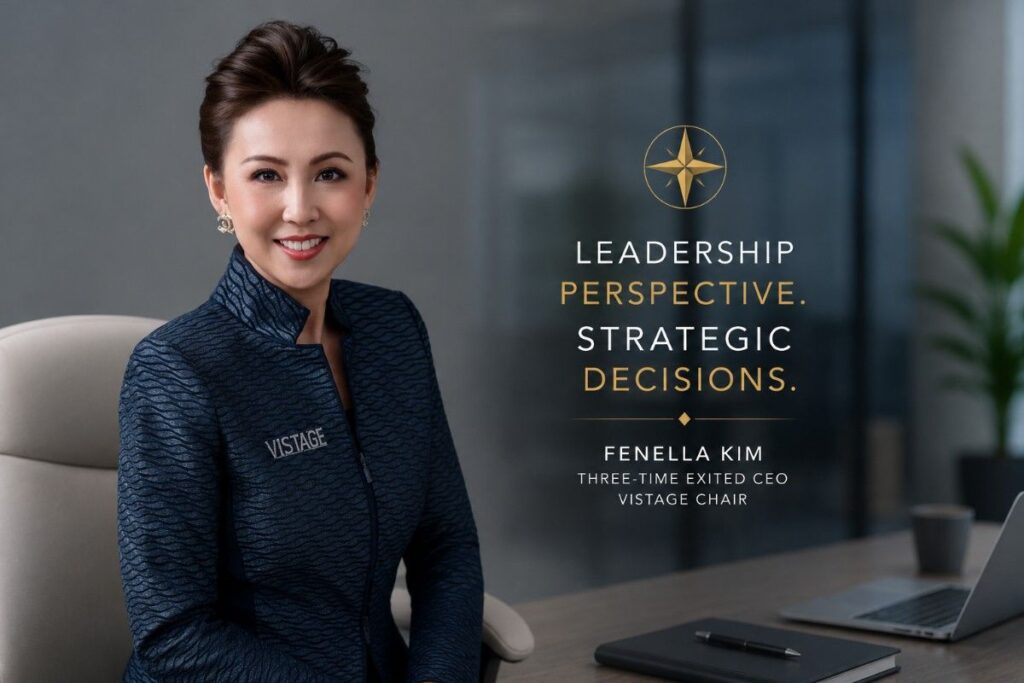
For leaders facing these challenges, Fenella Kim brings nearly three decades of entrepreneurial experience, including building, scaling, and exiting three companies. As a three-time exited CEO and Vistage Chair, she works with CEOs, founders, and senior executives navigating growth, leadership transitions, succession, and other high-stakes decisions.
For entrepreneurs who want to step back from day-to-day pressure and gain a clearer perspective, CEO coaching can provide a confidential environment to examine leadership challenges, decision-making, delegation, growth, and the demands that come with leading an organization.
What Is a Main Reason Why Entrepreneurs Experience Daily Stress?
The simplest answer is:
Entrepreneurs experience daily stress because they often carry a high level of responsibility while dealing with uncertainty and constant decision-making.
A business owner may be responsible for decisions that affect not just themselves, but employees, customers, investors, suppliers, and family members.
Consider a typical day.
A founder might begin the morning thinking about cash flow.
Then an employee needs help.
A major customer has a problem.
A candidate turns down an offer.
Sales numbers are below expectations.
An important executive wants to leave.
A competitor launches something new.
An investor asks about growth.
And before the entrepreneur has finished solving those problems, another strategic decision appears.
The challenge isn’t necessarily that any single problem is overwhelming.
It is the continuous accumulation of responsibility.
Entrepreneurs often don’t get to say, “That’s someone else’s problem.”
Eventually, the decision comes back to them.
That can create a form of pressure that follows the entrepreneur beyond working hours.
Why Entrepreneurial Stress Is Different From Ordinary Work Stress
Everyone experiences work pressure.
But entrepreneurship can create a different type of responsibility.
An employee might finish a difficult project and go home knowing that a manager will handle the next major decision.
An entrepreneur may finish the project and immediately start thinking about:
- Next month’s revenue
- Payroll
- Hiring
- Customer retention
- Business strategy
- Taxes
- Cash flow
- Competition
- Growth
- Long-term sustainability
The work doesn’t necessarily have a clear endpoint.
Research on self-employed workers has found that job demands such as long working hours, work intensity, short-notice work, job insecurity, and supervisory responsibilities can contribute to work-family conflict.
Research specifically examining entrepreneurs has also found relationships between workload and financial stressors and entrepreneurs’ emotional responses.
That doesn’t mean every entrepreneur is constantly stressed.
Entrepreneurship also offers autonomy, flexibility, achievement, and purpose.
The important point is that high autonomy does not automatically eliminate high demands.
In some situations, the freedom to make every decision also means carrying the responsibility for every decision.
10 Reasons Entrepreneurs Experience Daily Stress
1. Entrepreneurs Carry Too Much Responsibility
One of the clearest reasons for entrepreneurial stress is responsibility.
The founder may be responsible for almost everything.
Even when there is an executive team, the entrepreneur may still feel ultimately accountable for:
- Business performance
- Payroll
- Employees
- Customers
- Financial decisions
- Company reputation
- Growth
- Strategic direction
- Major risks
This creates a psychological burden that can be difficult to switch off.
Imagine a business owner who has built a company over 15 years.
They aren’t just managing a business.
They may feel responsible for the livelihoods of dozens or hundreds of people.
That makes decisions feel personal.
A disappointing quarter isn’t simply a disappointing number.
It may represent concerns about employees, investments, family finances, and the future.
This is one reason successful entrepreneurs can still experience significant stress.
Success doesn’t necessarily remove responsibility.
Sometimes it increases it.
2. Financial Uncertainty Creates Constant Pressure
Money is another major source of entrepreneurial stress.
Even profitable companies can experience financial uncertainty.
Entrepreneurs may constantly think about:
- Revenue
- Profit margins
- Cash flow
- Payroll
- Taxes
- Debt
- Investments
- Customer concentration
- Economic conditions
- Expansion costs
A business may be profitable on paper while still experiencing cash-flow pressure.
A founder might therefore ask:
“Can we afford to hire?”
“Should we expand?”
“Should we invest now or wait?”
“What happens if revenue drops next quarter?”
These questions don’t necessarily have perfect answers.
Entrepreneurs frequently have to make decisions with incomplete information.
Research examining daily entrepreneurial stress has specifically identified financial and workload stressors as important factors influencing entrepreneurs’ emotional experiences.
The uncertainty itself can become stressful.
3. Entrepreneurs Make Too Many Decisions
Decision-making is one of the most underestimated sources of entrepreneurial stress.
A founder might make dozens of decisions every day.
Some are small:
- Which meeting should happen first?
- Which email needs a response?
- Which candidate moves forward?
Others are significant:
- Should we acquire another company?
- Should we enter a new market?
- Should we replace an executive?
- Should we raise capital?
- Should we sell?
- Should we change our business model?
The problem is that decisions consume mental energy.
And entrepreneurs often make decisions across multiple areas of the business.
They may move from a marketing decision to a hiring decision to a financial decision to a strategic decision within a few hours.
This constant switching can make the day feel mentally exhausting.
4. Difficulty Delegating Can Increase Founder Stress
Many entrepreneurs struggle with delegation.
The reason is understandable.
They built the business.
They know its history.
They know the customers.
They know how things work.
And sometimes they genuinely can do a task faster themselves.
But that creates a dangerous cycle:
Founder does everything → team doesn’t develop ownership → founder becomes more essential → founder gets busier → stress increases → founder does even more.
The short-term solution creates a long-term problem.
Effective delegation isn’t simply giving someone a task.
It’s transferring ownership.
Instead of:
“Can you do this for me?”
the better leadership question may be:
“Can you own this outcome?”
That difference matters.
When leaders build capable people around them, they can gradually move from being the person who solves every problem to the person who develops the organization that solves problems.
5. Growth Creates a New Type of Stress
Entrepreneurs often assume that growth will make everything easier.
Sometimes it does.
But growth can also create new problems.
A company that doubles in size may require:
- More employees
- More managers
- Better systems
- More capital
- New processes
- Stronger technology
- More sophisticated reporting
- Greater accountability
The founder’s old way of operating may no longer work.
When a business has 10 employees, the founder might personally know everyone.
At 100 employees, that becomes much harder.
At 500 employees, leadership must operate through systems and other leaders.
This creates a critical transition:
The company grows faster than the founder’s old leadership model.
If the entrepreneur doesn’t evolve, stress can increase.
The answer isn’t always working harder.
Sometimes the answer is learning how to lead at the next level.
6. Leadership Can Be Lonely
This is one of the most important—and least discussed—sources of entrepreneurial stress.
Who can a CEO talk to about a major decision?
Not necessarily employees.
Not necessarily customers.
Not necessarily family.
And sometimes not even business partners.
Imagine you’re considering replacing a senior executive.
You can’t necessarily discuss the decision with the executive’s direct reports.
Or imagine you’re considering selling the company.
You may not want employees to know before the decision is final.
Or you’re considering an acquisition.
You may need an objective perspective from someone who understands the situation but isn’t emotionally involved in the outcome.
This is where leadership isolation can become a problem.
A leader can be surrounded by people and still feel alone in decision-making.
That is one reason confidential peer environments can be valuable.
A CEO may not need someone to tell them exactly what to do.
They may need someone who asks:
“What are you missing?”
“What assumption are you making?”
“What happens if you’re wrong?”
“What would you do if you weren’t afraid of the outcome?”
Sometimes perspective is more valuable than advice.
7. Work and Personal Life Can Become Blurred
Entrepreneurship doesn’t always fit neatly into a 9-to-5 schedule.
A founder might:
- Check email before breakfast
- Take calls during dinner
- Answer employee messages at night
- Work weekends
- Think about business problems before sleeping
- Wake up with a new strategic concern
The physical workday might end.
The mental workday doesn’t.
Research on self-employed people has found that work demands can contribute to work-family conflict, particularly when long hours, work intensity, insecurity, and other job demands are involved.
More recent research involving solo entrepreneurs has also found associations between work-life conflict, sleep problems, burnout, and mental-health outcomes.
This doesn’t mean entrepreneurship automatically damages personal life.
It means boundaries can become more difficult when the entrepreneur feels personally responsible for the business.
8. Fear of Failure Can Add Another Layer of Pressure
Entrepreneurs don’t all fear failure.
But for some founders, the possibility of failure carries significant consequences.
It may affect:
- Personal finances
- Employees
- Investors
- Family
- Reputation
- Customers
- Future opportunities
That can make certain decisions emotionally heavier.
A founder may think:
“If I make the wrong decision, people could lose their jobs.”
That’s different from making a mistake on an ordinary project.
The consequences can feel much larger.
The important thing is not to eliminate every fear.
Leadership requires accepting uncertainty.
The goal is to develop enough perspective to make thoughtful decisions without allowing fear to control every decision.
9. Entrepreneurs Live With Uncertainty
Business rarely provides complete information.
You don’t know exactly what customers will do.
You don’t know what competitors will launch.
You don’t know how the economy will change.
You don’t know whether a new hire will succeed.
You don’t know whether an expansion will work.
Yet the entrepreneur still has to decide.
That’s leadership.
Sometimes the decision is:
“We have 70% of the information. We need to move.”
That can be uncomfortable.
The entrepreneur has to balance:
Risk + Opportunity + Uncertainty + Timing.
This constant uncertainty can create mental pressure even when nothing is actively going wrong.
10. Entrepreneurs Don’t Always Have a Trusted Place to Think
Information isn’t necessarily the problem.
Entrepreneurs have more information than ever.
They can access:
- Business books
- Podcasts
- Consultants
- AI tools
- Market reports
- Industry publications
- Online communities
- Advisors
But information and perspective aren’t the same thing.
Sometimes a founder already knows the options.
What they need is someone to challenge their thinking.
That’s where a trusted advisor, coach, mentor, or peer group can become valuable.
Common Causes of Entrepreneurial Stress
| Source of Stress | Why It Creates Pressure | What Leaders Can Do |
|---|---|---|
| Too Much Responsibility | The entrepreneur feels responsible for employees, customers, revenue, operations, and business outcomes. | Delegate ownership and build a stronger leadership team. |
| Financial Uncertainty | Cash flow, revenue, payroll, investment, and unexpected expenses can create constant concern. | Improve financial visibility and make decisions based on clear priorities and data. |
| Constant Decision-Making | Entrepreneurs may need to make dozens of operational and strategic decisions every day. | Create decision-making frameworks and empower executives to make appropriate decisions. |
| Difficulty Delegating | Founders may feel that everything needs their personal involvement or approval. | Transfer responsibility for outcomes, not just individual tasks. |
| Business Growth | Growth creates new employees, systems, customers, processes, and leadership challenges. | Evolve from hands-on operator to strategic leader. |
| Leadership Isolation | CEOs may have few people with whom they can discuss confidential, high-stakes decisions. | Build trusted relationships with experienced peers, advisors, or coaches. |
| Work-Life Boundaries | Business concerns can continue after working hours, making it difficult to mentally disconnect. | Establish protected personal time and clearer communication boundaries. |
| Fear of Failure | Business decisions can affect employees, customers, investors, family, and personal finances. | Focus on informed decision-making rather than trying to eliminate uncertainty. |
| Uncertainty | Market conditions, competitors, employees, customers, and opportunities are difficult to predict. | Develop flexible strategies and focus on controllable factors. |
| Lack of Perspective | Being too close to the business can make it difficult to see blind spots or alternative solutions. | Seek objective outside perspective through coaching or peer advisory. |
The important takeaway: entrepreneurial stress isn’t always caused by working too many hours. In many cases, it comes from carrying too much responsibility, making too many decisions, and lacking enough space to step back and think strategically. Building the right leadership structure and having trusted people to challenge your thinking can help reduce unnecessary pressure.
Is Stress Always Bad for Entrepreneurs?
No.
Some level of pressure is a normal part of entrepreneurship.
Deadlines can create focus.
Competition can motivate action.
A difficult business challenge can encourage innovation.
The concern is persistent, overwhelming, or poorly managed stress.
The difference isn’t always the amount of work.
It can be the entrepreneur’s ability to recover, prioritize, delegate, and access support.
A 2024 study of self-employed people found that higher quantitative work demands were associated with mental exhaustion, while proactive coping showed negative associations with both job demands and mental exhaustion in the study sample.
So the question isn’t:
“How can I eliminate all stress?”
A more useful question is:
“How can I build a way of leading that doesn’t require me to carry unnecessary stress every day?”
How Daily Stress Can Affect Entrepreneurial Decision-Making
Persistent pressure can change how leaders approach decisions.
When someone is constantly reacting, they may prioritize whatever problem is loudest.
The loudest problem isn’t always the most important problem.
For example:
A customer complaint arrives.
The CEO immediately focuses on it.
Then an employee issue appears.
The CEO switches to that.
Then an urgent sales question arrives.
The CEO moves again.
At the end of the day, the CEO has solved 15 problems—but hasn’t spent an hour thinking about the company’s biggest strategic challenge.
That’s the difference between being busy and leading strategically.
A stressed leader can become trapped in reaction mode.
How Entrepreneurs Can Reduce Daily Stress
Reducing entrepreneurial stress doesn’t necessarily mean taking a vacation and returning to the same business structure.
Sometimes the structure itself needs to change.
Build a Decision-Making Framework
Not every decision should reach the CEO.
Create categories:
CEO decisions
Major strategy, capital allocation, leadership changes, acquisitions, and other high-impact decisions.
Leadership-team decisions
Operational decisions within established authority.
Team decisions
Routine decisions that should happen without executive involvement.
The goal is to prevent the CEO from becoming the approval point for everything.
Delegate Ownership, Not Just Tasks
Delegation becomes more powerful when leaders give people responsibility for outcomes.
Instead of assigning:
“Prepare the monthly report.”
Give ownership:
“You own our monthly performance reporting. Make sure leadership has the information needed to make decisions.”
The second approach develops leadership capacity.
Establish Clear Priorities
A company cannot have 25 “top priorities.”
If everything is urgent, nothing is strategic.
Identify the few outcomes that genuinely matter most.
Then align:
- People
- Time
- Budget
- Meetings
- Accountability
around them.
Create Boundaries Around Availability
Entrepreneurs don’t necessarily need to stop working at 5 p.m.
But they do need periods where they aren’t constantly reacting.
Consider:
- Meeting-free blocks
- Focus time
- Email boundaries
- Notification management
- Protected personal time
- Strategic planning periods
The goal isn’t perfection.
It’s creating enough space to think.
Build a Strong Leadership Team
A strong executive team can dramatically change how a founder experiences the business.
Instead of asking:
“How do I solve this?”
the CEO can increasingly ask:
“Who owns this?”
That’s a major leadership transition.
The entrepreneur moves from operator to organizational leader.
This is one of the central ideas behind effective leadership development.
Leadership development isn’t simply about becoming a better speaker or manager.
It can involve learning how to create an organization that doesn’t depend on one person for every important decision.
Why Entrepreneurs Need Perspective, Not Just More Information
Entrepreneurs are often excellent at solving problems.
That’s probably part of how they became successful.
But the skills that help someone build a company aren’t always the same skills needed to lead a larger organization.
A founder may have been successful because they were:
- Highly involved
- Fast-moving
- Independent
- Relentless
- Hands-on
As the company grows, those same strengths can become limitations if they aren’t balanced with:
- Delegation
- Trust
- Strategic thinking
- Executive development
- Systems
- Accountability
This is where outside perspective can become valuable.
A good coach or peer group doesn’t simply provide answers.
It can help the leader examine the way they are thinking.
How CEO Peer Advisory Can Help Reduce Leadership Isolation
For CEOs who don’t have many places to discuss high-stakes decisions openly, CEO peer advisory can provide a confidential environment for perspective and discussion.
A peer advisory environment can bring together leaders facing different versions of similar challenges.
One CEO might be navigating succession.
Another may be scaling.
Another may be preparing for an exit.
Another may be dealing with an executive-team problem.
The benefit isn’t necessarily that one person has the perfect answer.
It’s that leaders can learn from multiple perspectives.
A peer may ask a question that nobody inside the company would feel comfortable asking.
That can change the conversation.
How Fenella Kim Helps Leaders Think Through High-Stakes Decisions
Leader Transcend’s approach is built around creating environments where leaders can step back from the day-to-day and think more strategically.
At the center of that work is Fenella Kim, a three-time exited CEO, entrepreneur, investor, and Vistage Chair.
Her experience spans business building, leadership, growth, and exits across industries and cultures.
You can learn more about Fenella Kim’s leadership experience and how her firsthand experience shapes the way she works with CEOs and senior leaders.
The distinction matters.
Leadership support isn’t only about knowing frameworks.
Sometimes leaders want to speak with someone who understands what it feels like to sit in the decision-making seat.
CEO Coaching vs. Executive Coaching vs. Peer Advisory
Different leadership challenges require different environments.
CEO Coaching
CEO coaching can be useful when a leader wants individualized attention around leadership decisions, growth, transition, or other executive challenges.
Executive Coaching
Executive coaching can provide a confidential one-to-one environment for senior leaders working on leadership effectiveness and development.
CEO Peer Advisory
CEO peer advisory adds something different: perspective from other leaders who understand the complexity of executive responsibility.
There isn’t one universally “best” approach.
The right choice depends on the leader, the challenge, and the type of support they need.
Leadership Assessments Can Reveal Hidden Sources of Stress
Sometimes entrepreneurs know they’re stressed but don’t know exactly why.
The obvious answer might be:
“We’re growing too fast.”
But the deeper issue could be:
- The founder approves every decision.
- The executive team lacks accountability.
- Priorities aren’t clear.
- Roles overlap.
- The founder doesn’t trust delegation.
- Leadership communication isn’t consistent.
This is where leadership assessments can provide another perspective.
The objective isn’t to label the entrepreneur.
It’s to identify areas that may deserve greater attention.
When Entrepreneurial Stress Is a Sign to Change How You Lead
Sometimes recurring stress isn’t telling you to work harder.
It’s telling you that your leadership model needs to evolve.
Consider these questions:
Are you still approving decisions your team should own?
Does everyone come to you when something goes wrong?
Can you take a week away without the business becoming dependent on your return?
Does your leadership team have enough authority to act?
Are you spending more time solving problems than building the future?
If the answer to several of these questions is yes, the issue may not simply be workload.
It may be organizational dependency on the founder.
The solution can involve changing systems, responsibilities, leadership structures, and expectations.
A Simple Framework for Reducing Entrepreneurial Stress
Use this six-step framework.
1. Identify
Ask:
What is actually creating the pressure?
Don’t settle for “the business.”
Be specific.
Is it cash flow?
People?
Growth?
Decision-making?
Lack of trust?
Time?
2. Prioritize
Ask:
Which problems truly require my attention?
Not every problem is a CEO problem.
3. Delegate
Ask:
What should someone else own?
Move from doing tasks to building ownership.
4. Discuss
Ask:
Who can challenge my thinking?
Find people who aren’t afraid to tell you what you don’t want to hear.
5. Decide
Ask:
What decision am I avoiding?
Unmade decisions can consume enormous mental energy.
6. Build
Ask:
What system, team, or structure can prevent this problem from returning?
That’s how a founder moves from repeatedly solving problems to building an organization that solves them.
When Should an Entrepreneur Consider CEO Coaching?
CEO Coaching can be particularly useful when an entrepreneur is:
- Scaling rapidly
- Transitioning from founder to CEO
- Building an executive team
- Preparing for succession
- Navigating a major strategic decision
- Experiencing leadership isolation
- Preparing for an exit
- Struggling to delegate
- Managing significant organizational change
The purpose isn’t to eliminate every difficult decision.
It’s to create a better environment for making those decisions.
Frequently Asked Questions
What is a main reason why entrepreneurs experience daily stress?
One of the main reasons is the concentration of responsibility. Entrepreneurs may simultaneously carry responsibility for revenue, employees, customers, operations, cash flow, growth, and strategic decisions. Constant uncertainty and decision-making can make it difficult to mentally disconnect from the business.
Why do entrepreneurs feel stressed even when their business is successful?
Success can increase responsibility. A growing company may have more employees, customers, financial commitments, operational complexity, and expectations. As the business grows, the entrepreneur may also face new leadership challenges that weren’t present during the company’s early stages.
What causes stress for business owners?
Common sources include financial uncertainty, workload, decision-making, employee issues, customer demands, growth pressure, leadership responsibility, work-family conflict, and uncertainty about the future. Research on entrepreneurs has specifically examined workload and financial stressors as daily influences on entrepreneurial well-being.
How does decision-making contribute to entrepreneurial stress?
Entrepreneurs often make decisions across many areas of the business, sometimes with incomplete information. Constantly switching between financial, operational, people, customer, and strategic decisions can create significant cognitive pressure.
Why do entrepreneurs struggle to delegate?
Founders may struggle with delegation because they built the company themselves, believe they can perform tasks faster, or worry that others won’t meet their standards. Over time, however, excessive founder involvement can create dependency and limit organizational growth.
How can entrepreneurs reduce daily stress?
Entrepreneurs can reduce unnecessary pressure by clarifying priorities, delegating ownership, building a strong leadership team, establishing boundaries, creating decision-making systems, and developing trusted sources of perspective.
Does CEO coaching help with entrepreneurial stress?
CEO coaching can provide a confidential environment for leaders to examine decisions, leadership patterns, priorities, delegation, and organizational challenges. It should not be presented as a treatment for a medical or mental-health condition, but it can be a useful leadership-development resource.
Can peer advisory help entrepreneurs feel less isolated?
A confidential peer advisory environment can give CEOs an opportunity to discuss challenges with other leaders who understand the responsibilities of running an organization. The value often comes from perspective, questions, experience, and accountability rather than receiving a single prescribed answer.
What is the difference between executive coaching and CEO peer advisory?
Executive coaching is generally a one-to-one relationship focused on the individual leader’s goals and development. CEO peer advisory adds a group environment where leaders can learn from the experiences and perspectives of other executives. Some leaders may benefit from both.
When should an entrepreneur consider leadership coaching?
Consider leadership coaching when the business or leadership role has changed faster than your current approach. Examples include rapid growth, succession, building an executive team, major organizational change, or realizing that too many decisions still depend on you.
Entrepreneurial Stress Doesn’t Have to Be Carried Alone
Entrepreneurship will always involve uncertainty, difficult decisions, and moments when the pressure feels overwhelming. The goal isn’t to eliminate every source of stress—it is to make sure you’re not carrying responsibilities that should be shared, delegated, or approached from a different perspective.
So, what is a main reason why entrepreneurs experience daily stress?
Often, it comes down to the concentration of responsibility combined with uncertainty, workload, financial pressure, and constant decision-making.
As your company grows, the way you lead needs to evolve with it. That may mean:
- Delegating more responsibility to your leadership team
- Building stronger systems and processes
- Creating clearer priorities
- Developing confident decision-makers around you
- Protecting time for strategic thinking
- Seeking honest, outside perspective
- Building relationships with other experienced leaders
For entrepreneurs and CEOs, having the right perspective can make difficult decisions easier to navigate. Fenella Kim brings nearly three decades of entrepreneurial experience, including three successful CEO exits, and now works with CEOs and senior executives through confidential peer advisory and leadership experiences.
If you’re at a point where the business has grown, the decisions have become more complex, or too much still depends on you, it may be time to step back and look at your leadership from a different perspective.
You don’t have to carry every decision alone.
Explore Leader Transcend’s CEO leadership experiences or request a confidential conversation with Fenella Kim to discuss where you are, where you want to go, and what kind of leadership support may help you get there.