

Small business owners rarely have the luxury of looking at the market from a distance. Changes in inflation, customer demand, labor costs, interest rates, technology, and competition can quickly affect everyday decisions about hiring, pricing, investment, and growth.
That is why small business confidence fluctuates amid market changes. An owner can feel confident about the health of their company today while remaining cautious about what the next six or twelve months may bring. For leaders navigating these challenges, developing stronger strategic decision-making and leadership capabilities can make it easier to respond to uncertainty without losing sight of long-term goals.
Recent 2026 data illustrates this tension. The U.S. Chamber of Commerce reported that its Q2 Small Business Index remained relatively stable at 66.5, while 57% of small business owners identified inflation as their biggest concern. At the same time, 69% said their businesses were in good health.
Other surveys show a similarly mixed picture. NFIB’s June 2026 Small Business Optimism Index increased to 97.4, closer to its long-term average of 98, while its Uncertainty Index remained elevated at 89.
The message is important: confidence is not simply about whether business owners feel optimistic or pessimistic. It is about how leaders interpret changing conditions and decide what to do next. For CEOs and founders who need a confidential environment to think through complex business decisions, CEO coaching can provide an opportunity to step back, challenge assumptions, and gain greater clarity.
The message is important: confidence is not simply about whether business owners feel optimistic or pessimistic. It is about how leaders interpret changing conditions and decide what to do next.
What Does Small Business Confidence Really Mean?
Small business confidence refers broadly to how business owners view their company’s current position and future prospects.
It can be influenced by expectations around:
- Revenue
- Customer demand
- Profitability
- Hiring
- Investment
- Financing
- Operating costs
- Competition
- Economic conditions
- Business growth
But confidence and performance are not the same thing.
A company may be profitable today while its owner is concerned about rising costs next year. Another company may have modest current revenue but feel highly confident because its pipeline is growing rapidly.
Think of it this way:
| Business Performance | Business Confidence |
|---|---|
| What is happening now | What leaders expect to happen next |
| Revenue and profitability | Future revenue expectations |
| Current customers | Expected customer demand |
| Current workforce | Future hiring plans |
| Existing costs | Expected cost pressures |
| Current cash position | Future investment capacity |
This distinction explains why business confidence can change before a company’s financial results change significantly.
A business owner may see warning signs before they appear in the income statement. Conversely, an owner may remain confident because they see opportunities that aren’t yet reflected in today’s numbers.
Why Small Business Confidence Fluctuates Amid Market Changes
Understanding why small business confidence fluctuates amid market changes is important because these shifts can influence everything from hiring and pricing to investment and expansion decisions.The primary reason confidence changes is that business leaders are constantly evaluating uncertainty.
Market conditions can affect different businesses in very different ways. A change that creates pressure for a retailer may create an opportunity for a technology company. Higher costs may hurt one business while giving another company an opportunity to raise prices or gain market share.
Several factors commonly influence small business confidence.
Inflation and Rising Operating Costs
Inflation can affect almost every part of a company’s operating model.
Businesses may face higher costs for:
- Labor
- Rent
- Materials
- Insurance
- Transportation
- Technology
- Utilities
- Marketing
- Professional services
When costs rise faster than revenue, profit margins can become harder to protect.
The U.S. Chamber’s Q2 2026 Small Business Index found that 57% of small businesses identified inflation as their biggest challenge, up from 48% in Q2 2025.
That doesn’t necessarily mean businesses are failing. It means owners have to make more difficult decisions.
Should prices increase?
Should expenses be reduced?
Should hiring be delayed?
Should the business accept lower margins temporarily to protect market share?
Those questions can affect confidence even when the underlying company remains healthy.
Interest Rates and Access to Capital
Financing conditions can also influence business confidence.
When borrowing becomes more expensive, owners may reconsider:
- Equipment purchases
- Real estate investments
- New locations
- Inventory expansion
- Acquisitions
- Hiring plans
- Technology investments
A business that would normally borrow to accelerate growth may decide to wait.
This is one reason financing conditions matter beyond the finance department. They can influence the entire growth strategy.
The Federal Reserve’s Small Business Credit Survey provides ongoing insight into the financing needs and experiences of U.S. small businesses, including firms’ revenue, employment, and credit conditions.
Consumer Demand
Customer behavior is another major driver of business confidence.
If customers become more cautious, businesses may see:
- Longer sales cycles
- Smaller purchases
- Lower discretionary spending
- More price sensitivity
- Higher customer acquisition costs
When demand becomes unpredictable, forecasting becomes more difficult.
And when forecasting becomes more difficult, owners may become more cautious about hiring and investment.
Labor Market Conditions
People are another major part of the confidence equation.
Small businesses must continually evaluate:
- Whether they can find qualified employees
- How much they need to pay
- Whether they can retain key employees
- Whether they need additional management
- Whether technology can improve productivity
NFIB’s June 2026 data showed that 32% of small business owners reported job openings they could not fill, illustrating that hiring challenges can remain even when broader optimism improves.
A business may therefore be optimistic about revenue but cautious about its ability to find the people needed to support that growth.
Regulatory and Policy Changes
Business leaders also pay attention to changes in:
- Taxes
- Regulations
- Trade policy
- Tariffs
- Employment requirements
- Industry rules
- Government programs
Even before a new policy has a measurable financial effect, uncertainty about what it might mean can influence planning.
When owners don’t know what their costs or operating environment will look like six months from now, they may delay decisions that require significant commitments.
Competition and Technology
Technology is changing competitive dynamics across industries.
Artificial intelligence, automation, digital marketing, e-commerce, analytics, and new software tools can create opportunities for small companies to operate more efficiently.
But technology can also create new competitive pressure.
A company that ignores a major technology shift may lose efficiency or market relevance. A company that invests too aggressively without a clear business case may waste capital.
The leadership challenge is not simply deciding whether to adopt technology.
It is deciding where technology creates meaningful strategic value.
Why Business Owners Can Be Optimistic and Concerned at the Same Time
Confidence isn’t binary.
A business owner can genuinely believe:
“My company is doing well.”
and simultaneously think:
“I’m uncertain about what the market will look like next year.”
That isn’t necessarily contradictory.
It reflects the difference between company-level confidence and economy-level confidence.
The U.S. Chamber’s Q2 2026 data provides a good example. Nearly seven in ten small business owners reported that their businesses were healthy, yet only 33% rated their local economy as good, down from 41% a year earlier.
In other words, many owners can believe in their own company’s ability to compete while remaining cautious about the broader environment.
This distinction matters for decision-making.
A leader shouldn’t automatically change a company’s strategy simply because general economic sentiment becomes negative. This is one reason small business confidence fluctuates amid market changes even when a company’s underlying performance remains relatively strong.
Instead, the leader should ask:
What is happening specifically in my business?
That means examining actual customer behavior, margins, cash flow, sales pipelines, employee capacity, and competitive positioning.
How Market Changes Affect Small Business Decisions
Changing confidence eventually affects decisions. When small business confidence fluctuates amid market changes, owners may become more cautious about hiring, expansion, investment, and other long-term commitments.
Hiring Decisions
When confidence is high, owners may hire ahead of demand because they expect growth.
When confidence falls, they may:
- Delay hiring
- Use contractors
- Automate repetitive work
- Consolidate responsibilities
- Invest in employee productivity
The right answer depends on the company’s actual needs.
Hiring should not be based solely on whether headlines are positive or negative.
Pricing Decisions
Rising costs force businesses to think carefully about pricing.
A company may need to determine:
- Which costs have increased?
- How price-sensitive are customers?
- Can the company absorb some increases?
- Can it improve efficiency?
- Should pricing change across different products or services?
Interestingly, the July 2026 WSJ/Vistage Small Business CEO Confidence Index showed confidence rising to 92.0, while 42% of surveyed small businesses had increased prices over the previous three months and 33% planned to raise prices over the following three months.
That is a useful reminder that higher costs and stronger confidence can exist simultaneously.
Expansion Decisions
Business owners considering expansion may evaluate:
- Market demand
- Available capital
- Staffing
- Location costs
- Competitive conditions
- Expected return on investment
Instead of asking, “Is the economy good enough to expand?” a better question may be:
“Does this specific opportunity make sense given our financial position and strategic goals?”
Investment Decisions
Uncertainty can cause businesses to delay investments.
But delaying every investment can also create problems.
For example, a company may postpone technology upgrades because management is cautious about spending. But if the investment would significantly reduce operating costs or improve productivity, waiting could make the business less competitive.
The goal is not maximum spending.
It is disciplined investment.
Cash Flow Management
When confidence fluctuates, cash visibility becomes increasingly important.
Business leaders should understand:
- Current cash reserves
- Accounts receivable
- Upcoming obligations
- Recurring expenses
- Debt payments
- Expected revenue
- Potential downside scenarios
A clear view of cash flow can make uncertain conditions easier to navigate.
Marketing Decisions
Marketing is another area where businesses can become reactive.
When confidence falls, some owners immediately reduce marketing.
That can be a mistake if demand generation is essential to future revenue.
Instead, evaluate which marketing activities produce measurable value.
A disciplined approach might mean:
- Eliminating ineffective channels
- Protecting high-performing campaigns
- Improving conversion rates
- Strengthening customer retention
- Testing new acquisition strategies carefully
Should Small Businesses Slow Down When Confidence Falls?
Not necessarily.
A decline in confidence does not automatically mean a business should stop investing, hiring, or growing.
The correct response depends on the company’s circumstances.
Before slowing down, leaders should evaluate:
- Cash flow
- Customer demand
- Profit margins
- Debt levels
- Market opportunity
- Competitive position
- Operational capacity
- Leadership strength
Imagine two businesses operating in the same industry.
Business A has declining sales, weak margins, high debt, and limited cash reserves.
Business B has growing demand, strong margins, low debt, and a large cash buffer.
A market-wide decline in confidence should not produce the same strategy for both companies.
This is why strong leadership requires context rather than reaction.
The goal isn’t to predict every market movement.
The goal is to build a company capable of responding intelligently when conditions change.
How Small Business Owners Can Navigate Market Uncertainty
1. Focus on Cash Flow
Cash gives leaders options.
Maintain a clear understanding of what is coming in, what is going out, and what commitments are approaching.
Don’t rely exclusively on revenue growth as a measure of financial health.
A growing company can still experience cash pressure.
2. Review Costs Regularly
Cost management isn’t simply about cutting expenses.
It is about understanding which expenses contribute to growth and which do not.
Review:
- Software
- Suppliers
- Labor
- Advertising
- Facilities
- Professional services
- Operational processes
The goal is to make the business more efficient without damaging the capabilities that create long-term value.
3. Avoid Reactive Decisions
Market headlines can change quickly.
A strong leader doesn’t rebuild the business every time the news changes.
Instead, establish decision-making criteria in advance.
Ask:
- What evidence would cause us to change direction?
- What risks are acceptable?
- What risks are not?
- What are our leading indicators?
- What happens if our assumptions are wrong?
This makes strategic decision-making more deliberate.
4. Build Flexible Growth Plans
Rather than relying on one forecast, consider multiple scenarios.
Conservative scenario:
What happens if revenue grows more slowly than expected?
Expected scenario:
What happens if current trends continue?
Aggressive scenario:
What happens if demand increases faster than expected?
Scenario planning allows leaders to prepare without pretending they can predict the future perfectly.
5. Strengthen Customer Relationships
Customer retention becomes especially valuable when acquisition becomes more expensive or demand becomes uncertain.
Understand:
- Why customers stay
- Why they leave
- Which products or services create the most value
- Which customers are most profitable
- Where additional value can be created
Strong customer relationships can provide resilience when market conditions become difficult.
6. Invest in the Right Technology
Technology should solve a business problem.
For example, AI may help reduce repetitive administrative work, improve customer service, accelerate analysis, or increase employee productivity.
But technology investment should be connected to a measurable business objective.
The question shouldn’t simply be:
“Should we use AI?”
It should be:
“Where could technology meaningfully improve our business?”
7. Build Leadership Capacity
This may be one of the most important long-term strategies.
When every important decision depends on the founder, the business becomes vulnerable to the founder’s capacity.
As companies grow, leaders need to develop people who can:
- Make decisions
- Solve problems
- Lead teams
- Own outcomes
- Communicate effectively
- Operate independently
A stronger leadership team gives the company more capacity to respond when market conditions change.
Why Leadership Matters When Business Confidence Changes
Market conditions are outside a CEO’s complete control.
Leaders cannot control inflation, customer sentiment, interest rates, competitors, or every policy decision.
But they can control how they respond.
They can control:
- How they communicate
- How they prioritize
- How they allocate resources
- How quickly they respond
- How they develop their teams
- How they evaluate risk
- How they make decisions
- How they prepare for multiple scenarios
This is where strategic leadership during uncertainty becomes important.
The strongest leaders don’t necessarily have greater certainty than everyone else.
They often have a better process for making decisions when certainty is impossible.
The Role of CEO Coaching in Navigating Uncertainty
For many founders and CEOs, understanding why small business confidence fluctuates amid market changes is only the first step; the bigger challenge is deciding how to respond strategically. When market conditions change, CEOs sometimes need more than additional information.
They need perspective.
An outside leadership perspective can help a CEO step away from the immediate pressure of running the company and examine the larger picture.
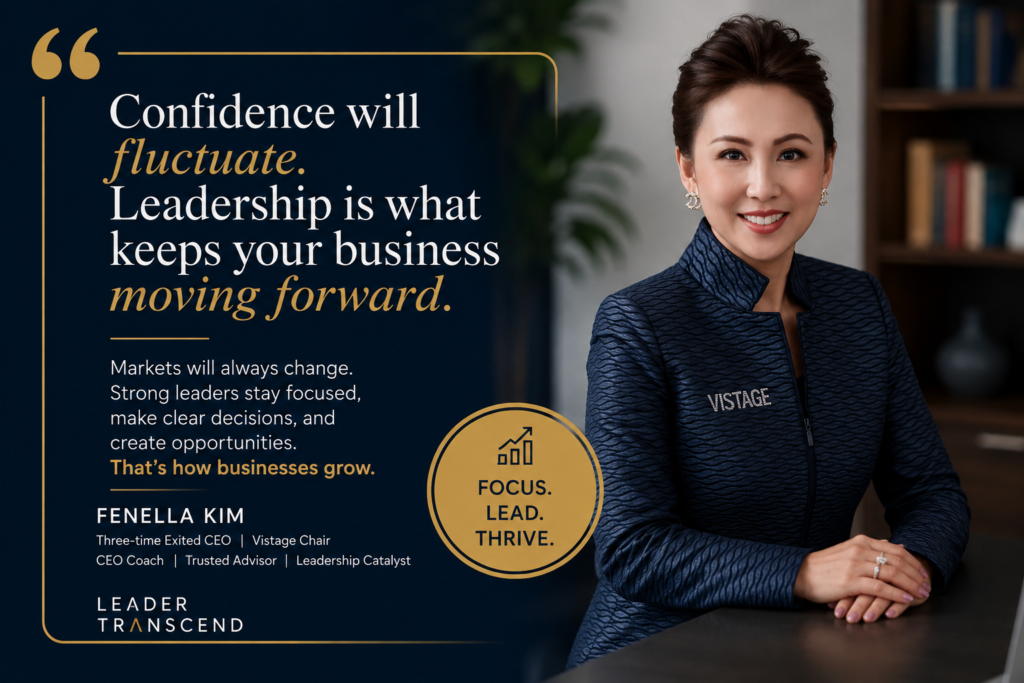
Fenella Kim is a three-time exited CEO, entrepreneur, investor, and Vistage Chair whose experience includes building, scaling, and exiting businesses across industries and cultures.
Her approach is grounded in firsthand leadership experience rather than theory alone.
For leaders navigating growth, uncertainty, succession, transformation, or high-stakes decisions, that perspective can be valuable because the hardest leadership questions rarely have a simple formula.
A coach doesn’t eliminate uncertainty.
Instead, the right coaching environment can give a leader space to examine assumptions, clarify priorities, and think more strategically.
How CEO Coaching Can Help Business Leaders Make Better Decisions
CEO coaching can provide a structured environment for leaders who are facing complex business and leadership decisions.
Depending on the leader’s circumstances, coaching can support:
- Challenging assumptions
- Clarifying priorities
- Improving decision-making
- Strengthening leadership confidence
- Navigating growth
- Delegating more effectively
- Developing leadership capacity
- Preparing for major transitions
The value isn’t having someone make the decision for you.
It is having a trusted environment where you can think more clearly before making the decision yourself.
Why Peer Perspective Matters During Market Uncertainty
Leadership can become isolating.
A founder or CEO may have employees who depend on them, investors who expect results, customers who expect reliability, and family members who may not fully understand the pressure of running the business.
That can make it difficult to have completely candid conversations.
A confidential CEO peer advisory environment can provide another perspective.
Peer advisory can give leaders an opportunity to discuss:
- Strategic challenges
- Growth decisions
- Leadership problems
- Hiring issues
- Organizational change
- Business uncertainty
- Personal leadership challenges
The benefit isn’t simply collecting advice.
It is hearing how other experienced leaders think about difficult situations.
That perspective can help a CEO identify assumptions, see alternatives, and approach a challenge from a different angle.
Leadership Development for Small Business Growth
Market uncertainty also highlights an important truth:
A growing business requires growing leadership capability.
As a company becomes larger, the founder’s role changes.
The owner who once made every decision may eventually need to lead through other executives and managers.
That requires skills in:
- Delegation
- Executive presence
- Strategic thinking
- Team development
- Organizational alignment
- Communication
- Decision-making
Leadership development coaching can help leaders develop the capabilities required as their responsibilities expand.
For some leaders, an executive coaching experience may also provide a more personalized environment for developing leadership effectiveness.
The objective isn’t simply to become a better manager.
It is to become a more effective enterprise leader.
Frequently Asked Questions
Why does small business confidence fluctuate?
Small business confidence changes as owners reassess revenue expectations, customer demand, operating costs, inflation, labor conditions, financing, competition, and broader economic conditions. Confidence can change even when a company’s current performance remains stable because owners are constantly evaluating what may happen next.
What factors affect small business confidence?
Major factors include inflation, operating costs, consumer demand, interest rates, access to financing, labor availability, wages, regulation, competition, technology, and expectations for future revenue and profitability.
How does inflation affect small business confidence?
Inflation can increase labor, materials, rent, insurance, transportation, and other operating costs. Businesses may respond by increasing prices, improving efficiency, reducing expenses, or accepting lower margins. The uncertainty surrounding future costs can also make long-term planning more difficult.
How do interest rates affect small businesses?
Higher borrowing costs can make loans and other forms of financing more expensive. This can influence decisions involving equipment, real estate, inventory, hiring, expansion, and acquisitions. Businesses with strong cash positions may be less affected than companies that depend heavily on external financing.
Should businesses invest during periods of low confidence?
Not automatically. Businesses should evaluate their cash flow, margins, customer demand, competitive position, debt, and expected return on investment. A period of uncertainty can sometimes create opportunities, but investments should be based on business fundamentals rather than market sentiment alone.
How can small businesses prepare for economic uncertainty?
Businesses can improve resilience by maintaining cash-flow visibility, reviewing expenses, diversifying where appropriate, strengthening customer relationships, building flexible scenarios, investing selectively, and developing leadership capacity throughout the organization.
How can CEOs make better decisions during uncertain markets?
CEOs can improve decision-making by separating facts from assumptions, defining clear priorities, evaluating multiple scenarios, monitoring leading indicators, seeking diverse perspectives, and avoiding decisions driven solely by short-term headlines.
Can CEO coaching help business owners navigate uncertainty?
CEO coaching can provide a confidential environment where leaders can examine complex decisions, challenge assumptions, strengthen leadership capabilities, and gain perspective. It does not remove business risk, but it can help leaders approach difficult decisions more deliberately.
Final Takeaway: Confidence Can Change, But Leadership Can Stay Strong
Small business confidence fluctuates amid market changes because businesses constantly respond to changing costs, customer demand, financing conditions, competition, labor markets, technology, and economic expectations.
But confidence isn’t a strategy.
Market conditions will continue to change. Some periods will create opportunities. Others will require caution. The strongest businesses aren’t necessarily those that predict every change correctly. They are the ones with the financial discipline, leadership capacity, customer relationships, and decision-making processes needed to respond effectively.
For business owners, that means focusing on what can actually be controlled:
- Clear priorities
- Financial discipline
- Customer value
- Strong teams
- Strategic decision-making
- Leadership development
- Flexible growth plans
- Long-term opportunities
And as a company grows, the leadership challenge changes too.
The founder may eventually need to stop being the person who solves every problem and become the person who creates the environment in which better decisions are made throughout the organization.
That transition requires perspective.
If you’re navigating growth, uncertainty, organizational change, succession, or a major strategic decision, Leader Transcend provides confidential leadership experiences designed to help CEOs and founders step back, gain perspective, and move forward with greater clarity.
Request a confidential selection conversation with Fenella Kim