
A CEO can have a strong business, an experienced leadership team, and a clear vision—and still reach a point where outside perspective becomes valuable. Perhaps the company is growing faster than expected, strategic priorities are becoming harder to balance, or the leader is spending too much time solving problems that should eventually be handled by the executive team.
At that point, an important question often arises: Should I work with a business strategist, a performance strategist, an executive coach, or someone who can bring elements of both approaches?
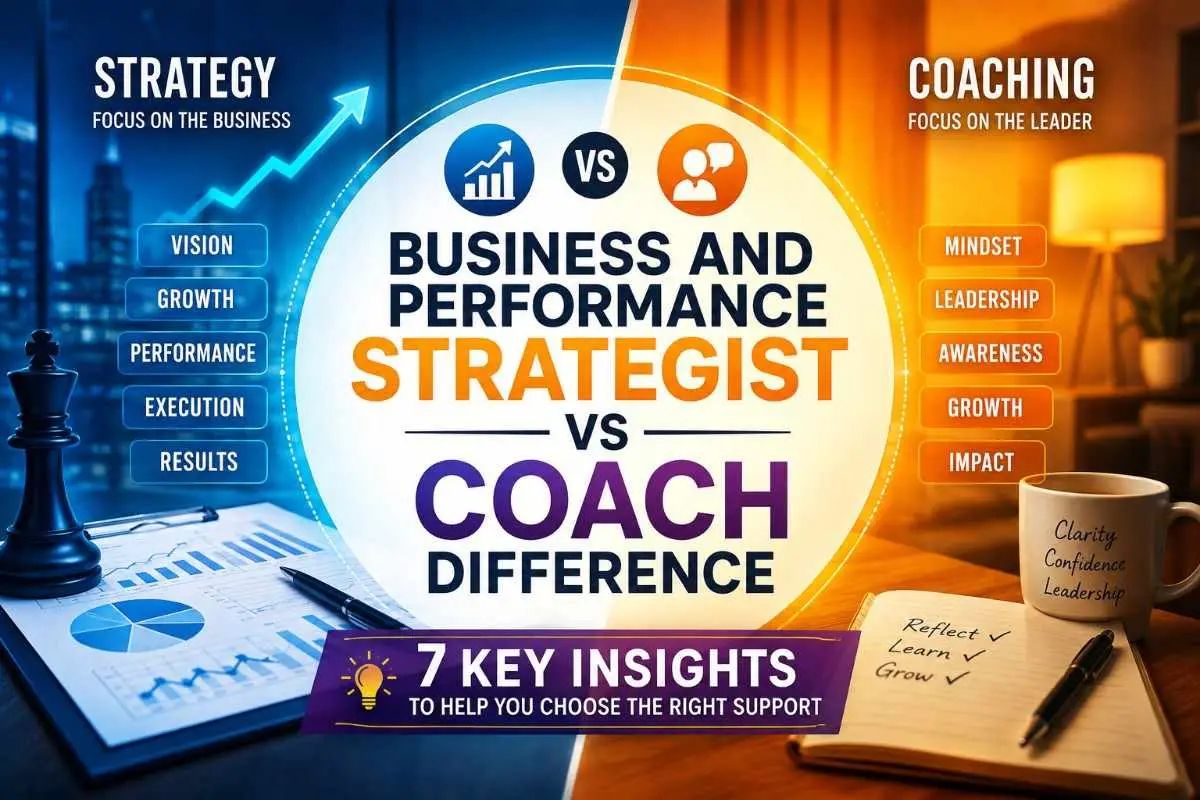
Understanding the business and performance strategist vs coach difference is important because these professionals can support leaders from different angles. A strategist typically focuses more heavily on the business—its direction, performance, priorities, growth opportunities, and execution. A coach, by contrast, focuses more directly on the leader, helping them examine their thinking, decision-making, communication, leadership behaviors, and effectiveness.
For example, a founder preparing to scale a company may need help determining which strategic priorities deserve attention, how the organization should evolve, and where performance is being constrained. At the same time, that founder may need to become more comfortable delegating, empowering executives, and making decisions without personally controlling every detail.
This is where the distinction between strategy and coaching becomes particularly useful. Business challenges and leadership challenges are often connected. A strategic decision may require a change in leadership behavior, while a leadership limitation may be preventing an otherwise sound business strategy from being executed effectively.
Leader Transcend works with CEOs and senior executives through services such as CEO Coaching and Executive Coaching, providing leaders with space to examine complex decisions, leadership challenges, and their broader strategic responsibilities. For leaders looking at the business as a whole, Business Coaching can also provide a broader perspective on strategy, performance, leadership, and organizational development.
The real question, therefore, is not simply “strategist or coach?” It is:
What challenge are you trying to solve, and what type of perspective will help you lead through it more effectively?
Understanding that distinction can help CEOs, founders, and senior executives choose the right kind of support—and recognize when they may benefit from a combination of strategic guidance, leadership development, and coaching.
Business and Performance Strategist vs Coach Difference: Which Approach Is Right for You?
The business and performance strategist vs coach difference becomes clearer when you look at the challenge a leader is facing. A strategist may help you evaluate business priorities, performance, growth opportunities, and execution, while a coach can help you examine your leadership approach, decision-making, communication, and personal effectiveness.
For CEOs and senior executives, these areas often overlap. A business challenge may require a change in leadership behavior, while a leadership challenge may be limiting business performance. Understanding what kind of support you need can help you choose a more focused path toward stronger leadership and business results.
What Is a Business and Performance Strategist?
A business and performance strategist generally focuses on the organization, its direction, and the factors affecting performance.
The work can involve looking at questions such as:
- Where should the company focus its resources?
- What is preventing growth?
- Which priorities deserve executive attention?
- Where are performance gaps occurring?
- How can the organization become more scalable?
- What needs to change as the company grows?
- How should leadership and operational priorities align?
A strategist typically looks at the business from a broader perspective.
For example, imagine a founder whose company has grown quickly but is now becoming difficult to manage. Revenue is increasing, but decision-making has slowed, the leadership team is stretched, and too many important decisions still come back to the founder.
The problem may not simply be that the founder needs to work harder.
The organization may need a different leadership structure, clearer accountability, stronger delegation, better strategic priorities, and systems that allow the company to operate without depending on one person for every decision.
That is where strategic thinking becomes important.
Leader Transcend’s Business Coaching approach, for example, connects business strategy with leadership development, organizational performance, accountability, and sustainable growth.
What Does a Coach Do?
Coaching generally focuses more directly on the person being coached and their ability to think, lead, communicate, and perform effectively.
An executive coach may help a leader explore:
- Leadership blind spots
- Decision-making patterns
- Communication
- Delegation
- Emotional intelligence
- Executive presence
- Conflict
- Accountability
- Team relationships
- Leadership transitions
One important distinction is that coaching does not necessarily mean telling a leader what to do.
A good coaching relationship can help a leader step away from the immediate pressure of a situation and examine it from a different perspective.
For example, a CEO may believe that their executive team is not capable of making important decisions.
A coach may challenge that assumption:
Is the team actually incapable—or has the CEO unintentionally created a culture where every important decision comes back to them?
That question can lead to a very different solution.
Leader Transcend describes Executive Coaching as a confidential development process that can help executives improve effectiveness, decision-making, communication, leadership presence, and strategic thinking. For a broader understanding of what professional coaching involves and how it differs from consulting and other forms of professional support, see the International Coaching Federation’s coaching guidance.
Business and Performance Strategist vs Coach Difference: A Clear Comparison
The simplest way to understand the distinction is to look at the primary focus of each role.
| Area | Business & Performance Strategist | Coach |
|---|---|---|
| Primary focus | Business performance and strategy | Leadership and individual effectiveness |
| Main perspective | Organization and business | Leader and leadership behavior |
| Typical questions | What should the business do? | How should I lead through this? |
| Focus areas | Growth, strategy, execution, performance | Leadership, decision-making, communication |
| Role | Strategic perspective and guidance | Reflection, challenge and development |
| Accountability | Business priorities and execution | Leadership commitments and growth |
| Common users | CEOs, founders, business owners | CEOs, executives, senior leaders |
| Desired outcome | Stronger business direction and performance | Stronger leadership capability |
This is a useful framework, but it should not be treated as an absolute rule.
Experienced professionals may combine strategy, advisory, and coaching depending on the leader’s circumstances.
That is particularly relevant at the CEO level, where the person and the business are often closely connected.
Strategist vs Coach: Which One Does a CEO Need?
There is no universal answer.
The better question is: What problem are you trying to solve?
A strategist may be valuable when the primary challenge is the business
Consider strategic support when you are dealing with:
- A growth plateau
- Unclear strategic priorities
- Expansion decisions
- Organizational complexity
- Performance problems
- Business model questions
- Operational scaling
- Succession or exit planning
- Resource allocation
- Leadership-team alignment
The central question may be:
“Where should we go, and how do we improve the business’s ability to get there?”
Coaching may be valuable when the primary challenge is the leader
Coaching can be particularly useful when you are dealing with:
- Difficulty delegating
- Leadership blind spots
- Executive communication problems
- Conflict
- Decision-making pressure
- A transition into a larger role
- Difficulty influencing other executives
- Building executive presence
- Accountability challenges
- Managing change
The central question becomes:
“How do I need to lead differently?”
That distinction can save a leader from treating the wrong problem.
When a CEO May Need Both Strategy and Coaching
Some executive challenges cannot be separated neatly into “business” and “personal” categories.
Consider a hypothetical founder whose company has reached a stage where the organization needs a professional executive team.
Strategically, the business may need:
- New organizational structure
- Clearer responsibilities
- Better processes
- Stronger leadership capacity
- More disciplined decision-making
But there may also be a leadership challenge.
The founder may struggle to stop making operational decisions personally. They may have spent years being the person with all the answers, and delegating authority may feel risky.
A strategic plan alone will not necessarily solve that problem.
The founder may need to develop a different approach to delegation, trust, communication, and accountability.
This is where strategy and coaching can complement one another.
The business needs a better direction.
The leader needs to develop the capacity to lead that direction.
How Business Strategy and Leadership Performance Work Together
Business strategy only becomes valuable when leaders can execute it.
A company may have an excellent strategic plan, but if the leadership team is misaligned, priorities constantly change, and accountability is weak, execution can suffer.
Likewise, a highly capable executive can still struggle if the organization lacks strategic clarity.
The relationship can be thought of this way:
Strategic clarity → Leadership alignment → Better execution → Stronger performance
Consider a CEO who decides to expand into a new market.
The strategy may identify the opportunity.
But leadership still has to answer:
- Who owns the initiative?
- What resources are required?
- What risks need to be considered?
- How will the executive team stay aligned?
- What decisions belong to the CEO?
- What decisions should be delegated?
- How will progress be measured?
This is why business performance and leadership effectiveness often need to be considered together.
Business Coaching vs Executive Coaching
The terms business coaching and executive coaching are sometimes used interchangeably, but their emphasis can be different.
Business coaching generally looks more broadly at the organization and the leader’s role in improving its performance.
It may involve:
- Strategy
- Growth
- Leadership teams
- Accountability
- Organizational systems
- Business performance
- Scaling
- Succession
Executive coaching tends to focus more specifically on the leader’s development and effectiveness.
It may address:
- Executive presence
- Communication
- Decision-making
- Leadership style
- Emotional intelligence
- Delegation
- Conflict
- Strategic thinking
There can be substantial overlap.
At Leader Transcend, Business Coaching combines business strategy, leadership development, accountability, and organizational development rather than treating business performance and leadership as completely separate issues.
For a senior leader seeking more individualized development, Executive Coaching provides a confidential environment for examining leadership effectiveness, decision-making, communication, and strategic thinking.
How to Choose the Right Professional Support
Before hiring a strategist or coach, start with the problem—not the title.
Ask yourself these questions.
Is the main problem strategic?
If your biggest question is:
“What should the business do next?”
Strategic support may be the better starting point.
Is the main problem leadership-related?
If your biggest question is:
“How can I lead this situation more effectively?”
Coaching may be more appropriate.
Is the problem both?
If your challenge sounds more like:
“I know what the business needs to do, but I’m struggling with how to lead the organization through it.”
A combined approach may make more sense.
This is especially common during periods of rapid growth, succession, organizational change, or significant leadership transition.
Questions to Ask Before Hiring a Strategist or Coach
Before entering an engagement, ask:
1. What problem are we actually solving?
Be specific.
“Improve the business” is too broad.
“Prepare the leadership team for the next stage of growth” is much more useful.
2. Do I need advice, reflection, accountability, or all three?
Different professionals approach these areas differently.
Understanding what you need will help you choose more effectively.
3. Does the person understand executive-level challenges?
CEOs often deal with decisions involving employees, capital, boards, family members, customers, partners, and long-term business value.
Experience with those realities can matter.
4. How will progress be evaluated?
The engagement should have a clear sense of what meaningful progress looks like.
5. Can I speak openly?
For executive coaching and advisory relationships, confidentiality and trust are fundamental.
6. Does the approach fit my situation?
A leader navigating succession may need something different from a founder scaling rapidly or an executive preparing for a larger role.
Where Executive Coaching Fits Into Strategic Leadership
Executive coaching should not necessarily be viewed as separate from business performance.
Leadership affects how strategy gets implemented.
A CEO’s ability to communicate priorities, delegate decisions, build accountability, manage conflict, and align executives can influence whether a strategic plan becomes reality.
This is why leadership development can be particularly important during periods of change.
Leader Transcend’s Leadership Development Coaching focuses on areas including strategic thinking, executive communication, emotional intelligence, decision-making, change leadership, accountability, and team development.
For a leader, the goal is not simply to acquire more leadership knowledge.
It is to become more effective when the decisions matter most.
When a CEO May Benefit From Peer Advisory
There is another form of support that sits somewhere between traditional coaching, strategic thinking, and advisory perspective: confidential peer advisory.
A CEO may have excellent executives around them and still lack people who can challenge their thinking without being directly affected by the decision.
That is one reason peer advisory can be valuable.
Leader Transcend’s CEO Peer Advisory Group brings together non-competing business leaders in a confidential environment where CEOs can discuss real challenges, hear different perspectives, and think through important decisions.
A peer environment is different from one-to-one coaching.
Instead of one professional providing perspective, the leader can hear how other experienced executives have approached comparable challenges.
For some CEOs, that perspective can be particularly valuable when they are dealing with growth, succession, organizational change, or a difficult strategic decision.
How Leader Transcend Combines Leadership and Business Perspective
The distinction between strategist and coach becomes less rigid when the professional has substantial experience leading businesses themselves.
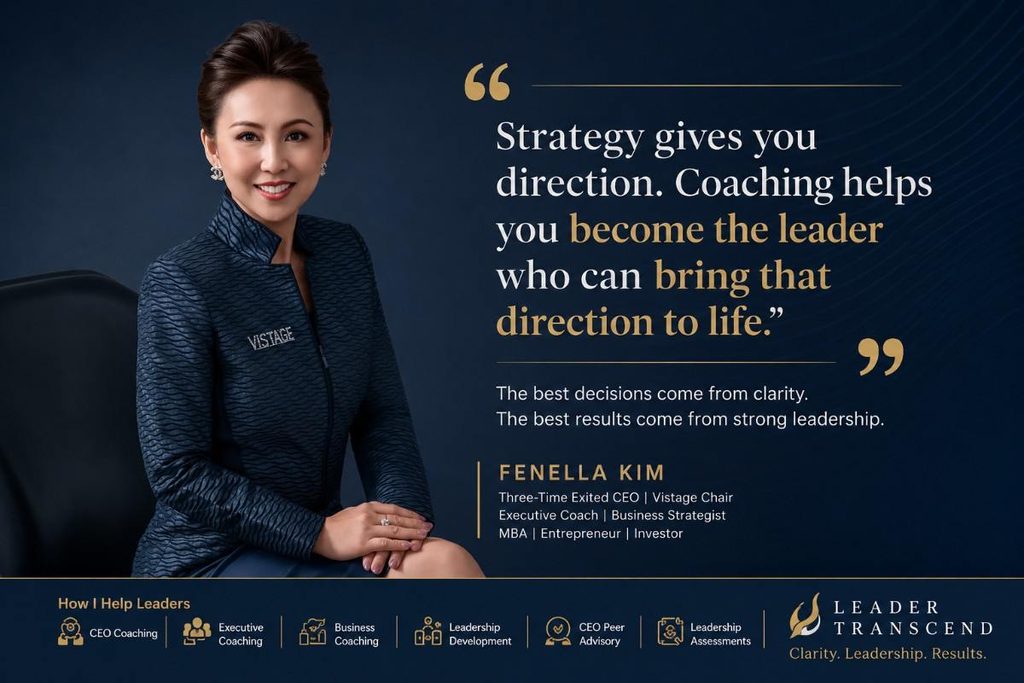
Leader Transcend is led by Fenella Kim, an MBA, three-time exited CEO, entrepreneur, investor, and Vistage Chair. Her work combines executive coaching, business perspective, leadership development, and confidential peer advisory.
That firsthand experience matters because senior leaders are rarely dealing with isolated problems.
A CEO may simultaneously be:
- Making a strategic decision
- Managing an executive team
- Preparing for succession
- Addressing organizational change
- Developing future leaders
- Thinking about business value
- Navigating personal leadership challenges
In those situations, separating “business” from “leadership” can be artificial.
Leader Transcend offers several forms of support depending on the situation, including CEO Coaching, Executive Coaching, Business Coaching, Leadership Development Coaching, and CEO Peer Advisory.
The appropriate option depends on what the leader is actually trying to accomplish.
A Simple Framework: Business, Leader, or Both?
When deciding what kind of support you need, consider three questions.
1. What is happening in the business?
Look at:
- Growth
- Profitability
- Strategy
- Organizational structure
- Performance
- Execution
2. What is happening with the leadership?
Look at:
- Decision-making
- Communication
- Delegation
- Confidence
- Executive presence
- Relationships
- Accountability
3. Are the two connected?
In many executive situations, the answer is yes.
If business growth is creating leadership problems, addressing only the business strategy may not be enough.
If leadership problems are preventing strategic execution, focusing only on personal development may also be incomplete.
The strongest approach begins by identifying the actual challenge.
Final Thoughts: Strategist or Coach?
Understanding the business and performance strategist vs coach difference is ultimately less about choosing a title and more about identifying the kind of perspective you need.
A strategist may help you answer:
Where should the business go, and how can its performance improve?
A coach may help you answer:
How do I need to think, behave, and lead differently to get there?
And for many CEOs, those questions are connected.
Business strategy requires leadership.
Leadership effectiveness influences execution.
Execution determines whether strategy becomes reality.
That is why the right support may sometimes involve business coaching, executive coaching, leadership development, peer advisory, or a combination of these approaches.
If you are a CEO, founder, or senior executive trying to determine what kind of support would be most valuable for your current situation, Leader Transcend’s CEO Coaching and business leadership services provide different pathways depending on your goals and challenges.
The first step does not have to be deciding which service you need.
It can simply be getting clear about the challenge you are trying to solve.
Frequently Asked Questions
What is the difference between a business strategist and a coach?
A business strategist generally focuses on business direction, performance, growth, and strategic priorities, while a coach focuses more on developing the leader’s thinking, behavior, decision-making, and leadership effectiveness.
What does a performance strategist do?
A performance strategist examines factors affecting organizational or business performance and helps leaders identify priorities, opportunities, challenges, and ways to improve execution.
Should a CEO hire a strategist or a coach?
It depends on the challenge. A strategist may be useful for business direction and performance questions, while a coach may be more appropriate for leadership development and executive effectiveness. Some CEOs benefit from both.
Can a business strategist also provide coaching?
Yes. Some professionals combine strategic advisory with coaching. However, the specific approach varies by professional, so CEOs should clarify what type of guidance and support will actually be provided.
What is the difference between business coaching and executive coaching?
Business coaching generally focuses more broadly on business performance, strategy, systems, growth, and organizational development. Executive coaching focuses more specifically on an individual leader’s effectiveness, decision-making, communication, and leadership development.
When should a CEO consider executive coaching?
A CEO may consider coaching when facing leadership transitions, growth, difficult decisions, executive-team challenges, delegation problems, organizational change, succession, or a desire to develop greater leadership effectiveness.
Can coaching improve business performance?
Coaching can support business performance by helping leaders improve decision-making, communication, delegation, accountability, strategic thinking, and leadership effectiveness. The specific impact depends on the leader, organization, goals, and engagement.
How do I choose between a strategist and a coach?
Start by identifying the primary problem. If the central question concerns business direction or performance, strategic support may be appropriate. If it concerns how you lead and make decisions, coaching may be more suitable. If both are connected, consider an approach that addresses both.
How to Apply the Business and Performance Strategist vs Coach Difference to Your Leadership Situation
Understanding the business and performance strategist vs coach difference is useful, but the more important question for a CEO is: What kind of support does your current situation actually require?
If your primary challenge involves business growth, strategic priorities, organizational performance, execution, or preparing the company for its next stage, a broader business-focused approach may be appropriate. If the challenge involves leadership effectiveness, decision-making, delegation, communication, executive presence, or navigating a complex transition, executive coaching may be the better fit.
For many CEOs, however, the challenge sits somewhere in between.
Identify the Challenge Before Choosing the Support
Before choosing a strategist or coach, consider three areas:
1. Business challenge:
Are you trying to solve issues involving growth, profitability, strategic direction, organizational structure, performance, or execution?
2. Leadership challenge:
Are you working through delegation, communication, decision-making, accountability, conflict, executive presence, or leadership development?
3. Connected challenge:
Is the way you or your leadership team are operating affecting the company’s ability to execute its strategy?
When business and leadership challenges are connected, addressing only one side may not be enough.
For example, a CEO may have identified a strong growth opportunity but find that the executive team is not aligned enough to execute it. Another founder may have a capable leadership team but continue to make too many operational decisions personally. In both situations, the business issue and leadership issue are closely connected.
Where Leader Transcend Can Support CEOs
Leader Transcend works with CEOs, founders, and senior executives who are navigating complex leadership and business challenges. The right service depends on the leader’s specific goals, circumstances, and the type of challenge they are trying to address.
For leaders looking for individualized support around executive effectiveness, decision-making, communication, leadership presence, and strategic thinking, Executive Coaching can provide a confidential environment to step back from day-to-day pressures and examine how they are leading.
CEOs who need more focused support around their role, responsibilities, and challenges can explore CEO Coaching, which is designed to help leaders think through complex decisions and become more effective at the highest level of the organization.
When the challenge involves both the leader and the organization, Business Coaching provides a broader perspective that can connect business strategy, leadership, performance, accountability, and organizational development.
Leaders focused on strengthening their capabilities for the next stage of their career or organization can also explore Leadership Development Coaching, with a focus on areas such as strategic thinking, executive communication, decision-making, change leadership, accountability, and developing leadership capability.
For CEOs who would benefit from the perspective of other experienced business leaders, CEO Peer Advisory Group offers another option. A confidential peer environment can provide valuable perspectives when navigating growth, succession, organizational change, and difficult strategic decisions.
A Practical Decision Framework for CEOs
A simple way to apply the business and performance strategist vs coach difference is to start with the question you are trying to answer:
“What should the business do next?”
→ Consider a business strategy or business-focused approach.
“How do I need to lead differently?”
→ Consider executive or CEO coaching.
“I know what needs to happen, but I need help leading the organization through it.”
→ Consider an integrated approach that addresses both business performance and leadership effectiveness.
There is no single answer that applies to every CEO. The most appropriate form of support depends on the organization’s stage, the leader’s responsibilities, and the complexity of the challenge.
Ultimately, the goal is not simply to choose between a strategist and a coach. It is to find the perspective and support that can help you think more clearly, make stronger decisions, improve execution, and lead the business more effectively.