
A company can have talented employees, advanced technology, strong products, and well-defined processes—and still struggle to perform at its best.
Often, the problem isn’t a lack of effort. It is a lack of leadership clarity.
When priorities are unclear, decisions move slowly, communication breaks down, accountability becomes inconsistent, or too many responsibilities remain concentrated at the top, even capable teams can lose momentum. This is why enhancing leadership skills boosting productivity should be viewed as an organizational priority rather than simply a personal development goal.
Effective leadership influences how teams communicate, make decisions, solve problems, prioritize work, and take ownership. For CEOs, founders, executives, and business owners, developing these capabilities can create the conditions for people to perform more effectively without requiring the leader to personally manage every detail. Learn more about our executive leadership solutions and how we help leaders strengthen organizational performance.
For CEOs and senior executives looking to strengthen leadership capability while improving organizational performance, executive coaching can provide the structure, perspective, and accountability needed to turn leadership development into measurable business progress.
Enhancing Leadership Skills Boosting Productivity: Why Leadership Matters
Leadership has a direct influence on how work gets done.
Consider two companies with similarly talented employees. In one, leaders communicate priorities clearly, delegate responsibility, make decisions at the appropriate level, and create accountability. In the other, priorities constantly change, decisions are escalated unnecessarily, and employees are uncertain about who owns what.
The difference is not necessarily talent. It is leadership.
Strong leadership can improve organizational productivity by creating greater clarity around:
- Business priorities
- Individual responsibilities
- Decision-making authority
- Expected outcomes
- Communication standards
- Accountability
- Team collaboration
- Strategic objectives
This is why enhancing leadership skills boosting productivity is better understood as a relationship between leadership capability and organizational execution.
A leader who communicates clearly reduces unnecessary confusion. A leader who delegates effectively prevents bottlenecks. A leader who makes timely decisions helps teams maintain momentum. A leader who develops other leaders creates greater organizational capacity.
Leadership development therefore affects productivity indirectly but meaningfully: better leadership creates better conditions for productive work.
1. Strengthen Communication to Improve Team Productivity
Communication problems are often productivity problems.
An employee may spend hours working on the wrong priority simply because expectations were unclear. A department may duplicate work because another team was unaware of what had already been completed. A project may miss its deadline because a critical decision was never communicated.
For leaders, effective communication means more than talking frequently. It means creating clarity.
A strong communication approach should answer questions such as:
- What needs to happen?
- Why does it matter?
- Who owns the outcome?
- What does success look like?
- What decisions have already been made?
- What information does the team need?
- When should progress be reviewed?
Leaders can also improve communication by creating consistent rhythms. Regular leadership meetings, concise updates, clearly documented decisions, and direct feedback can prevent small misunderstandings from becoming larger operational problems.
For CEOs and executives, communication also means knowing when to step back. Not every message needs to come from the CEO. Developing capable leaders who can communicate priorities within their own teams makes the organization less dependent on one person.
In practical terms, enhancing leadership skills boosting productivity starts with making sure people understand what matters most and how their work contributes to it.
2. Improve Decision-Making
Slow decision-making can become one of the most expensive productivity bottlenecks in a growing organization.
When employees wait for approval, projects stall. When leaders repeatedly revisit the same issue, teams lose momentum. When nobody knows who has decision-making authority, even relatively simple choices can move upward unnecessarily.
Effective leaders do not necessarily make decisions faster simply because they have more experience. They create better decision-making structures.
A useful approach is to:
- Define the actual problem.
- Separate facts from assumptions.
- Identify the information that genuinely matters.
- Consider potential risks and consequences.
- Determine who should own the decision.
- Make the decision at the appropriate level.
- Review the outcome and learn from it.
Not every decision deserves CEO-level attention.
One of the most important transitions for a growing founder or CEO is learning which decisions require personal involvement and which should be handled by capable members of the leadership team.
This is particularly important during periods of growth, when the number of decisions increases faster than one person’s capacity to make them.
Leadership effectiveness therefore involves knowing when to decide, when to delegate, and when to create a process that allows others to decide.
3. Learn to Delegate Without Losing Accountability
Delegation is one of the clearest tests of leadership maturity.
Many leaders say they delegate, but in practice they simply assign tasks while retaining every important decision. This creates a situation where employees are responsible for execution but still depend on the leader for permission.
There is a significant difference between delegating tasks and delegating ownership.
Task delegation sounds like:
“Please prepare this report and send it to me.”
Ownership sounds more like:
“You own this reporting process. Determine what information is needed, establish the reporting rhythm, and bring me any issues that require executive input.”
The second approach gives the employee more responsibility while keeping expectations and accountability clear.
Effective delegation requires leaders to define:
- The desired outcome
- Decision-making authority
- Available resources
- Important constraints
- Deadlines
- Measurement criteria
- When escalation is appropriate
The goal is not to remove accountability. It is to move accountability closer to the person responsible for the result.
For CEOs who are becoming bottlenecks in their organizations, CEO Coaching can provide a structured environment for examining delegation, leadership structure, decision-making, and the transition from founder-led execution to scalable leadership.
4. Build a Culture of Accountability
Accountability is often misunderstood as pressure.
In healthy organizations, accountability is not about constantly checking whether employees are working. It is about creating clear ownership of outcomes.
A productive accountability culture answers three questions:
Who owns this?
What result are we expecting?
How will we know whether we achieved it?
Without those answers, teams can become busy without becoming effective.
Leaders can strengthen accountability by establishing clear responsibilities, measurable expectations, consistent follow-up, and constructive feedback.
Importantly, accountability should apply to leaders as well as employees.
If an executive repeatedly changes priorities without explanation, misses commitments, or avoids difficult conversations, the organization receives a message about what accountability really means.
The strongest cultures make accountability predictable rather than personal.
That means leaders address problems early, recognize strong ownership, clarify expectations when necessary, and create opportunities for people to learn from mistakes.
Accountability should help employees understand what they control—not make them afraid of making decisions.
5. Develop Emotional Intelligence
Leadership is fundamentally a people-centered responsibility.
A CEO can have excellent technical knowledge and still struggle to lead effectively if they cannot listen, manage difficult conversations, understand how their behavior affects others, or respond constructively under pressure.
This is where emotional intelligence becomes particularly important.
Emotional intelligence can influence:
- Communication
- Conflict management
- Trust
- Self-awareness
- Team relationships
- Feedback
- Employee engagement
- Leadership presence
For example, imagine a senior executive responding aggressively whenever a team member challenges an idea. Over time, employees may stop raising concerns—not because they agree with the executive, but because they have learned that disagreement is unwelcome.
The result is not stronger leadership. It is less information reaching the decision-maker.
Emotionally intelligent leadership creates room for honest communication while maintaining appropriate standards.
Research and commentary published by Harvard Business Review have also highlighted the relationship between emotional intelligence, communication, and effective teams.
For executives, developing emotional intelligence does not mean becoming less decisive. It means becoming more aware of how emotions, communication patterns, and interpersonal dynamics affect decisions and execution.
6. Give Teams Clear Priorities
A team can be extremely busy and still be unproductive.
One reason is competing priorities.
When everything is urgent, employees struggle to distinguish meaningful progress from activity. Meetings increase, projects multiply, and people constantly switch between tasks.
Leaders need to create hierarchy around priorities.
One useful distinction is:
Urgent vs. important
Another is:
Activity vs. meaningful progress
A CEO might ask:
- What are the three most important outcomes for this quarter?
- Which initiatives directly support those outcomes?
- What should we stop doing?
- Which decisions are slowing execution?
- Which projects have become distractions?
- Where is leadership attention most valuable?
This is where enhancing leadership skills boosting productivity becomes a strategic exercise rather than a simple time-management technique.
Leaders create productivity when they help teams understand what deserves attention—and what does not.
Clear priorities also make delegation easier. Once the organization understands its most important objectives, individual leaders can make better decisions about where to allocate time, people, and resources.
7. Develop Leaders Instead of Creating Dependence
A strong leader should not become the person everyone depends on for every answer.
This is one of the biggest challenges facing growing companies.
In the early stages of a business, founders often need to be deeply involved. They may approve hiring decisions, solve customer problems, review contracts, manage operations, and make strategic decisions personally.
But what works at $1 million in revenue may not work at $10 million.
As an organization grows, the CEO’s role must evolve from being the primary problem-solver to developing people who can solve problems independently.
Leadership development can help organizations:
- Build decision-making capability
- Increase employee ownership
- Strengthen succession planning
- Develop future executives
- Reduce leadership bottlenecks
- Improve organizational resilience
- Create greater strategic capacity
This is one reason Leadership Development Coaching can be valuable for organizations that want to develop leadership capability beyond the executive team.
The objective is not simply to produce better managers. It is to create an organization with more people capable of thinking and acting like leaders.
Leadership Skills That Can Influence Productivity
| Leadership Skill | Common Problem | Potential Productivity Benefit |
|---|---|---|
| Communication | Unclear expectations | Better alignment |
| Delegation | Leader becomes a bottleneck | Greater team ownership |
| Decision-making | Decisions take too long | Faster execution |
| Accountability | Responsibilities are unclear | Stronger ownership |
| Emotional intelligence | Conflict and communication issues | Better collaboration |
| Strategic thinking | Teams focus on low-value tasks | Better prioritization |
| Coaching | Employees rely too heavily on leaders | More independent teams |
The important point is that these skills do not operate independently.
Communication makes delegation clearer. Delegation creates ownership. Accountability reinforces ownership. Strategic thinking determines priorities. Emotional intelligence strengthens communication and relationships. Coaching develops people who can eventually lead others.
Together, they create a stronger leadership system.
How Leadership Development Supports Business Performance
Leadership development should not be viewed only as personal improvement.
The relationship can be thought of as:
Leader → Team → Execution → Productivity → Business Performance
When a leader becomes better at communicating, the team gains clarity.
When leaders delegate effectively, employees gain ownership.
When decision-making improves, execution becomes less dependent on escalation.
When accountability becomes clearer, teams understand expected outcomes.
When future leaders are developed, organizational capacity increases.
That is why leadership development can become a business strategy rather than simply an employee-development initiative.
Leader Transcend describes its approach as connecting leadership development with strategic decision-making, organizational alignment, accountability, and business growth.
For CEOs and business owners who want to connect leadership development with broader organizational priorities, Business Coaching can provide a broader strategic perspective.
When Should a CEO Invest in Leadership Development?
Leadership development is not only for organizations experiencing problems.
In many cases, it becomes especially valuable when a company is entering a new stage of complexity.
Signs that leadership development may be worth prioritizing include:
- The CEO is making too many operational decisions.
- Managers constantly escalate routine problems.
- Employees lack ownership.
- Strategic priorities keep changing.
- Teams are working hard but results are not improving.
- Communication problems are affecting execution.
- The leadership team is not developing future leaders.
- Growth is creating organizational complexity.
- The founder remains central to too many processes.
- Succession planning has been postponed.
These situations do not necessarily indicate poor leadership. They may simply indicate that the leadership model that worked previously has become insufficient for the organization’s current stage.
A growing company often requires leaders to develop new capabilities at the same time the business develops new systems.
That is why leadership development should be treated as an ongoing process rather than a one-time training event.
Ready to Strengthen Your Leadership?
If leadership challenges are affecting execution, growth, or your team’s ability to operate independently, it may be time to take a closer look.
Connect with Leader Transcend to explore your leadership challenges and identify practical next steps.
Leadership Development Is About More Than Productivity
Productivity is an important outcome, but it should not be the only reason to develop better leaders.
Leadership development can also support:
- Better decision-making
- Stronger professional relationships
- Greater leadership confidence
- Strategic thinking
- Organizational resilience
- Leadership succession
- Employee development
- Stronger communication
- Better conflict management
- Long-term business growth
A leader who becomes more effective at developing people may create benefits that cannot be measured by a single productivity metric.
For example, developing a capable successor may reduce future transition risk. Improving executive communication may prevent recurring conflict. Strengthening strategic thinking may help a company avoid pursuing an attractive but poorly aligned opportunity.
The value of leadership development often appears through the quality of decisions and organizational capabilities that compound over time.
Learning From Real Leadership Experience
Leadership development becomes more practical when it is grounded in real business experience.
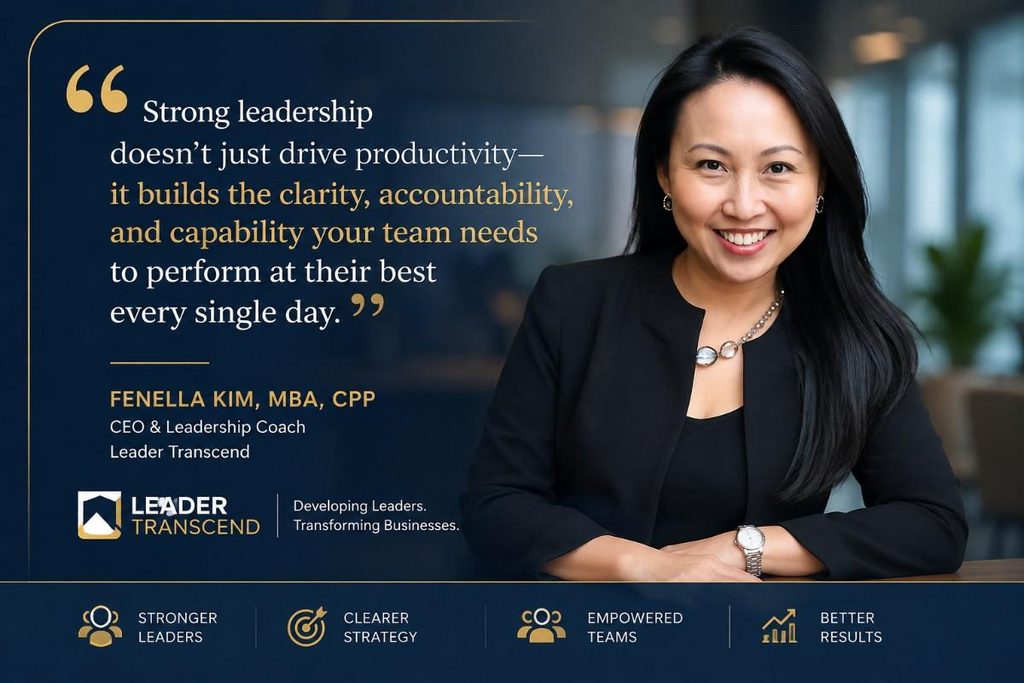
Fenella Kim, MBA, CPP, is the CEO of Leader Transcend and a Vistage Chair. According to her profile, she is a global entrepreneur, investor, leadership mentor, and three-time exited CEO with nearly three decades of experience building, scaling, transforming, and exiting businesses. Her experience includes fintech, consumer products, and education.
Her background also includes managing teams of more than 500 employees and agents across 23 U.S. states, along with a global perspective shaped by being born in Malaysia and speaking five languages.
That experience informs Leader Transcend’s practical approach to leadership development. Rather than treating leadership as an abstract collection of theories, the focus is on the decisions leaders actually face: growth, organizational complexity, succession, strategic choices, people development, and building businesses that can operate beyond the founder.
For executives, this distinction matters.
Leadership development should ultimately help leaders become more effective in real situations—not simply help them learn more terminology about leadership.
How Leader Transcend Helps Leaders Become More Effective
Leader Transcend works with CEOs, founders, executives, business owners, and emerging leaders around challenges involving leadership, strategic decision-making, organizational growth, and leadership development.
Its services are designed around different leadership needs.
For CEOs and business owners facing high-stakes decisions, organizational growth, founder dependence, or succession questions, CEO Coaching provides a confidential leadership partnership focused on decision-making, strategic thinking, executive teams, and organizational leadership.
For senior leaders who want to strengthen executive presence, communication, strategic thinking, and leadership capability, Executive Coaching can provide individualized development.
For organizations looking to build leadership capability throughout the company, Leadership Development Coaching focuses on areas such as communication, emotional intelligence, decision-making, accountability, delegation, team development, and developing future leaders.
And for business owners who want leadership development connected to broader business strategy, Business Coaching combines strategic planning, leadership development, accountability, organizational development, and sustainable growth.
Leaders who value learning alongside peers may also explore a CEO Peer Advisory Group, where non-competing business leaders can discuss challenges, share perspectives, and learn from one another in a confidential environment.
The appropriate approach depends on the leader, organization, stage of growth, and challenges involved.
Conclusion: Better Leadership Creates Better Conditions for Performance
Improving productivity is not always about asking people to work faster.
Sometimes the more important question is whether leaders are creating an environment where people can work effectively.
Better leadership can create clearer priorities.
Clearer priorities can improve focus.
Better communication can reduce confusion.
Effective delegation can increase ownership.
Strong accountability can improve execution.
Emotional intelligence can strengthen relationships and communication.
Developing future leaders can reduce organizational dependence on a single person.
Together, these capabilities demonstrate why enhancing leadership skills boosting productivity is ultimately about more than individual performance. It is about building organizations where people understand what matters, have the authority to act, and are equipped to perform at their best.
For CEOs, founders, and executives considering their next stage of leadership development, Leadership Development Coaching or CEO Coaching can provide a structured environment for examining leadership challenges and developing more effective approaches.
The goal of leadership development isn’t simply to help leaders work harder. It’s to help them create organizations where people can think, decide, and perform at their best.
Frequently Asked Questions
What does enhancing leadership skills boosting productivity mean?
Enhancing leadership skills boosting productivity refers to developing leadership capabilities that create better conditions for effective work and execution. This includes communication, delegation, decision-making, accountability, emotional intelligence, strategic thinking, and coaching others. The idea is not that leadership development automatically produces a specific productivity increase, but that stronger leadership can improve clarity, ownership, alignment, and decision-making across an organization.
How do leadership skills affect employee productivity?
Leadership skills influence productivity by shaping the environment in which employees work. Clear communication helps employees understand expectations, effective delegation gives people ownership, and strong decision-making reduces unnecessary delays. Accountability clarifies responsibility, while emotional intelligence can support healthier communication and collaboration. When employees understand priorities and have the authority and resources to act, they can spend less time navigating confusion and more time focusing on meaningful work.
What leadership skills have the biggest impact on productivity?
Several leadership skills can influence productivity, including communication, delegation, decision-making, accountability, strategic thinking, emotional intelligence, and coaching. The most important skill depends on the organization’s specific challenges. For example, a growing company with a founder bottleneck may need better delegation, while an organization struggling with conflicting priorities may need stronger strategic communication and decision-making.
How can CEOs improve their leadership skills?
CEOs can improve leadership skills through deliberate practice, reflection, feedback, leadership assessments, peer learning, mentoring, and executive coaching. They can also identify recurring situations where their leadership creates bottlenecks and examine how those patterns can change. CEO coaching can provide a confidential environment for challenging assumptions, improving decision-making, strengthening leadership teams, and working through complex organizational issues.
Can leadership development improve team performance?
Leadership development can support stronger team performance by improving communication, accountability, decision-making, delegation, trust, and alignment. However, leadership development should not be treated as a guaranteed productivity solution. Team performance is also influenced by strategy, resources, organizational structure, incentives, technology, and market conditions. Strong leadership creates better conditions for teams to work effectively within those broader factors.
What is the role of coaching in leadership development?
Coaching provides personalized support around real leadership situations rather than relying solely on general training. A coach can help leaders examine their decision-making, communication, leadership style, delegation, emotional intelligence, and relationships with their teams. Ongoing coaching can also create accountability and reflection, helping leaders turn new insights into consistent behaviors over time.
When should a company invest in leadership development?
A company can invest in leadership development at any stage, but it becomes especially relevant during periods of growth, organizational change, succession planning, leadership transitions, or increasing complexity. Warning signs include excessive CEO involvement in operational decisions, managers constantly escalating problems, weak accountability, unclear priorities, and a lack of future leadership capability. Developing leaders before a transition becomes urgent can give an organization greater flexibility and resilience.
Ready to Strengthen Leadership and Improve Business Performance?
Stronger leadership can create better decision-making, accountability, communication, and organizational performance. If you’re a CEO, founder, or senior executive looking to strengthen your leadership capabilities and build a stronger organization, Leader Transcend provides confidential executive coaching and leadership development support tailored to your goals.