

Great executives are not expected to know everything. They are expected to keep learning, adapting, making better decisions, and helping the people around them become better leaders.
As executives move into larger roles, the skills that helped them succeed earlier in their careers may no longer be enough. Leading a department is different from leading an organization. Managing a team is different from influencing an executive team. Running a growing company requires a different level of strategic thinking, communication, decision-making, and organizational leadership.
This is why understanding the skills developed through executive coaching matters for CEOs, founders, senior executives, directors, and high-potential leaders preparing for greater responsibility.
Executive coaching can help leaders become more self-aware, communicate more effectively, make stronger decisions, manage difficult situations, build high-performing teams, and think more strategically.
At Leader Transcend, executive coaching is designed around the real challenges leaders face as their responsibilities grow—from strategic decisions and organizational change to executive communication, leadership development, and preparing for greater responsibility.
But what skills can you actually develop through executive coaching?
Let’s look at the most important ones.
What Skills Can Be Developed Through Executive Coaching?
The skills developed through executive coaching can vary depending on the leader’s goals, role, organization, and challenges.
However, executive coaching commonly focuses on capabilities such as:
- Strategic thinking
- Decision-making
- Executive communication
- Emotional intelligence
- Self-awareness
- Executive presence
- Delegation
- Conflict management
- Stakeholder influence
- Change leadership
- Accountability
- Team and leadership development
The value of coaching is that these skills are not developed through generic lectures alone. They are usually connected to the executive’s actual leadership situations, decisions, relationships, and organizational challenges.
12 Skills Developed Through Executive Coaching
1. Strategic Thinking
One of the most important skills developed through executive coaching is strategic thinking.
As leaders become more senior, they need to spend less time solving individual operational problems and more time understanding the bigger picture.
Executive coaching can help leaders:
- Identify long-term priorities
- Evaluate opportunities and risks
- Challenge assumptions
- Think beyond immediate problems
- Connect decisions to organizational objectives
- Anticipate potential consequences
- Focus resources on what matters most
For example, a CEO may have five competing growth opportunities but limited resources. The challenge isn’t simply choosing the most attractive opportunity. The leader needs to understand which option best supports the company’s long-term direction.
Coaching creates a structured environment for examining those decisions more objectively.
2. Better Decision-Making
Senior leaders make decisions with incomplete information.
They may have competing priorities, limited time, conflicting opinions, and significant consequences attached to their choices.
Executive coaching can strengthen the ability to:
- Frame complex problems
- Separate facts from assumptions
- Identify blind spots
- Evaluate risks
- Consider alternative perspectives
- Make decisions under uncertainty
- Avoid unnecessary decision delays
The coach does not make the decision for the executive.
Instead, the coaching process can help the leader develop a better way of thinking about difficult decisions.
This becomes increasingly important as executives move into roles where there may be no obvious right answer.
3. Executive Communication
Leadership communication is different from simply communicating information.
Executives need to communicate with employees, leadership teams, boards, investors, customers, partners, and other stakeholders.
Executive coaching can help leaders develop:
- Greater clarity
- More confident communication
- Active listening
- Better questioning
- Difficult-conversation skills
- Persuasive communication
- Strategic storytelling
- Communication during uncertainty
A strong executive needs to know not only what to say, but also how, when, and why to say it.
For example, communicating a restructuring decision to an executive team requires a different approach from presenting the same decision to employees.
The message may be consistent, but the context, concerns, and questions will differ.
4. Emotional Intelligence
Emotional intelligence is another important area of executive development.
It includes understanding your own emotions, recognizing how your behavior affects others, managing relationships, and responding effectively in difficult situations.
Executive coaching can help leaders examine:
- Self-awareness
- Emotional regulation
- Empathy
- Relationship management
- Listening habits
- Leadership reactions
- Interpersonal patterns
Consider a leader who becomes defensive whenever someone challenges an idea.
The problem may not be the leader’s intelligence or strategic ability. The issue may be how others experience that reaction.
Greater self-awareness can help the leader recognize the pattern and choose a more effective response.
5. Executive Presence
Executive presence is often misunderstood.
It is not simply about appearing confident or speaking loudly in meetings.
Strong executive presence can involve:
- Credibility
- Confidence
- Composure
- Clarity
- Authenticity
- Professional judgment
- Communication
- Ability to influence others
Executive coaching can help leaders understand how they are perceived and identify behaviors that strengthen their leadership presence.
This can be especially valuable for executives moving into larger roles.
Someone who was highly effective as a functional leader may need to develop a different presence when communicating with a board or leading an enterprise-wide initiative.
6. Self-Awareness
Leadership development often starts with understanding yourself.
Executives may have strengths that contributed to their success but also behaviors that become limitations as their responsibilities expand.
For example, being highly detail-oriented can be an advantage.
But if that same behavior turns into micromanagement, it can prevent a leadership team from developing.
Executive coaching provides an opportunity to examine:
- Leadership strengths
- Blind spots
- Habits
- Communication patterns
- Decision-making tendencies
- Reactions under pressure
- Personal leadership values
Greater self-awareness can help leaders decide what they should continue doing, what they should change, and what they should delegate.
7. Delegation and Empowerment
One of the biggest challenges for successful executives is letting go.
Leaders who built organizations through personal effort may struggle to delegate important responsibilities.
They may think:
“It will be faster if I just do it myself.”
That approach can work temporarily.
It becomes a problem when the organization grows.
Executive coaching can help leaders develop more effective delegation and empowerment skills, including:
- Defining ownership
- Setting expectations
- Establishing accountability
- Trusting capable leaders
- Avoiding unnecessary micromanagement
- Developing direct reports
- Building leadership capacity
The objective isn’t simply to give work away.
The objective is to create an organization where capable people can make decisions and take ownership.
8. Conflict Management
Conflict is not necessarily a sign of poor leadership.
Healthy disagreement can produce better decisions.
The challenge is knowing how to manage conflict productively.
Executive coaching can help leaders handle:
- Difficult conversations
- Executive team disagreements
- Performance problems
- Strategic disagreements
- Personality conflicts
- Accountability issues
- Organizational tension
Instead of avoiding difficult conversations, leaders can learn to approach them with greater clarity and confidence.
This can strengthen trust while reducing the cost of unresolved conflict.
9. Influence and Stakeholder Management
The higher a leader rises, the less leadership depends purely on authority.
Executives often need to influence people they do not directly manage.
That can include:
- Board members
- Investors
- Executive peers
- Employees
- Customers
- Business partners
- Department leaders
Executive coaching can help leaders develop stronger influence by improving communication, relationship management, credibility, listening, and strategic alignment.
Influence becomes particularly important when an executive needs several departments to support a major organizational initiative.
10. Change Leadership
Growth creates change.
So do restructuring, succession, acquisitions, technology shifts, market disruption, and leadership transitions.
Executives need to do more than announce change.
They need to help people understand it, navigate it, and commit to it.
Executive coaching can help leaders develop:
- Change communication
- Resilience
- Adaptability
- Stakeholder alignment
- Organizational influence
- Decision-making during uncertainty
- Leadership confidence during transformation
A leader’s behavior during uncertainty can significantly influence how the organization responds.
11. Accountability and Follow-Through
Leadership development isn’t complete when a leader gains a new insight.
The insight needs to become action.
A useful leadership-development cycle is:
Insight → Decision → Action → Accountability → Learning
Executive coaching can help leaders turn intentions into specific commitments.
For example:
Instead of:
“I need to communicate better with my leadership team.”
The conversation can become:
“I will establish a weekly leadership communication rhythm, ask for feedback after the next executive meeting, and review the results during my next coaching session.”
That makes development practical and measurable.
12. Team Development and Leadership Development
Great executives don’t simply produce results themselves.
They develop people who can produce results without depending on them for every decision.
Executive coaching can help leaders improve their ability to:
- Coach direct reports
- Develop emerging leaders
- Give constructive feedback
- Build accountability
- Identify leadership gaps
- Strengthen executive teams
- Prepare successors
- Create a stronger leadership pipeline
This is particularly important for organizations experiencing growth.
The long-term goal isn’t simply to make the CEO better.
It’s to create a stronger leadership system throughout the organization.
How Does Executive Coaching Actually Develop These Skills?
Executive coaching is not simply a leadership course delivered one-on-one.
A strong coaching relationship is personalized around the leader’s circumstances.
A typical process may include several stages. Research from the Center for Creative Leadership highlights executive coaching’s potential to strengthen self-awareness, strategic thinking, emotional intelligence, resilience, leadership effectiveness, and the ability to navigate change.
Assessment
The coach and executive identify strengths, challenges, goals, and development priorities.
Reflection
The leader examines current behaviors, assumptions, decisions, and leadership patterns.
Challenge
The coach asks questions that may challenge existing thinking and expose blind spots.
Strategy
The executive identifies practical actions that can be applied to current leadership situations.
Practice
The leader applies new approaches in meetings, conversations, decisions, and organizational situations.
Accountability
Progress is reviewed and the approach is adjusted as circumstances change.
This is one reason executive coaching can be different from traditional leadership training.
The development happens around real leadership challenges.
Executive Coaching vs. Leadership Training: What’s the Difference?
| Executive Coaching | Leadership Training |
|---|---|
| Highly personalized | Usually broader and standardized |
| Individual leadership challenges | Common curriculum |
| Confidential one-to-one environment | Often group-based |
| Real-time application | Structured learning |
| Ongoing reflection and accountability | Often defined by a course or program |
| Focuses on the individual leader | Can focus on broader leadership skills |
The two approaches don’t necessarily compete.
An organization may use leadership training to establish common capabilities while using executive coaching to support individual leaders facing specific challenges.
Who Benefits Most From Executive Coaching?
Executive coaching can be useful at different stages of a leadership career.
CEOs
CEOs regularly face decisions that cannot easily be discussed internally.
Coaching can provide a confidential environment to examine strategic decisions, leadership challenges, organizational growth, succession, and other high-stakes issues.
Founders
Founders often need to transition from doing everything themselves to leading through other people.
Coaching can help with delegation, leadership-team development, strategic thinking, and the transition from founder-led execution to scalable leadership.
Senior Executives
Executives preparing for larger responsibilities may need to strengthen strategic thinking, influence, communication, and enterprise-level leadership.
Emerging Leaders
High-potential leaders can begin developing executive capabilities before they receive their next promotion.
Leaders Navigating Change
Executives leading restructuring, growth, succession, transformation, or other significant transitions can benefit from having an objective space to think through their leadership approach.
Signs You May Benefit From Executive Coaching
You may want to consider executive coaching if:
- You’re making increasingly complex decisions.
- Too many decisions still come back to you.
- You struggle to delegate.
- Your leadership team needs to become stronger.
- You want to communicate with greater confidence.
- You are dealing with recurring executive-team conflict.
- You’re preparing for a CEO or senior leadership role.
- Your organization is going through significant change.
- You want an objective perspective outside your organization.
- You know something needs to change but aren’t sure where to start.
None of these situations mean that a leader is failing.
In many cases, they simply mean the leader has reached a level of responsibility where a different kind of support can be valuable.
Ready to Strengthen Your Leadership Skills?
Executive growth often begins with an honest look at how you think, communicate, decide, and lead. If you’re facing a leadership challenge or preparing for your next stage of growth, a confidential conversation can help you explore what kind of support may be right for you.
How Fenella Kim Helps Leaders Develop Executive Skills
The right executive coach should understand that leadership is not theoretical.
Leaders deal with real decisions, real people, real consequences, and real business pressure.
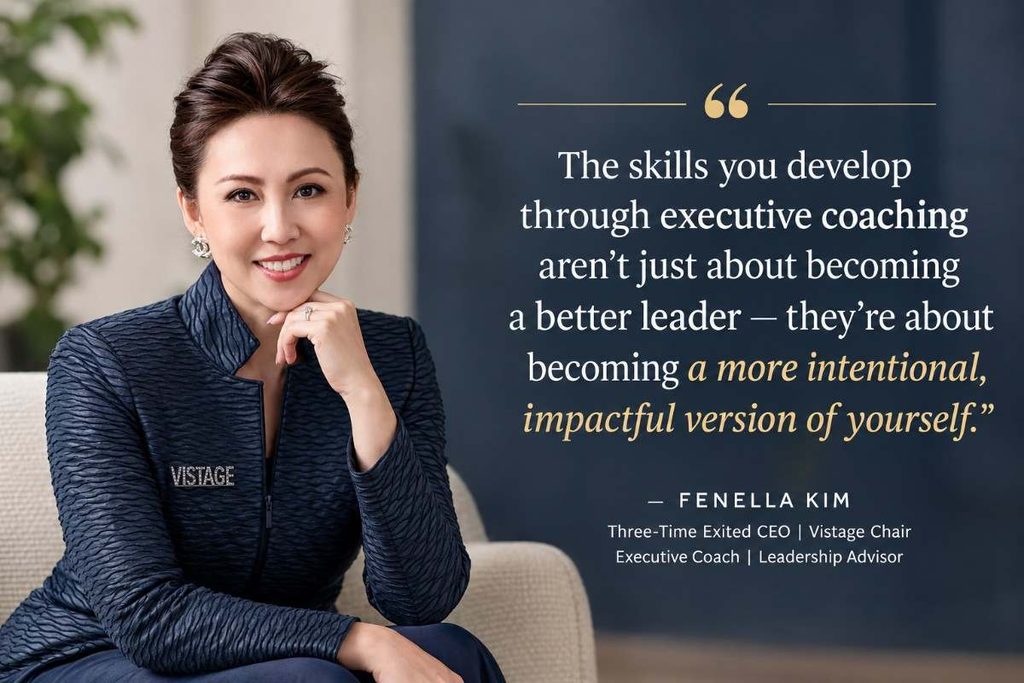
Fenella Kim brings direct executive experience to her work with CEOs, founders, and senior leaders. She is a three-time exited CEO, Vistage Chair, executive coach, and leadership advisor. Leader Transcend’s executive coaching approach focuses on areas including strategic thinking, executive presence, decision-making, communication, organizational influence, change leadership, team development, and preparing leaders for greater responsibility.
Her coaching process includes discovery, leadership assessment, a strategic coaching plan, confidential coaching sessions, and ongoing accountability.
For leaders considering executive coaching, learning more about Fenella Kim’s leadership experience can provide useful context when evaluating whether her approach is a good fit.
How Steve Kahn Supports Business Leaders Through Peer Perspective
Executive development doesn’t always have to happen through one-to-one coaching.
For some CEOs and business owners, the ability to discuss difficult decisions with experienced peers can be equally valuable.
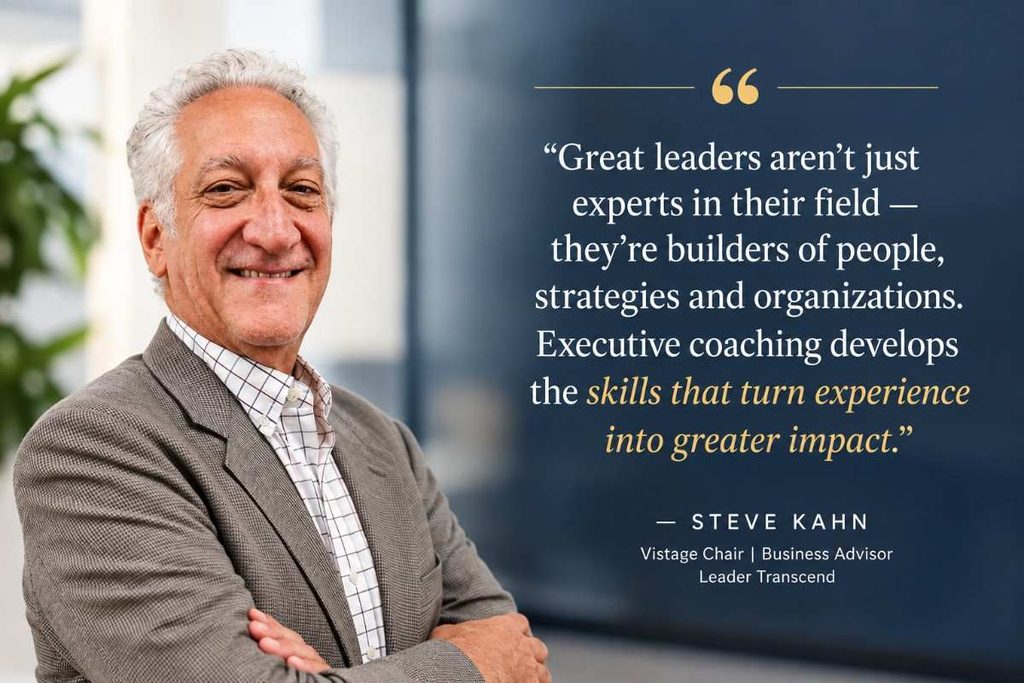
Steve Kahn brings more than 35 years of entrepreneurial, operational, and leadership experience to his role as a Vistage Chair with Leader Transcend. His background includes business ownership, operations, strategic planning, team development, and navigating a Fortune 500 acquisition. He also focuses on practical applications of AI and technology for business workflows and efficiency.
Steve’s approach is centered on helping business leaders gain perspective, challenge assumptions, make better decisions, and strengthen their organizations without having to carry every leadership challenge alone.
This can be especially valuable for leaders who want the perspective of other experienced business owners rather than only traditional coaching.
Executive Coaching With Leader Transcend
Leader Transcend offers several leadership-development options depending on the executive’s situation.
CEO Coaching
CEO coaching is designed for leaders dealing with the unique challenges of top-level leadership.
It can provide a confidential environment for strategic thinking, leadership development, decision-making, growth, transition, and accountability.
Executive Coaching
Executive coaching can help senior leaders strengthen skills such as:
- Executive presence
- Strategic thinking
- Decision-making
- Communication
- Emotional intelligence
- Organizational influence
- Change leadership
- Team development
Leader Transcend describes its executive coaching as personalized leadership development for senior leaders, with a focus on helping executives grow into broader organizational responsibility.
Leadership Development Coaching
Leadership development coaching can be particularly relevant for executives, managers, founders, and emerging leaders who want to strengthen their ability to lead people and prepare for future responsibility.
Business Coaching
Leadership skills become more valuable when they are connected to the business.
Business coaching can help leaders work through organizational alignment, strategic priorities, leadership pipelines, growth planning, and accountability. Leader Transcend’s business coaching approach combines business strategy with leadership development and practical accountability.
CEO Advisory Board
Some executives need more than an individual coaching conversation.
Leader Transcend’s CEO Advisory Board provides confidential strategic guidance, executive insight, peer perspective, and leadership accountability for CEOs, founders, presidents, and business owners.
This can provide another layer of development for leaders making high-stakes decisions.
What Should You Expect From Executive Coaching?
Executive coaching should not be viewed as a guarantee of a promotion, revenue increase, or specific business result.
Leadership development is personal.
Results can depend on:
- The leader’s commitment
- The quality of the coaching relationship
- Clarity of development goals
- Willingness to receive feedback
- Consistency of practice
- The complexity of the leadership challenge
- The organization’s environment
However, areas of development may include greater self-awareness, stronger communication, improved decision-making, better delegation, increased confidence, stronger strategic thinking, and improved leadership effectiveness.
The goal is not to create a perfect leader.
The goal is to help a leader become more intentional, capable, and effective.
How Long Does It Take to Develop Executive Leadership Skills?
There is no universal timeline.
A leader may gain an important insight during the first few conversations.
But insight is different from lasting behavioral change.
Meaningful leadership development often requires:
- Awareness
- Practice
- Feedback
- Reflection
- Adjustment
- Repetition
Some changes may happen quickly.
Others may require months of consistent practice.
Executive coaching is therefore best viewed as a development process rather than a quick fix.
How to Choose the Right Executive Coach
Choosing an executive coach is an important leadership decision.
Look for someone who has:
- Relevant executive experience
- Strong coaching experience
- Business understanding
- Experience with leaders at your level
- Excellent listening skills
- The ability to challenge appropriately
- A clear coaching process
- Strong professional credibility
- A confidential approach
- A coaching style that fits you
You should also ask potential coaches:
Who do you typically coach?
Understanding their typical client profile can help determine whether their experience matches your needs.
What leadership challenges do you specialize in?
Look for relevance rather than simply a long list of credentials.
How do you structure coaching?
Ask how goals are established, sessions are conducted, and progress is reviewed.
How do you measure progress?
Good coaching should have a clear sense of what development means for the individual leader.
How do you challenge executives?
An executive coach should be supportive, but support should not mean avoiding difficult conversations.
What happens during the first few sessions?
Understanding the process can help determine whether the coaching relationship feels appropriate.
Frequently Asked Questions
What are the main skills developed through executive coaching?
The main skills developed through executive coaching can include strategic thinking, decision-making, executive communication, emotional intelligence, self-awareness, executive presence, delegation, conflict management, stakeholder influence, change leadership, accountability, and team development.
Does executive coaching improve leadership skills?
Executive coaching can help leaders identify development opportunities, challenge existing thinking, practice new behaviors, and build greater self-awareness and leadership effectiveness.
Can executive coaching improve decision-making?
Yes. Coaching can provide a structured environment for executives to examine assumptions, evaluate options, recognize blind spots, and approach complex decisions more deliberately.
Can executive coaching improve communication?
Communication is a common area of executive development. Coaching can help leaders become clearer, more intentional, confident, and effective when communicating with teams, executives, boards, and other stakeholders.
What leadership skills can CEOs develop through coaching?
CEOs may work on strategic thinking, decision-making, executive presence, communication, delegation, organizational influence, team development, change leadership, accountability, and succession planning.
Is executive coaching worth it for senior executives?
It can be valuable when an executive has specific leadership challenges, is preparing for greater responsibility, is navigating organizational change, or wants an objective and confidential environment for development.
How long does it take to see changes from executive coaching?
Some insights can occur quickly, but meaningful behavioral development generally requires continued practice, feedback, reflection, and accountability.
What is the difference between executive coaching and leadership coaching?
The terms can overlap. Executive coaching generally focuses on leaders operating at senior levels and the complexity of executive responsibility, while leadership coaching can apply more broadly across different levels of an organization.
Can executive coaching help with confidence?
It can help leaders understand what is affecting their confidence, examine leadership patterns, prepare for difficult situations, and develop greater clarity in their decisions and communication.
How do I choose an executive coach?
Consider the coach’s executive experience, coaching approach, client profile, confidentiality, relevant expertise, process, and whether their style is a good fit for your leadership needs.
Final Thoughts: The Skills You Develop Can Change How You Lead
The skills developed through executive coaching extend far beyond learning how to manage people.
They can change how a leader thinks, communicates, makes decisions, handles pressure, builds relationships, develops other leaders, and approaches the future.
The most important skills include:
- Strategic thinking
- Better decision-making
- Executive communication
- Emotional intelligence
- Self-awareness
- Executive presence
- Delegation
- Conflict management
- Influence
- Change leadership
- Accountability
- Team development
But the ultimate objective isn’t simply to add more skills to a leadership checklist.
It’s to become a more effective leader when the decisions matter most.
For some leaders, that development may happen through one-to-one executive coaching. For others, it may include business coaching, leadership development, CEO advisory, or confidential peer conversations.
At Leader Transcend, Fenella Kim brings real CEO experience to executive coaching and leadership development, while Steve Kahn brings decades of entrepreneurial and operational experience to his work as a Vistage Chair and peer advisor. Together, these perspectives reflect an important principle of leadership: even experienced leaders benefit from having the right people around them.
If you’re ready to strengthen your leadership capabilities, challenge your thinking, and prepare for the next level of responsibility, the right conversation can be the beginning of meaningful leadership growth.