
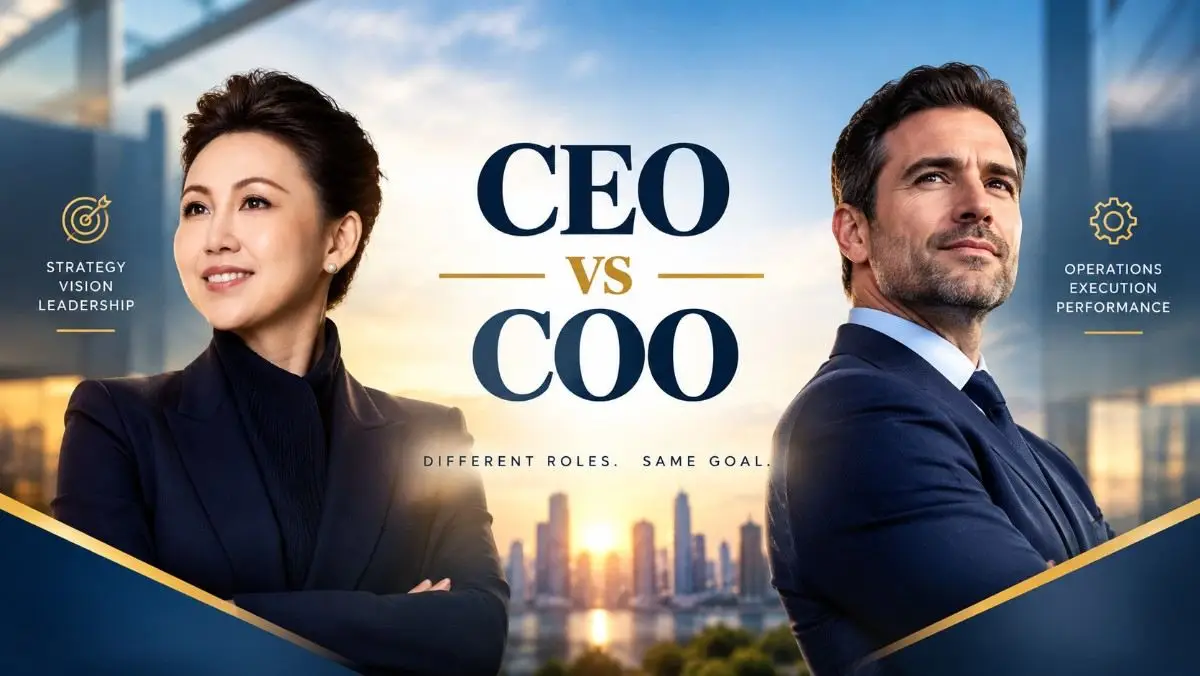
A CEO may be responsible for deciding where a company is going. A COO is often responsible for helping ensure the organization has the people, systems, and operational discipline to get there.
That simple distinction makes the CEO vs COO comparison sound straightforward—but in growing companies, the relationship between these two executive roles can be much more complex.
Both the Chief Executive Officer and Chief Operating Officer can influence strategy, leadership, growth, culture, and organizational performance. The difference is often found in where their primary accountability sits.
In most organizations, the CEO carries overall responsibility for the company’s direction, performance, leadership, and long-term strategy. The COO typically focuses more heavily on operations, execution, organizational systems, and turning strategic priorities into results.
For CEOs, founders, and executive teams navigating growth or organizational change, Leader Transcend provides executive coaching, business coaching, leadership development, and advisory support designed to help leaders make better decisions and build stronger organizations.
Quick answer: The CEO generally leads the overall organization and sets strategic direction, while the COO generally leads or coordinates operations and execution. However, responsibilities vary significantly depending on the company’s size, industry, ownership structure, and leadership model.
CEO vs COO at a Glance
Before going deeper, here’s the simplest way to understand the CEO vs COO difference:
| Area | CEO | COO |
|---|---|---|
| Full title | Chief Executive Officer | Chief Operating Officer |
| Primary focus | Overall company direction | Operations and execution |
| Main responsibility | Strategy, leadership, and organizational performance | Operational performance and implementation |
| Time horizon | Often long-term | Often short- to medium-term execution |
| Organizational role | Leads the company | Often leads or coordinates operations |
| External role | Board, investors, partners, stakeholders | Primarily internal, depending on role |
| Accountability | Overall organizational results | Operational results |
| Typical reporting | Board/owners | Usually CEO |
| Key question | “Where are we going?” | “How do we execute effectively?” |
These are general patterns rather than universal rules. A startup CEO may be deeply involved in operations, while a COO at a large organization may have substantial strategic responsibility.
What Does a CEO Do?
The Chief Executive Officer (CEO) is generally the organization’s highest-ranking executive and carries overall responsibility for the company’s direction and performance.
But being a CEO isn’t simply about making the biggest decisions.
An effective CEO creates the conditions in which other leaders can make good decisions and execute effectively.
Setting the Company’s Vision
The CEO typically establishes or champions the organization’s long-term vision.
That means answering questions such as:
- Where should the company go?
- What should the organization become?
- Which markets or opportunities matter?
- What should the company be known for?
- What should leadership prioritize?
The CEO’s vision provides the broader context for strategic decisions throughout the organization.
Defining Strategic Direction
CEOs are typically responsible for major strategic decisions involving:
- Growth
- Market positioning
- Business models
- Investments
- Acquisitions
- Organizational structure
- Major partnerships
- Leadership
- Long-term business priorities
The CEO must also decide what not to pursue.
Leading the Executive Team
The CEO works closely with other senior leaders, including the COO, CFO, CMO, CTO, and other executives.
This makes executive alignment particularly important.
A CEO can have a strong strategy, but if the leadership team interprets that strategy differently, execution can become fragmented.
Working With the Board and Key Stakeholders
Depending on the company’s structure, the CEO may be responsible for relationships with:
- Board members
- Owners
- Investors
- Strategic partners
- Major customers
- External stakeholders
Building Leadership Capability
One of the most important CEO responsibilities is developing an organization that does not depend entirely on the CEO.
As a company grows, the CEO needs capable leaders who can independently own important areas of the business.
This is one reason CEO coaching can become valuable as an organization becomes more complex.
Leader Transcend CEO Coaching focuses on confidential coaching and strategic support for CEOs navigating leadership challenges, growth, transitions, and complex business decisions.
What Does a COO Do?
The Chief Operating Officer (COO) is generally focused on how the organization operates and executes its strategy.
The role can vary significantly from one company to another.
A COO might oversee:
- Business operations
- Operational strategy
- Processes and systems
- Organizational efficiency
- Cross-functional coordination
- Performance management
- Operational KPIs
- Service delivery
- Supply chain
- Customer operations
- Scaling infrastructure
- Execution of strategic priorities
The COO often acts as a bridge between strategy and execution.
For example, a CEO might establish the strategic goal of doubling the company’s revenue over several years.
The COO may then help determine:
- What operational capabilities are required?
- Which processes need to change?
- Where are the bottlenecks?
- What teams need to grow?
- Which systems need improvement?
- What KPIs should be tracked?
- How should different departments coordinate?
This doesn’t mean the COO simply “executes whatever the CEO says.”
A strong COO can be deeply involved in strategic thinking and may challenge assumptions, identify operational risks, and help shape the strategy itself.
CEO vs COO: 10 Key Differences
1. Vision vs. Execution
One of the simplest ways to understand the distinction is:
CEO: Establishes the broader direction.
COO: Helps turn that direction into organizational execution.
However, both leaders should understand strategy.
A COO who doesn’t understand the company’s strategic objectives cannot execute effectively.
Likewise, a CEO who doesn’t understand operational realities may create strategies that are difficult or impossible to implement.
2. Strategy vs. Operational Implementation
The CEO often has primary responsibility for overall corporate strategy.
The COO frequently focuses on how that strategy will work inside the organization.
For example:
CEO: “We need to expand into three new markets.”
COO: “What organizational structure, systems, people, processes, and resources are required to make that expansion successful?”
The roles overlap—but the emphasis is different.
3. External Leadership vs. Internal Coordination
CEOs frequently spend significant time representing the organization externally.
This can involve:
- Investors
- Board members
- Partners
- Industry relationships
- Major customers
- Media
- Strategic stakeholders
COOs are often more internally focused on ensuring departments, teams, processes, and resources work together.
However, this distinction is not absolute.
Some COOs have extensive external responsibilities depending on the company.
4. Overall Accountability vs. Operational Accountability
The CEO generally carries overall organizational accountability.
The COO may carry substantial responsibility for operational performance.
If an organization is struggling with execution, the COO may be expected to identify what is preventing the company from performing effectively.
But the CEO remains responsible for the organization as a whole.
5. Long-Term Direction vs. Day-to-Day Performance
CEOs often spend more time thinking about the company’s future.
COOs often spend more time ensuring the current organization can perform effectively while preparing for future requirements.
A CEO might ask:
“What should this company look like five years from now?”
A COO might ask:
“What needs to change in our organization this quarter to move us toward that future?”
Both questions are important.
6. Board and Investor Relationships vs. Operational Leadership
In many organizations, the CEO serves as the primary connection between the company and its board or investors.
The COO is more likely to focus on operational leadership.
But as organizations become more complex, the COO may also participate heavily in board discussions, strategic planning, and stakeholder communication.
7. Organizational Vision vs. Organizational Systems
The CEO may define what the organization needs to accomplish.
The COO often focuses on whether the organization’s systems are capable of delivering it.
That could include:
- Processes
- Workflows
- Performance systems
- Organizational structure
- Resource allocation
- Accountability
- Cross-functional coordination
This distinction becomes particularly important during periods of rapid growth.
8. Executive Leadership vs. Cross-Functional Execution
The CEO typically leads the entire executive team.
The COO may have significant responsibility for coordinating multiple departments.
This can make the COO particularly valuable when growth creates organizational complexity.
For example, sales may need to coordinate with marketing, operations, finance, technology, and customer service.
Someone needs to ensure these functions aren’t operating independently.
9. Business Direction vs. Operational Scalability
A CEO may decide that the company needs to scale.
The COO may need to determine whether the existing organization can actually support that scale.
Scaling can expose problems such as:
- Inefficient processes
- Weak management structures
- Poor communication
- Technology limitations
- Unclear accountability
- Leadership gaps
A successful COO helps build the infrastructure required for sustainable growth.
10. CEO Accountability vs. COO Accountability
Ultimately, the CEO generally carries the broadest organizational accountability.
The COO typically has significant accountability for the areas under their operational leadership.
The healthiest organizations make these responsibilities clear rather than allowing the CEO and COO to compete for authority.
COO vs CEO: Who Has More Power?
This is one of the most common questions surrounding COO vs CEO.
In most traditional organizational structures, the CEO has greater overall authority and accountability than the COO.
The COO usually reports to the CEO.
But “power” isn’t always the most useful way to understand the relationship.
A better question is:
Who has decision-making authority over what?
A COO may have considerable authority over operations while the CEO retains ultimate responsibility for the organization.
For example:
| Decision | Typical Primary Owner |
|---|---|
| Overall corporate direction | CEO |
| Major strategic decisions | CEO / Executive Team |
| Daily operations | COO |
| Operational processes | COO |
| Board relationship | CEO |
| Organization-wide leadership | CEO |
| Operational KPIs | COO |
| Executive team alignment | CEO |
| Cross-functional execution | Often COO |
| Major organizational changes | CEO + Executive Team |
The exact structure depends on the organization.
Clear decision rights are often more important than titles.
Chief Executive Officer vs Chief Operating Officer: Who Reports to Whom?
A common organizational structure looks like this:
Board / Owners
↓
CEO
↓
COO + Other Executive Leaders
In this model, the COO reports to the CEO.
But organizations can structure leadership differently.
The responsibilities and reporting relationships may depend on:
- Company size
- Ownership
- Industry
- Corporate governance
- Founder involvement
- Organizational maturity
- Executive experience
This is why CEOs and founders should avoid copying another company’s organizational structure without considering their own needs.
CEO vs COO Responsibilities: Side-by-Side Comparison
| Responsibility | CEO | COO |
|---|---|---|
| Company vision | Primary | Supports |
| Corporate strategy | Primary/shared | Contributes |
| Daily operations | Oversees | Often leads |
| Executive team | Leads | Supports/coordinates |
| Business systems | Oversees | Often leads |
| Operational scalability | Shared | Often leads |
| Major stakeholders | Often primary | Depends on role |
| Performance management | Organization-wide | Operational |
| Leadership development | Critical | Critical |
| Strategic execution | Accountable | Often leads implementation |
| Organizational transformation | Leads direction | Often leads execution |
| Succession planning | Major responsibility | Often contributes |
The important point is that CEO and COO responsibilities should complement each other rather than compete with each other.
How Should a CEO and COO Work Together?
The strongest CEO-COO relationships are built on more than a reporting structure.
They require trust, clarity, communication, and shared strategic priorities.
A productive CEO and COO partnership should include:
Clear Decision Rights
Both leaders should know which decisions belong to whom.
Shared Strategic Understanding
The COO needs to understand the CEO’s strategic priorities.
The CEO needs to understand the operational implications of those priorities.
Regular Communication
Problems should be surfaced early rather than becoming major organizational issues.
Constructive Disagreement
A strong COO should be able to challenge the CEO when appropriate.
A strong CEO should be able to hear difficult operational feedback without treating disagreement as disloyalty.
Mutual Accountability
Both leaders should be accountable for organizational outcomes within their respective responsibilities.
Complementary Strengths
The ideal relationship isn’t necessarily between two executives who think alike.
It can be between leaders who bring different strengths while remaining aligned on the organization’s objectives.
What Happens When the CEO and COO Are Not Aligned?
When the CEO and COO relationship breaks down, the consequences can spread throughout the organization.
Common problems include:
- Conflicting priorities
- Duplicate decision-making
- Confusion among employees
- Slow execution
- Leadership politics
- Communication breakdowns
- Departmental conflict
- CEO micromanagement
- COO operating without strategic clarity
- Poor accountability
For example, imagine the CEO announces aggressive growth targets while the COO believes the company lacks the operational capacity to support that growth.
If the disagreement isn’t addressed, teams may receive contradictory instructions.
The solution isn’t necessarily for one executive to “win.”
The leadership team needs to determine:
What is the objective? What constraints exist? What needs to change? Who owns the decision?
This is where experienced executive coaching and leadership advisory support can be useful.
Does Every Company Need a COO?
No.
Not every organization needs a Chief Operating Officer.
A COO may become increasingly valuable when:
- The company has grown substantially
- Operations have become complex
- The CEO is overloaded
- The founder is too involved in daily operations
- Multiple departments require coordination
- The business is scaling rapidly
- Execution has become inconsistent
- The company needs stronger operational leadership
- The CEO needs more time for strategic priorities
But hiring a COO isn’t automatically the answer.
Sometimes the organization needs:
- Better delegation
- Stronger managers
- Improved processes
- Leadership development
- Executive coaching
- Organizational restructuring
The right solution depends on the underlying problem.
When Should a CEO Consider Executive Coaching?
The CEO vs COO discussion often reveals a larger leadership question:
Is the current executive structure helping the CEO lead effectively?
Executive coaching can be useful when a CEO is:
- Navigating rapid growth
- Becoming a bottleneck
- Struggling with delegation
- Leading organizational transformation
- Managing executive-team conflict
- Making complex strategic decisions
- Preparing for succession
- Transitioning into a larger leadership role
- Building a stronger executive team
- Balancing strategic and operational responsibilities
Leader Transcend Executive Coaching provides personalized executive coaching focused on areas such as strategic thinking, decision-making, executive communication, leadership presence, change leadership, influence, and organizational alignment.
The purpose isn’t to tell a CEO what decision to make.
It is to create a confidential environment where the leader can think more clearly about difficult decisions and leadership challenges.
How Leadership Development Helps CEOs and COOs Work Better Together
Strong executive relationships depend on strong leadership capabilities.
Both CEOs and COOs may need to develop skills involving:
- Strategic thinking
- Executive communication
- Decision-making
- Emotional intelligence
- Conflict management
- Delegation
- Accountability
- Change leadership
- Executive presence
- Team development
- Organizational influence
Leader Transcend’s Leadership Development Coaching can be relevant for executives and emerging leaders who need to strengthen these capabilities as their responsibilities evolve.
This is especially important when a company is growing faster than its existing leadership structure.
How Fenella Kim Helps CEOs and Executive Leaders
Leadership challenges often become more complicated as businesses grow.
A CEO may need to make a strategic decision while simultaneously managing an executive team, organizational change, succession issues, growth pressures, and operational challenges.
This is where an experienced outside perspective can make a difference.
Fenella Kim’s executive leadership experience includes experience as a three-time exited CEO, Vistage Chair, executive coach, and leadership advisor.
Her work with leaders can address challenges involving:
- Strategic decision-making
- Executive leadership
- Business growth
- Leadership transitions
- Organizational transformation
- Executive team effectiveness
- Accountability
- Succession
- Business strategy
For a CEO trying to determine whether the organization needs a COO, strengthen an existing CEO-COO partnership, or prepare the leadership team for the next stage of growth, the most useful question may not be:
“Who should have more authority?”
It may be:
“What leadership structure will allow the organization to perform at its best?”
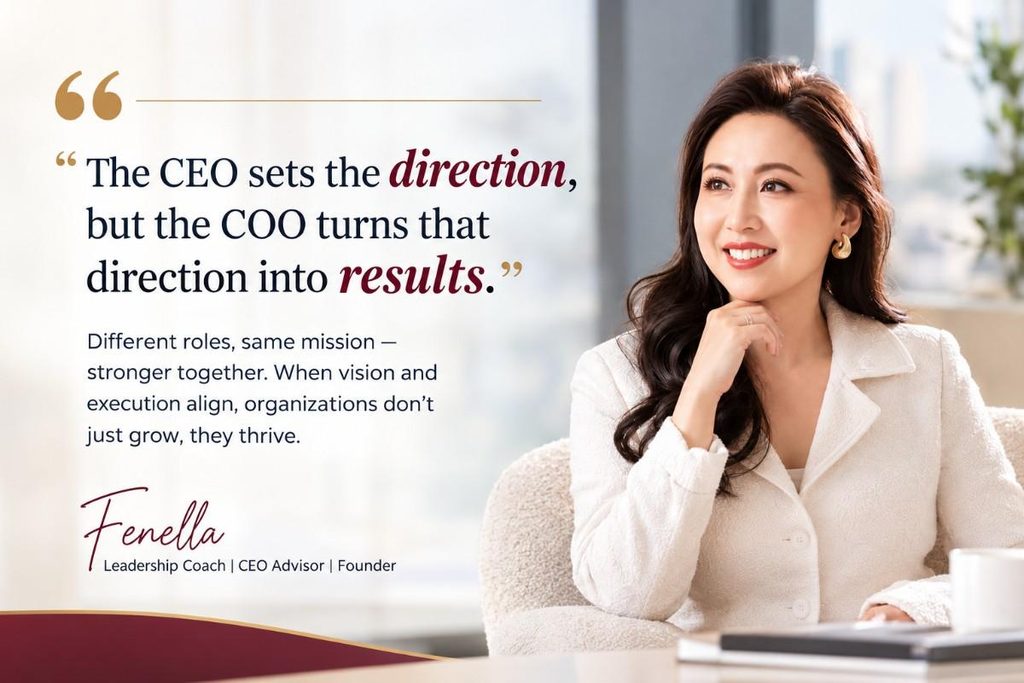
CEO vs COO: Which Role Is Right for Your Business?
For a mature organization, the question isn’t necessarily whether to choose a CEO or a COO.
You may need both.
Instead, ask:
Where is the company going?
The CEO should provide clarity around strategic direction.
Who owns operational execution?
The organization should clearly define who is responsible for turning priorities into results.
Where is the CEO spending time?
If the CEO spends most of their time solving operational problems, the organization may have a leadership or structural issue.
Are departments aligned?
If teams are constantly working against one another, stronger operational coordination may be needed.
Is the business ready to scale?
Growth can require new systems, processes, leadership capabilities, and accountability.
Are decision rights clear?
Executives should know who makes which decisions.
CEO vs COO vs Other C-Suite Roles
The CEO and COO are only two parts of the broader executive leadership structure.
| Role | Primary Focus |
|---|---|
| CEO | Overall company direction and leadership |
| COO | Operations and execution |
| CFO | Finance and financial strategy |
| CMO | Marketing and brand growth |
| CTO | Technology and technical strategy |
| CHRO | People and organizational leadership |
The strongest executive teams don’t operate as isolated departments.
They work together around shared organizational priorities.
The CEO may establish the strategic direction.
The COO may coordinate execution.
The CFO evaluates financial implications.
The CMO develops market strategy.
The CTO manages technology direction.
The CHRO develops organizational capability.
The result should be a connected leadership system, not a collection of competing executives.
CEO vs COO: Common Questions
What is the difference between a CEO and COO?
The CEO generally has overall responsibility for the company’s direction, strategy, leadership, and performance. The COO generally focuses on operations, execution, organizational systems, and operational performance.
Is a COO higher than a CEO?
Typically, no. In many organizations, the COO reports to the CEO. However, organizational structures vary.
Who has more authority, a CEO or COO?
The CEO generally has broader organizational authority and accountability. A COO may have significant authority over operations and execution.
Can a company have both a CEO and COO?
Yes. Many organizations use both roles, particularly when the company has become complex enough to require dedicated executive leadership for strategy and operations.
What does a COO do that a CEO does not?
A COO often focuses more heavily on operational execution, processes, systems, cross-functional coordination, and organizational performance. However, responsibilities overlap.
Does a COO report to the CEO?
In a traditional structure, yes. But reporting relationships can vary depending on the organization’s leadership model.
Does every company need a COO?
No. A COO isn’t necessary for every business. The role becomes more useful when operational complexity, growth, or organizational scale creates a need for dedicated operational leadership.
Can a COO become a CEO?
Yes. COOs can develop broad organizational, strategic, and leadership experience that can prepare them for CEO responsibilities, depending on their experience and the organization’s needs.
What skills does a successful COO need?
Important capabilities can include operational leadership, strategic thinking, communication, decision-making, organizational design, accountability, cross-functional leadership, and change management.
How can executive coaching help CEOs and COOs?
Executive coaching can provide a confidential environment to examine leadership challenges, improve decision-making, strengthen communication, develop leadership capabilities, and navigate organizational change.
Is Your Executive Team Ready for the Next Stage of Growth?
When the distinction between strategy and execution becomes unclear, growth can become harder than it needs to be.
If you’re a CEO, COO, founder, or senior executive navigating growth, leadership challenges, organizational change, or strategic uncertainty, an outside perspective can help you think through the next step.
Conclusion: CEO and COO Should Create Leadership Leverage
The CEO vs COO distinction is ultimately about more than titles.
The CEO generally provides the broader direction, strategic leadership, and organizational accountability.
The COO generally focuses on operations, execution, systems, and organizational performance.
But the most effective CEO-COO relationships don’t divide leadership into simple categories such as “CEO thinks and COO executes.”
Both executives need to think strategically.
Both need to understand the organization’s goals.
Both need to communicate.
Both need to challenge assumptions.
And both need to remain focused on creating value for the organization.
For growing companies, the real question isn’t simply “CEO vs COO: Who has more power?”
The better question is:
“Have we created a leadership structure that allows strategy and execution to work together?”
For CEOs and executive teams looking to strengthen leadership, improve strategic decision-making, develop executives, or navigate organizational change, Leader Transcend offers CEO coaching, executive coaching, leadership development, business coaching, and advisory support.
With the perspective of leaders such as Fenella Kim, the focus can move beyond simply defining executive roles toward building a stronger leadership system for the organization’s next stage. For additional insights into effective CEO and executive leadership, the Center for Creative Leadership provides research-based resources on leadership development and executive effectiveness.
The real advantage isn’t having the most powerful executive title. It’s having the right leadership structure to turn strategy into results.