
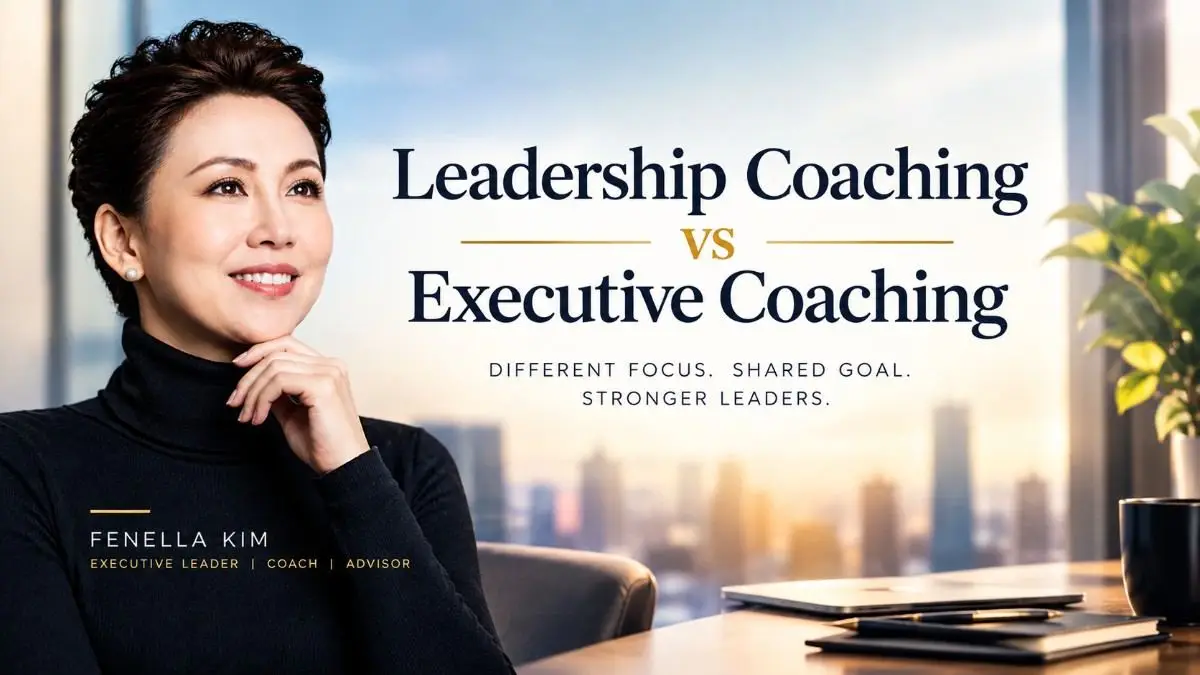
Leadership coaching and executive coaching are often used interchangeably—but they are not always designed for the same leadership challenges.
Leadership coaching generally focuses on helping leaders strengthen their ability to lead people, teams, and organizational change. Executive coaching often works at a broader organizational level, helping senior leaders navigate strategic decisions, executive presence, stakeholder relationships, organizational complexity, and leadership transitions.
There is also significant overlap between the two.
So, when comparing leadership coaching vs executive coaching, the real question isn’t which one is better. It is which type of coaching aligns with your role, responsibilities, leadership goals, and current challenges?
Leader Transcend provides leadership development and executive coaching for executives, managers, founders, CEOs, and emerging leaders, with coaching led by Fenella Kim, a three-time exited CEO and Vistage Chair.
Leadership Coaching vs Executive Coaching at a Glance
| Area | Leadership Coaching | Executive Coaching |
|---|---|---|
| Primary audience | Managers, emerging leaders, executives, founders | Senior executives, CEOs, founders, future CEOs |
| Main focus | Leadership capability and people leadership | Executive effectiveness and organizational leadership |
| Typical goals | Communication, delegation, team development, confidence | Strategic thinking, decision-making, influence, executive presence |
| Scope | Individual, team, or department | Executive, enterprise, or organizational |
| Common challenges | Managing people, conflict, delegation, team performance | Complex decisions, organizational change, executive transitions |
| Development | Building stronger leadership habits | Becoming more effective at senior leadership levels |
| Perspective | Leadership and team-focused | Strategic and organization-focused |
The distinction isn’t absolute. A senior executive may work on communication and emotional intelligence—skills commonly associated with leadership coaching—while a manager preparing for a C-suite role may need executive-level development.
What Is Leadership Coaching?
Leadership coaching is a structured development process that helps individuals become more effective leaders.
It can be useful for people at different stages of their leadership journey, from emerging managers to experienced executives.
Rather than simply giving someone advice, leadership coaching can help a leader examine how they think, communicate, make decisions, handle conflict, delegate responsibility, and develop other people.
Common areas of leadership coaching include:
- Strategic thinking
- Communication
- Emotional intelligence
- Decision-making
- Delegation
- Conflict management
- Team development
- Accountability
- Leadership confidence
- Influence
- Change leadership
- Coaching and mentoring
For example, a newly promoted manager may be technically excellent but struggle with delegation. Instead of continuing to do everything personally, coaching can help the manager develop the habits and communication skills required to empower the team.
Leader Transcend’s Leadership Development Coaching is designed for executives, managers, founders, emerging leaders, high-potential employees, and others developing greater leadership responsibility. Its stated development areas include strategic thinking, executive communication, emotional intelligence, executive presence, decision-making, change leadership, accountability, coaching, team development, and organizational influence.
What Is Executive Coaching?
Executive coaching focuses on helping senior leaders improve their effectiveness in complex leadership environments.
Executives often face challenges that extend beyond managing a team.
Their decisions may affect:
- Multiple departments
- Organizational strategy
- Investors and boards
- Customers
- Employees
- Business performance
- Organizational culture
- Succession planning
- Long-term growth
As a result, executive coaching can address both the individual leader and the broader organizational context.
Typical areas include:
- Executive decision-making
- Strategic thinking
- Executive presence
- Leadership communication
- Stakeholder management
- Organizational alignment
- Change leadership
- Conflict resolution
- Delegation
- Executive team development
- Succession planning
- CEO readiness
Leader Transcend’s Executive Coaching focuses on helping executives develop capabilities such as strategic thinking, decision-making, executive presence, change leadership, conflict resolution, delegation, organizational alignment, and succession planning.
The goal isn’t simply to help an executive perform better in a particular position. It can also involve helping that leader grow into the level of leadership their organization requires next. Research from the Center for Creative Leadership highlights how executive coaching can help senior leaders strengthen leadership capabilities, navigate complex challenges, and support lasting behavior change
Leadership Coaching vs Executive Coaching: 7 Key Differences
1. Who the Coaching Is Designed For
One of the clearest differences is the typical audience.
Leadership coaching can support:
- New managers
- Emerging leaders
- Directors
- Department heads
- Founders
- Senior leaders
- Executives
Executive coaching tends to focus more heavily on:
- CEOs
- Presidents
- Senior executives
- C-suite leaders
- Business owners
- Future CEOs
- Executives preparing for larger roles
However, these categories overlap.
A director preparing to become a CEO may benefit from executive coaching, while a CEO working specifically on team leadership may focus on capabilities commonly associated with leadership development.
2. The Scope of Responsibility
Leadership coaching often focuses on how a person leads people.
Executive coaching may increasingly focus on how a person leads an organization.
Consider two examples.
A department manager might be asking:
“How can I delegate more effectively without losing control?”
A CEO might be asking:
“How should I restructure my leadership team as the company enters its next stage of growth?”
Both are leadership questions.
But the scope, consequences, and organizational complexity are different.
That’s why coaching should be matched to the leader’s actual responsibilities rather than simply their job title.
3. The Complexity of Decisions
As leaders move upward, decisions generally become less about solving a single operational problem and more about balancing competing priorities.
An executive may need to consider:
- Growth
- Risk
- Talent
- Culture
- Capital
- Customers
- Organizational structure
- Market changes
- Long-term strategy
Executive coaching can provide a confidential environment for examining these decisions from different perspectives.
Leader Transcend describes its executive coaching approach as personalized around the leader’s challenges, goals, organizational priorities, communication, team leadership, and strategic decision-making.
4. Team Leadership vs. Enterprise Leadership
Leadership coaching frequently helps leaders become better at leading teams.
This might involve:
- Building trust
- Giving feedback
- Managing conflict
- Delegating
- Motivating employees
- Developing future leaders
Executive coaching can include all of those areas—but may also address enterprise-level leadership.
For example:
Leadership coaching question:
“How do I improve accountability across my department?”
Executive coaching question:
“How do I create accountability across an executive team without becoming the bottleneck?”
The second question involves not only people leadership but also organizational structure, decision rights, culture, and executive behavior.
5. Strategic Responsibility
Strategic thinking becomes increasingly important as leadership responsibility expands.
Leadership coaching may help someone move from:
Doing the work → leading the work → developing people who can lead the work.
Executive coaching may help a senior leader move from:
Leading a function → leading across functions → shaping organizational strategy.
This doesn’t mean managers don’t need strategic thinking or executives don’t need team-development skills.
Instead, the context and scale change.
6. Executive Presence and Stakeholder Influence
Senior leaders frequently need to influence people they don’t directly manage.
That can include:
- Board members
- Investors
- Executive peers
- Employees
- Customers
- Strategic partners
- Other stakeholders
Executive coaching may therefore place greater emphasis on executive presence, communication, influence, and navigating high-stakes conversations.
These capabilities are also relevant to leadership coaching, particularly for leaders preparing to take on greater responsibility.
7. Leadership Transitions
Leadership transitions are another area where coaching can become particularly valuable.
Examples include:
- Individual contributor → manager
- Manager → director
- Director → executive
- Executive → CEO
- Founder → professional CEO
- Rapid-growth leadership
- Organizational restructuring
- Succession
- New executive-team responsibilities
The transition isn’t simply about receiving a new title.
The leader often needs to change how they make decisions, communicate, delegate, influence, and allocate their time.
Is Leadership Coaching the Same as Executive Coaching?
No, but there is substantial overlap.
Both can help leaders develop:
- Self-awareness
- Strategic thinking
- Communication
- Emotional intelligence
- Decision-making
- Accountability
- Influence
- Change leadership
- Team development
The main distinction is usually context, seniority, scope, and organizational responsibility.
Leadership coaching can be appropriate across many leadership levels.
Executive coaching is generally more specialized toward executives and senior leaders dealing with broader organizational responsibilities.
What Skills Can Leadership Coaching Develop?
Leadership coaching can help develop a broad range of interpersonal, strategic, and organizational capabilities.
Strategic Thinking
Leaders learn to move beyond immediate problems and consider longer-term consequences.
Communication
Effective leaders need to communicate priorities, expectations, feedback, and vision clearly.
Emotional Intelligence
Understanding your own reactions and recognizing how others may respond can improve leadership relationships.
Delegation
Strong delegation isn’t simply assigning tasks. It involves creating ownership while maintaining accountability.
Conflict Management
Leaders frequently need to address disagreements before they become larger organizational problems.
Team Development
Leadership includes developing people who can eventually take on greater responsibility.
Accountability
Coaching can help leaders establish clearer expectations and follow-through.
Change Leadership
Organizations constantly evolve. Leaders need to help people understand and navigate change.
Leader Transcend specifically identifies emotional intelligence, executive communication, decision-making, change leadership, accountability, coaching and mentoring, and team development among the competencies addressed through its leadership development coaching.
What Skills Can Executive Coaching Develop?
Executive coaching can focus on many of the same capabilities but within a more senior organizational context.
Key areas may include:
Executive Presence
How you communicate, carry authority, build credibility, and influence others.
Strategic Decision-Making
Making important decisions while balancing opportunity, risk, people, and long-term organizational priorities.
Organizational Influence
Leading beyond your formal authority and aligning different parts of an organization.
Executive Communication
Communicating effectively with boards, investors, executives, employees, and other stakeholders.
Change Leadership
Helping an organization navigate transformation and uncertainty.
Leadership Team Development
Moving from personally solving problems toward building an executive team capable of solving them.
Delegation
Creating systems where responsibility is distributed without losing accountability.
Succession Planning
Preparing future leaders before a leadership transition becomes urgent.
If you’re specifically researching the skills developed through executive coaching, Leader Transcend also explores strategic thinking, decision-making, executive communication, emotional intelligence, executive presence, delegation, conflict management, influence, change leadership, accountability, and team development in its related guide.
When Should You Consider Leadership Coaching?
Leadership coaching may be worth exploring if:
- You recently became a manager.
- Your responsibilities are expanding.
- You are struggling with delegation.
- Difficult conversations are becoming more frequent.
- Your team isn’t aligned.
- You want to improve your communication.
- You are preparing for a larger leadership role.
- You need to develop future leaders.
- Your organization is going through change.
- You want to become a more intentional leader.
You don’t need to be a CEO to benefit from leadership development.
In fact, developing leadership capability before someone reaches the C-suite can help prepare them for greater responsibility.
When Should You Consider Executive Coaching?
Executive coaching may be particularly relevant when:
- You are a CEO or senior executive.
- Your decisions affect the broader organization.
- You are leading significant organizational change.
- You are preparing for a CEO position.
- You are managing an executive team.
- You are scaling a company.
- You are navigating a major leadership transition.
- You need a confidential space to challenge your thinking.
- You are dealing with complex stakeholder relationships.
- You want to strengthen executive presence and strategic decision-making.
Leader Transcend’s executive coaching page specifically describes support for future CEOs, executives, and leaders preparing for greater responsibility, organizational change, and executive-team development.
Leadership Coaching vs Executive Coaching for CEOs
CEOs may use several types of leadership support depending on the challenge.
Leadership Development Coaching
Useful when the focus is developing leadership capability throughout the organization.
Executive Coaching
Useful when the focus is the effectiveness and development of a senior executive.
CEO Coaching
More specifically focused on the responsibilities and challenges of the chief executive.
Leader Transcend’s CEO Coaching is led by Fenella Kim and includes discovery, leadership assessment, strategic coaching planning, confidential executive coaching, and ongoing accountability.
Business Coaching
Business coaching can bring leadership development together with broader business strategy, organizational systems, growth, and accountability. Leader Transcend describes its business coaching as focused on building a stronger company rather than simply helping the owner work harder.
These approaches can overlap rather than existing as completely separate categories.
How Fenella Kim Helps Leaders Develop Their Leadership Capability
Leadership development becomes more meaningful when it connects to real business situations.
Fenella Kim brings experience as a three-time exited CEO and Vistage Chair, and Leader Transcend positions its coaching around practical executive experience rather than theory alone.
Her work through Leader Transcend addresses leadership development, executive coaching, CEO coaching, business growth, strategic decision-making, organizational change, and leadership transitions.
You can learn more about Fenella Kim and her leadership background.
For leaders who want to strengthen capabilities across an organization, Leadership Development Coaching can address areas such as strategic thinking, executive communication, emotional intelligence, decision-making, change leadership, team development, and organizational influence.
Leadership Development Coaching at Leader Transcend
Leadership development isn’t only about fixing a weakness.
It can also involve preparing a leader for what’s next.
Leader Transcend works with different leadership stages, including emerging leaders, managers, senior leaders, executive teams, CEOs, founders, family business leaders, and high-potential employees.
This makes leadership development relevant when an organization wants to:
- Develop future leaders
- Strengthen executive communication
- Improve decision-making
- Build stronger teams
- Increase organizational alignment
- Prepare successors
- Develop leadership capability
- Navigate organizational change
The underlying idea is simple:
As the business grows, leadership capability needs to grow with it.
Executive Coaching at Leader Transcend
For senior leaders, executive coaching can provide a confidential environment to step back from day-to-day demands and examine the bigger picture.
Leader Transcend’s Executive Coaching focuses on leadership capabilities including strategic thinking, decision-making, executive presence, change leadership, conflict resolution, coaching leadership, organizational alignment, delegation, and succession planning.
This can be particularly relevant when an executive is:
- Preparing for a larger role
- Leading organizational change
- Building an executive team
- Developing future leaders
- Managing increased organizational complexity
- Preparing for CEO responsibility
What About CEO Advisory Boards and Peer Advisory?
Coaching isn’t the only form of leadership support available to senior leaders.
A CEO advisory board or peer advisory group introduces another perspective: learning from other leaders who are dealing with their own business challenges.
Executive coaching is generally a one-to-one relationship.
A peer advisory environment brings multiple leaders together for structured discussion, perspective, accountability, and problem-solving.
Leader Transcend’s CEO Peer Advisory Group describes this model as a confidential environment where CEOs and business leaders discuss challenges, share insights, and improve decision-making through peer learning and executive coaching.
Its CEO Advisory Board can therefore be considered a complementary form of support rather than simply another name for executive coaching.
How to Choose Between Leadership Coaching and Executive Coaching
Instead of asking, “Which one is better?”, ask these questions:
1. What is my current leadership responsibility?
Are you managing a team, department, multiple functions, or an entire organization?
2. What challenge are you trying to solve?
Is the issue delegation and communication—or strategic decision-making and organizational complexity?
3. What do you want to develop?
Do you want to become a stronger people leader, improve executive presence, prepare for a CEO role, or develop future leaders?
4. How broad is your decision-making responsibility?
The larger the organizational impact of your decisions, the more important strategic and enterprise-level leadership capabilities may become.
5. What is the next stage of your leadership journey?
Sometimes coaching isn’t about solving today’s problem. It is about preparing for tomorrow’s responsibility.
| Situation | Potentially Relevant Support |
|---|---|
| New manager | Leadership coaching |
| Developing team leadership | Leadership development coaching |
| Senior department leader | Leadership or executive coaching |
| Preparing for C-suite | Executive coaching |
| CEO or founder | CEO coaching |
| Business growth challenge | Business coaching |
| CEO seeking peer perspective | CEO peer advisory |
These are general examples, not rigid categories. A qualified coach can help determine which approach fits the leader’s actual needs.
Leadership Coaching vs Executive Coaching: Which One Is Right for You?
The difference between leadership coaching vs executive coaching isn’t simply about job titles.
It is about scope, responsibility, complexity, and development goals.
Leadership coaching can help people become stronger leaders at different stages of their careers. Executive coaching can provide more specialized support for senior leaders dealing with complex organizational responsibilities.
And sometimes the best approach may combine several forms of support.
For example:
A new manager may benefit from leadership coaching.
A senior executive may benefit from executive coaching.
A CEO may benefit from CEO coaching combined with peer advisory.
A growing business owner may benefit from business coaching alongside leadership development.
The right approach depends on the leader—not simply the title on the business card.
Ready to Explore Your Leadership Development Needs?
Leadership challenges rarely fit neatly into one category.
Whether you’re developing as a leader, navigating a larger executive role, or preparing for the next stage of organizational growth, a confidential conversation can help clarify what type of support may be most useful.
Explore Leader Transcend’s leadership and executive coaching services or start a confidential conversation with the team.
Frequently Asked Questions
What is the difference between leadership coaching and executive coaching?
Leadership coaching generally focuses on developing leadership capabilities such as communication, delegation, team development, decision-making, and change leadership. Executive coaching often works with senior leaders on broader organizational responsibilities, strategic decisions, executive presence, influence, and leadership transitions.
Is leadership coaching only for managers?
No. Leadership coaching can support emerging leaders, managers, directors, executives, founders, CEOs, and other professionals who want to strengthen their leadership capabilities.
Is executive coaching only for CEOs?
No. Executive coaching can support senior executives, directors, vice presidents, future CEOs, founders, and other leaders with significant organizational responsibilities.
What skills does leadership coaching develop?
Leadership coaching can address strategic thinking, communication, emotional intelligence, decision-making, delegation, conflict management, accountability, team development, influence, and change leadership.
What skills does executive coaching develop?
Executive coaching may focus on strategic thinking, executive communication, decision-making, executive presence, organizational influence, change leadership, delegation, conflict resolution, succession planning, and executive-team development.
Can a manager benefit from executive coaching?
Yes. A manager preparing for a larger executive role may use executive coaching to develop capabilities needed for greater organizational responsibility.
What is the difference between executive coaching and CEO coaching?
Executive coaching can support leaders across senior executive levels, while CEO coaching is specifically focused on the responsibilities and challenges of chief executives and founders. Leader Transcend makes this distinction on its executive coaching and CEO coaching services.
How do I choose an executive coach?
Consider the coach’s relevant leadership experience, coaching approach, confidentiality, understanding of your challenges, development process, and whether their experience matches the level of responsibility you currently have or are preparing to take on.
Final Thoughts: Leadership Development Should Match the Leader
The comparison between leadership coaching vs executive coaching shouldn’t be viewed as a competition.
Both can help leaders develop greater self-awareness, improve decision-making, communicate more effectively, build stronger teams, and navigate change.
The important question is what kind of leadership challenge are you facing now—and what responsibility are you preparing to take on next?
For some leaders, leadership development coaching may be the right starting point. For others, executive coaching or CEO coaching may provide a more appropriate environment for navigating complex strategic and organizational challenges.
At Leader Transcend, Fenella Kim brings real-world CEO experience, executive coaching, leadership development, business coaching, and peer advisory perspectives together to support leaders as their responsibilities evolve.
Strong leadership isn’t a finished skill. It develops as your responsibilities, organization, and challenges evolve.