
Business transformation rarely fails because a company lacks ideas. More often, the challenge is turning those ideas into a clear strategy that leaders can align around and execute consistently.
As organizations grow, CEOs and executive teams face increasingly complex decisions involving people, technology, operations, customers, culture, and long-term growth. A successful executive leadership business transformation strategy connects these moving parts so the organization can change without losing focus on what matters most.
For CEOs and business leaders navigating growth, restructuring, operational change, or a major strategic shift, Leader Transcend provides executive coaching, leadership development, business coaching, and advisory support designed to help leaders make better decisions and lead with greater clarity.
What Is an Executive Leadership Business Transformation Strategy?
An executive leadership business transformation strategy is a structured approach to leading significant organizational change while keeping the company’s strategy, leadership, people, operations, and business objectives aligned.
Business transformation can involve much more than adopting new technology.
It may include:
- Changing the business model
- Entering new markets
- Restructuring teams
- Improving operational performance
- Developing new leadership capabilities
- Implementing new technology
- Improving customer experience
- Preparing for succession
- Scaling the organization
- Changing company culture
- Improving strategic execution
The executive leadership team plays a central role because transformation affects the entire organization.
A new technology platform, for example, may change workflows. But executives still need to answer bigger questions:
Why are we making this change? What outcome are we trying to achieve? Who needs to lead it? What capabilities will we need? How will we measure success?
Without clear executive ownership, transformation can become a collection of disconnected initiatives rather than a coherent business strategy.
Why Executive Leadership Is Critical to Business Transformation
Transformation creates uncertainty. Employees may not understand what is changing or why. Departments may have competing priorities. Leaders may disagree about where resources should be invested.
This is where executive leadership becomes particularly important.
1. Creating a Clear Transformation Vision
Leaders need to establish a clear picture of where the organization is going.
A strong transformation vision should answer:
- What needs to change?
- Why does it matter?
- What does success look like?
- What will the organization look like afterward?
- How will the transformation support the company’s broader strategy?
When the vision is unclear, teams can interpret transformation differently.
2. Connecting Transformation to Business Strategy
Transformation should not exist separately from the company’s overall strategy.
If the organization’s strategy is to grow through operational efficiency, transformation efforts should support that objective.
If the strategy is to expand into a new market, leadership may need to rethink talent, organizational structure, customer experience, technology, and sales capabilities.
The executive team must continually ask:
“Does this transformation initiative move the business closer to its strategic objective?”
3. Aligning the Executive Team
Transformation becomes difficult when executives are working toward different outcomes.
The CEO may prioritize growth.
The CFO may prioritize profitability.
The COO may prioritize operational efficiency.
The technology leader may prioritize modernization.
All of these priorities can be valid. The challenge is creating alignment around the organization’s most important goals.
4. Making Difficult Strategic Decisions
Transformation often requires leaders to make uncomfortable choices.
Executives may need to:
- Stop initiatives that are not working
- Reallocate resources
- Change organizational structures
- Invest before results are visible
- Develop new leadership capabilities
- Address underperformance
- Change established processes
Effective transformation therefore requires strong executive decision-making—not simply a good project plan.
10 Executive Leadership Strategies for Successful Business Transformation
1. Start With the Business Outcome, Not the Technology
One of the biggest mistakes organizations make is starting transformation with a technology solution.
Technology can enable transformation, but it should not define the transformation strategy.
Start by identifying the business outcome.
For example:
Weak approach:
“We need to implement a new technology platform.”
Stronger approach:
“We need to reduce operational friction, improve customer experience, and create a scalable operating model.”
Once the desired outcome is clear, leaders can determine which technology, processes, people, and organizational changes are actually required.
2. Align the Executive Leadership Team Around One Vision
Transformation becomes much easier when the executive team understands the same destination.
Leadership alignment does not mean every executive will agree on everything.
It means leaders understand:
- The organization’s strategic priorities
- Their individual responsibilities
- The trade-offs being made
- How their department contributes
- What outcomes matter most
Regular executive discussions can help identify disagreements before they become organizational problems.
The goal is not simply to create consensus.
The goal is to create strategic clarity and accountability.
3. Turn Business Strategy Into Clear Execution Priorities
A strategy is only valuable when the organization can execute it.
Executives should translate broad strategic goals into a manageable number of priorities.
For example:
Business goal: Scale the company.
That goal may require specific priorities such as:
- Strengthening the leadership team
- Improving operational systems
- Clarifying organizational roles
- Developing management capability
- Improving customer retention
- Building scalable processes
When everything becomes a priority, nothing receives enough attention.
Effective transformation requires leaders to determine what must happen first.
4. Identify Leadership and Organizational Gaps
Transformation can expose weaknesses that were previously hidden.
A company may have performed well at one stage of growth but discover that its leadership structure no longer fits the organization.
Ask:
- Do leaders have the skills required for the next stage?
- Are responsibilities clearly defined?
- Are decision rights understood?
- Is the organization overly dependent on the CEO?
- Are managers prepared to lead change?
- Does the leadership team communicate effectively?
- Are future leaders being developed?
This is where leadership development becomes an important component of transformation.
Leader Transcend’s Leadership Development Coaching focuses on helping executives and emerging leaders strengthen capabilities such as strategic thinking, executive communication, decision-making, change leadership, accountability, and team development.
5. Make Faster and Better Strategic Decisions
Transformation creates a high volume of decisions.
Some will be operational.
Others will have long-term consequences.
Executives need to distinguish between decisions that can be delegated and decisions that require senior leadership attention.
Strong decision-making involves:
- Defining the real problem
- Identifying assumptions
- Considering alternatives
- Evaluating risks
- Seeking appropriate outside perspectives
- Making the decision
- Communicating it clearly
- Monitoring the outcome
Leaders should also recognize their own blind spots.
Sometimes the most valuable question in an executive meeting is not:
“What do we think?”
It is:
“What might we be missing?”
6. Build a Culture That Can Handle Change
Even an excellent strategy can struggle if employees do not understand or support the change.
People naturally question major organizational changes.
They may wonder:
- Will my role change?
- Why are we doing this?
- What happens if the transformation fails?
- Will I receive enough support?
- Does leadership understand the challenges we face?
Executive leaders must communicate consistently and honestly.
They should explain not only what is changing, but also why the change is necessary.
A transformation culture requires trust, accountability, learning, and openness to new ways of working.
7. Break Down Executive and Departmental Silos
Transformation rarely happens within one department.
A strategic change may affect:
Sales → Marketing → Operations → Finance → Technology → HR → Customer Experience
If each department optimizes only its own objectives, the overall transformation can become fragmented.
Executive leadership should create mechanisms for cross-functional collaboration.
This could involve:
- Cross-functional leadership teams
- Shared KPIs
- Regular strategic reviews
- Clear ownership
- Joint problem-solving
- Better executive communication
The objective is to make the organization operate as a connected system rather than a collection of independent departments.
8. Develop Leaders Who Can Execute the Transformation
CEOs cannot personally lead every aspect of a transformation.
They need capable leaders throughout the organization.
That means developing executives and managers who can:
- Make decisions
- Communicate strategy
- Lead teams
- Manage conflict
- Navigate uncertainty
- Take ownership
- Develop other leaders
- Execute strategic priorities
Leadership development should therefore be connected directly to the organization’s future strategy.
If the business plans to double in size, for example, leadership capabilities must evolve before the company reaches that size.
9. Create Accountability Around Transformation
Transformation initiatives need clear ownership.
For every major priority, leadership should understand:
Who owns it?
What does success look like?
How will progress be measured?
When will results be reviewed?
Without accountability, strategic initiatives can slowly lose momentum.
Executives should establish measurable outcomes rather than simply tracking activity.
Instead of asking:
“Did the team complete the project?”
Ask:
“Did the project create the business outcome we expected?”
That distinction can significantly improve strategic execution.
10. Treat Transformation as an Ongoing Leadership Responsibility
Business transformation should not always be viewed as a project with a beginning and an end.
Markets change.
Customers change.
Technology changes.
Employees change.
Competitors change.
Therefore, leadership must continually evaluate whether the organization’s strategy and capabilities remain appropriate.
The most resilient executive teams develop the ability to adapt without constantly abandoning strategic direction.
Transformation becomes part of leadership—not simply another initiative.
The Biggest Leadership Mistakes That Can Derail Business Transformation
Even experienced executives can encounter common transformation challenges.
No Clear Executive Ownership
If nobody at the executive level truly owns the transformation, responsibility can become fragmented.
Strategy Without Execution
A company may have an impressive strategic plan but lack the leadership structure, resources, or accountability required to implement it.
Too Many Priorities
Trying to transform everything simultaneously can overwhelm leadership and employees.
Poor Communication
Employees cannot effectively support a transformation they do not understand.
Ignoring Organizational Culture
Changing systems without considering people and culture can create resistance.
Executive Team Disagreement
Leadership misalignment can spread throughout the organization.
Failure to Develop Leaders
A transformation may require leadership capabilities the current organization has not yet developed.
Measuring Activity Instead of Outcomes
Completing initiatives does not automatically mean the business has transformed successfully.
Strategy vs. Execution: Where Business Transformation Often Breaks Down
One of the most important distinctions in transformation is the difference between having a strategy and executing it.
| Transformation Stage | Executive Leadership Responsibility |
|---|---|
| Vision | Define where the organization needs to go |
| Strategy | Decide how the business will get there |
| Alignment | Create executive and organizational commitment |
| Execution | Establish ownership and accountability |
| Measurement | Track meaningful business outcomes |
| Adaptation | Adjust strategy as conditions change |
A transformation strategy becomes powerful when these stages work together.
The sequence should look something like:
Vision → Strategy → Leadership Alignment → Execution → Measurement → Adaptation
If one element is missing, the transformation can lose momentum.
How Executive Coaching Supports Business Transformation
Business transformation often requires leaders to change how they think, communicate, prioritize, and make decisions.
That is one reason executive coaching can be valuable during periods of significant change.
Executive coaching can help leaders explore:
- Strategic thinking
- Decision-making
- Leadership presence
- Executive communication
- Delegation
- Accountability
- Conflict management
- Change leadership
- Team development
- Organizational alignment
Leader Transcend’s CEO Coaching provides confidential coaching and strategic support for CEOs navigating leadership challenges, growth, transitions, and complex business decisions.
For executives who want to strengthen their leadership effectiveness and prepare for larger responsibilities, Executive Coaching can provide a structured environment to examine leadership challenges, decision-making, communication, influence, and organizational impact.
For broader business and organizational challenges, Business Coaching can connect leadership development with business strategy, accountability, organizational systems, and long-term growth.
How Fenella Kim Helps Leaders Navigate Business Transformation
Business transformation can place CEOs in situations where there is no obvious answer.
Leaders may have extensive industry experience and still benefit from having a trusted outside perspective.
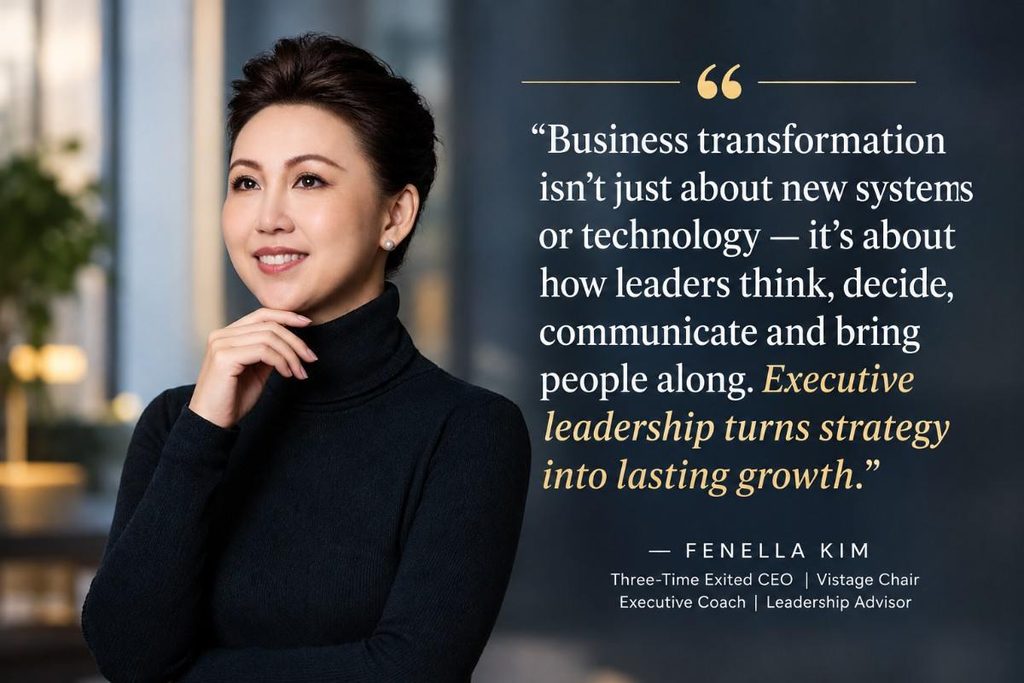
Fenella Kim brings experience as a three-time exited CEO, Vistage Chair, executive coach, and leadership advisor.
Her perspective can be particularly valuable when leaders are navigating questions involving:
- Business growth
- Strategic decision-making
- Leadership team effectiveness
- Organizational transformation
- Executive transitions
- Accountability
- Business strategy
- Leadership development
The value of experienced executive support is not necessarily about giving a CEO a ready-made answer.
It can be about helping the leader ask better questions, challenge assumptions, evaluate options, and make decisions with greater clarity.
Why CEOs Should Not Lead Transformation Alone
Being a CEO can be isolating.
The organization may expect the CEO to provide answers while simultaneously depending on that person to make difficult decisions about the company’s future.
But transformation creates complex situations where an outside perspective can be extremely useful.
A strong leadership support system may include:
- Executive coaching
- Peer advisory
- Business coaching
- Leadership development
- Strategic advisory
- Trusted executive relationships
Leader Transcend’s CEO Peer Advisory Group can provide another avenue for leaders to gain perspective through confidential peer-level discussions.
Similarly, a CEO Advisory Board can provide strategic guidance and leadership accountability when executives are facing important business decisions.
The objective is not to replace the CEO’s judgment.
It is to make that judgment stronger.
When Should a Business Consider Executive Leadership Support?
Your organization may benefit from additional executive leadership support if:
- Growth has created greater organizational complexity
- The executive team is struggling with alignment
- Strategic decisions are taking too long
- The CEO has become a bottleneck
- Departments are operating in silos
- The organization is preparing for significant growth
- The business is restructuring
- A new CEO or executive is stepping into a larger role
- The company is preparing for succession
- Your strategy is not translating into measurable results
- Leadership responsibilities are unclear
- The organization needs to develop its next generation of leaders
The important question is not whether your business is “broken.”
Sometimes leadership support is most valuable before a major problem develops.
Is Your Leadership Team Ready for the Next Stage of Growth?
Business transformation creates bigger decisions, greater complexity, and new leadership demands. If your organization is facing growth, change, restructuring, or strategic uncertainty, a conversation can help clarify where leadership support may create the greatest impact.
Executive Leadership, Business Transformation, and Long-Term Growth
A successful transformation requires more than a strategic plan.
It requires leaders who can translate strategy into action.
That means connecting:
Strong leadership + clear strategy + aligned people + disciplined execution + continuous learning
As companies grow, the leadership capabilities that worked yesterday may not be enough for tomorrow.
A founder leading a small organization may eventually need to become the leader of a complex executive team.
A successful CEO may suddenly need to lead through restructuring.
An established business may need to reinvent its operating model.
A growing company may need to develop leaders who can operate independently rather than relying on the CEO for every major decision.
In each situation, business transformation becomes a leadership challenge.
The organizations most capable of navigating transformation are often those whose leaders are willing to examine not only what the business needs to change, but also how they themselves need to lead differently.
Frequently Asked Questions
What is an executive leadership business transformation strategy?
An executive leadership business transformation strategy is an approach that connects executive leadership, business strategy, organizational capabilities, people, processes, and execution to successfully manage significant business change.
Why is executive leadership important in business transformation?
Executive leaders establish the vision, make strategic decisions, allocate resources, align teams, communicate priorities, and create accountability. Their involvement helps ensure transformation supports the organization’s broader business objectives.
What role does a CEO play in business transformation?
The CEO typically provides strategic direction, establishes priorities, aligns the executive team, makes high-impact decisions, communicates the reason for change, and ensures leaders are accountable for transformation outcomes.
How does executive coaching support business transformation?
Executive coaching can help leaders strengthen strategic thinking, decision-making, communication, leadership presence, accountability, and change leadership while providing a confidential environment to work through complex leadership challenges.
What leadership skills are important during organizational transformation?
Important capabilities can include strategic thinking, decision-making, executive communication, emotional intelligence, adaptability, conflict management, delegation, influence, accountability, and change leadership.
How can executives improve strategy execution?
Executives can improve execution by establishing clear priorities, assigning ownership, defining measurable outcomes, aligning leadership teams, communicating expectations, reviewing progress, and adapting strategy when circumstances change.
When should a company seek executive leadership support?
Organizations may consider executive leadership support during periods of rapid growth, restructuring, succession, leadership transition, strategic uncertainty, organizational change, or when the existing leadership team needs greater alignment and accountability.
Can executive coaching help during major business change?
Yes. Executive coaching can provide leaders with structured reflection, outside perspective, accountability, and support as they navigate complex decisions, leadership transitions, organizational change, and strategic challenges.
Conclusion: Transformation Starts With Leadership
An effective executive leadership business transformation strategy is not simply about implementing new technology, changing processes, or launching a new strategic initiative.
It is about creating the leadership capability to move the organization from its current state toward its future.
That requires CEOs and executive teams to align around a clear vision, make difficult decisions, develop leaders, communicate effectively, create accountability, and continuously connect strategy with execution. For additional insights into executive leadership and leadership development, leaders can also explore.
The strongest transformation strategies recognize a simple reality:
Business transformation is ultimately a leadership challenge as much as it is a strategy, technology, or operational challenge.
For CEOs and executives looking to strengthen leadership, improve strategic decision-making, or navigate significant organizational change, Leader Transcend provides executive coaching, business coaching, leadership development, and advisory support.
And with Fenella Kim’s leadership experience, leaders can gain a perspective grounded in real-world executive experience—not just theory.
The question for today’s leaders is therefore not simply:
“How do we transform our business?”
It may be more important to ask:
“Do we have the leadership capability to successfully lead the transformation?”