

What building, scaling, and exiting three companies across three industries taught Fenella about leadership—and about herself.
From the outside, building and successfully exiting three companies across three different industries can look like a story of entrepreneurial success.
But success rarely tells the whole story.
Behind every company are difficult decisions, unexpected setbacks, uncertain moments, difficult conversations, hiring decisions, financial pressures, and periods when the next step isn’t obvious.
For Fenella, building three companies was not simply a journey of creating businesses. It was a journey of discovering what leadership actually requires when the stakes become real.
Each company was different.
Each industry presented different challenges.
And each stage of growth required her to become a different kind of leader.
Looking back, some of the most valuable lessons had little to do with revenue, growth, or the eventual exits. They were lessons about people, judgment, resilience, trust, self-awareness, and knowing when to step back from the business to see it more clearly.
These are the leadership lessons from building a business that Fenella wishes she had understood much earlier.
Three Companies, Three Different Leadership Experiences
Building one company can teach you how to start.
Scaling a company teaches you how to build systems, teams, and structure.
Exiting a company teaches you something different again: how to let go, reflect, and recognize what the experience has changed in you.
Doing all three multiple times creates a perspective that is difficult to gain from theory alone.
Fenella built, scaled, and exited companies in three different industries. Each experience forced her to confront different questions about leadership.
What should the CEO personally own?
What should be delegated?
How do you build a leadership team you can trust?
How do you make decisions when you don’t have enough information?
How do you maintain culture as the organization grows?
And perhaps the most difficult question:
How do you make sure the business grows without losing yourself in the process?
The answers evolved with every company.
But several lessons continued to emerge.
Three Stages of Business Growth and the Leadership Lessons They Teach
| Business Stage | What the Leader Typically Faces | Key Leadership Challenge | What Fenella’s Experience Teaches |
|---|---|---|---|
| Building | Creating the business, finding customers, hiring the first team, establishing a market position | Moving quickly while making decisions with limited resources and information | Strong leadership requires clarity, adaptability, and the willingness to make decisions without having every answer |
| Scaling | Growing revenue, expanding teams, increasing complexity, and managing more strategic priorities | Delegating effectively and building a leadership team that can operate without constant founder involvement | The leader must evolve from doing everything personally to creating systems, accountability, and ownership |
| Leading Through Change | New markets, organizational changes, leadership transitions, and unexpected challenges | Keeping people aligned while making difficult decisions under uncertainty | Effective leaders create clarity and stability even when the path forward isn’t completely certain |
| Exiting | Preparing the company for a transition, managing changing responsibilities, and eventually letting go | Separating personal identity from the business and recognizing what comes next | An exit is not only a business transaction; it can be an opportunity for reflection, reinvention, and personal growth |
| After the Exit | Reflecting on past experiences and applying them to future ventures or leadership roles | Turning experience into perspective rather than simply repeating old patterns | The most valuable lessons become useful when they help you lead differently in the future and support other leaders |
Leadership Lesson #1: Growth Requires the Leader to Change
One of the biggest mistakes founders can make is assuming that the leadership approach that worked in the early days will continue to work as the company grows.
It usually won’t.
In the beginning, the founder may need to be involved in almost everything.
They may handle sales, operations, hiring, customer relationships, finances, product decisions, and strategy.
That level of involvement can be necessary.
But eventually, the business becomes too complex for one person to remain at the center of every decision.
The CEO’s job changes.
Instead of asking:
“How can I get everything done?”
the question becomes:
“How do I build an organization where the right people can get the right things done?”
That shift can be uncomfortable.
Founders often have strong instincts and deep knowledge of their businesses. They may believe that staying closely involved protects quality and reduces risk.
But excessive involvement can eventually create a bottleneck.
Decisions slow down.
Executives wait for approval.
Employees become dependent on the founder.
And the CEO becomes overwhelmed by operational details.
Fenella learned that sustainable growth requires leaders to evolve alongside the business.
This is one of the principles that informs her work through CEO Coaching, where CEOs can step away from the immediate demands of the business and examine how their leadership role needs to evolve.
The goal isn’t simply to help a CEO do more.
It is to help the CEO think at the level the organization now requires.
Leadership Lesson #2: Stop Confusing Control With Leadership
Early in a company’s life, control can feel like responsibility.
You care deeply about the outcome, so you stay involved.
You want to make sure things are done properly.
You want to protect the culture.
You want customers to have a good experience.
You want important decisions to be right.
But there comes a point when control starts working against the very thing you’re trying to protect.
A growing organization needs capable people who can make decisions.
That requires trust.
It also requires accountability.
Fenella discovered that effective delegation isn’t about simply handing tasks to other people.
It is about transferring ownership.
That means giving someone:
- Clear expectations
- The authority to make appropriate decisions
- The resources they need
- Accountability for the outcome
- Space to operate without unnecessary interference
This can be particularly challenging for founders because the business may feel deeply personal.
But leadership maturity often means recognizing that the organization doesn’t need the CEO to have all the answers.
It needs the CEO to create the conditions in which other people can succeed.
Leadership Lesson #3: Build the Team Before You Desperately Need It
One of the clearest lessons from scaling multiple companies is that leadership capacity has to grow ahead of the business.
If a company waits until everyone is overwhelmed before adding leadership capacity, the organization is already operating under pressure.
Growth creates complexity.
More customers create more demands.
More employees create more communication challenges.
More revenue creates more financial responsibility.
More markets create more strategic decisions.
Eventually, the founder cannot personally carry all of that complexity.
The solution isn’t simply hiring more people.
It is building the right leadership structure.
That means identifying what capabilities the business will need next—not just what it needs today.
It also means being honest about where the founder is no longer the best person to lead.
That can be one of the hardest decisions an entrepreneur makes.
Sometimes the leader who was perfect for building the company isn’t necessarily the person best suited to lead every future stage in exactly the same way.
Great leaders recognize this.
They build teams that complement their strengths rather than simply surrounding themselves with people who think like they do.
Leadership Lesson #4: You Don’t Have to Have Every Answer
One of the myths surrounding successful CEOs is that great leaders always know what to do.
Real leadership is rarely that simple.
There are moments when the information is incomplete.
There are situations where every option carries risk.
There are decisions where nobody can tell you with certainty what will happen.
And there are moments when experience helps—but doesn’t provide the answer.
Fenella learned that leadership is less about certainty and more about judgment.
Good leaders learn to distinguish between:
- What they know
- What they believe
- What they assume
- What they need to discover
- What they cannot know yet
That distinction can improve decision-making dramatically.
It also creates room for other perspectives.
A leader who believes they must always have the answer can unintentionally discourage their team from challenging assumptions.
A leader who is willing to say, “Let’s examine this from another angle,” can create better decisions.
This is one reason having an experienced, confidential thinking partner can be valuable for CEOs.
Through Executive Coaching, leaders can create space to examine complex situations, challenge their assumptions, and think through decisions without the pressures that often accompany their normal executive environment.
Sometimes the most valuable question isn’t:
“What should I do?”
It is:
“What am I not seeing?”
Leadership Lesson #5: Strategy Matters More Than Constant Activity
Entrepreneurs are often rewarded for being action-oriented.
Move quickly.
Solve problems.
Take opportunities.
Keep going.
But activity and progress are not the same thing.
As companies grow, CEOs have to become increasingly selective about where they spend their attention.
Every hour spent solving a problem that someone else could own is an hour not spent thinking about the company’s future.
Every unnecessary operational decision pulls attention away from strategy.
Every constantly changing priority creates confusion for the leadership team.
Fenella learned that one of the most important transitions in leadership is moving from constant execution to strategic thinking.
That means asking:
- What matters most right now?
- What can wait?
- What should the leadership team own?
- Where is the biggest opportunity?
- What is creating the greatest risk?
- What decisions will matter six months or two years from now?
- What does the organization need from the CEO that nobody else can provide?
This broader perspective is central to Business Coaching, where business performance, strategy, leadership, accountability, and organizational development can be considered together.
Because the CEO’s greatest contribution is not necessarily solving the most problems.
It may be choosing which problems deserve attention in the first place.
Leadership Lesson #6: Culture Cannot Be an Afterthought
When a company is small, culture can feel effortless.
People know each other.
Communication happens naturally.
The founder is close to the team.
Everyone understands what the company is trying to achieve.
But growth changes that.
As organizations become larger, culture becomes something leaders must actively protect and develop.
The values written on a website are not necessarily the culture people experience.
Culture is revealed through behavior.
It shows up in:
- Who gets promoted
- How mistakes are handled
- How leaders communicate
- How conflict is addressed
- Whether people can challenge decisions
- What behavior gets rewarded
- How accountability works
- What happens when performance falls short
Fenella learned that protecting culture during growth requires deliberate leadership.
A company can have a strong strategy and talented people, but if the culture doesn’t support accountability, trust, communication, and execution, growth can become increasingly difficult.
This is particularly important when new executives and employees join the organization.
The leader’s role is not to preserve everything exactly as it was.
It is to preserve what matters while allowing the organization to evolve.
Leadership Lesson #7: Resilience Isn’t Just About Pushing Through
Entrepreneurship often celebrates persistence.
And persistence matters.
But there is a difference between resilience and simply refusing to stop.
Sometimes resilience means continuing.
Sometimes it means changing direction.
Sometimes it means admitting that something isn’t working.
And sometimes it means stepping away long enough to regain perspective.
Building companies can create enormous personal pressure.
The leader may feel responsible for employees, customers, investors, partners, and the future of the business.
That responsibility can become part of their identity.
Over time, the line between leading the business and being the business can become blurred.
Fenella learned that sustainable leadership requires self-awareness.
Leaders need to understand their own energy, boundaries, motivations, fears, and patterns.
They need to recognize when pressure is improving their performance—and when it is beginning to reduce it.
Because a leader who continually sacrifices everything outside the business may eventually discover that success came at a cost they didn’t fully understand.
The Personal Lesson: Don’t Lose Yourself While Building the Company
Some of the most important leadership lessons from building a business have nothing to do with business metrics.
They are personal.
When you are building something from the ground up, it can consume your attention.
There is always another problem.
Another opportunity.
Another decision.
Another person who needs you.
The business can always justify another hour.
Another evening.
Another weekend.
And because entrepreneurs often take enormous pride in what they build, stepping back can feel like giving up.
But sustainable leadership requires boundaries.
It requires understanding that the business is part of your life—not the entirety of it.
That doesn’t mean ambition disappears.
It means ambition becomes more intentional.
A leader can pursue significant growth without allowing the company to consume every part of their identity.
That lesson became increasingly important to Fenella as she reflected on the experiences of building and exiting multiple businesses.
What an Exit Teaches You About Leadership
Building a company requires you to create.
Scaling requires you to expand.
Exiting requires you to let go.
That final stage can reveal something unexpected about leadership.
For years, the company may have been closely connected to your identity.
You made decisions every day.
You worried about its future.
You celebrated its wins.
You carried its problems.
Then the relationship changes.
An exit can create financial freedom, professional opportunity, and a sense of accomplishment.
But it can also create a period of reflection.
Who am I now?
What did I learn?
What would I do differently?
What do I want to build next?
Those questions can be as important as the financial outcome of the transaction.
For Fenella, each exit became another opportunity to reflect on what leadership had taught her.
And those lessons eventually became part of the perspective she brings to other business leaders.
The Value of Seeking Perspective Earlier
If there is one lesson Fenella wishes she had learned sooner, it may be this:
You don’t have to wait until you have a problem to seek perspective.
Leaders often seek outside support when something is already wrong.
The business is struggling.
The executive team isn’t aligned.
Growth has stalled.
A succession issue has emerged.
A major decision has become urgent.
But perspective can be equally valuable when things are going well.
A CEO preparing for the next stage of growth can benefit from stepping back before the current model becomes a limitation.
A founder can examine whether their leadership style is still appropriate before organizational complexity exposes the weaknesses.
An executive can identify blind spots before they become expensive mistakes.
That’s one of the reasons Fenella believes in creating space for leaders to think before they are forced to react.
Why CEOs Need a Place to Think
Being the CEO can be surprisingly isolating.
There are plenty of people around you, but very few people who can speak to you without being affected by your decisions.
Employees may need direction.
Executives may need confidence.
Investors may have their own priorities.
Family members may not fully understand the situation.
Even highly experienced CEOs can benefit from having a place where they don’t have to perform certainty.
That could be one-to-one coaching, strategic business support, or a confidential peer environment.
For leaders who value learning from other experienced CEOs, CEO Peer Advisory Group provides an opportunity to discuss real challenges and gain perspective from peers who understand the realities of leadership.
There is tremendous value in hearing:
“I’ve been there.”
But there can be even more value in hearing:
“Here’s what I learned when I was there.”
Turning Experience Into Leadership Development
Experience only becomes truly valuable when you learn from it.
A difficult decision can become wisdom.
A leadership mistake can become self-awareness.
A failed strategy can become better judgment.
A challenging employee situation can reveal a blind spot.
A successful exit can create perspective about what really mattered.
This is why Fenella’s experiences across three companies continue to influence her work.
Through Leadership Development Coaching, leaders can work on capabilities that become increasingly important as their responsibilities grow, including strategic thinking, executive communication, decision-making, accountability, change leadership, and team development.
Leadership development isn’t simply about becoming better at managing people.
It is about becoming more capable of leading through complexity.
The Leadership Lessons From Building a Business That Fenella Wishes She Knew Sooner
Looking back across three companies, the biggest lessons were not simply about how to build a successful business.
They were about how to become the kind of leader capable of sustaining that success.
The most important leadership lessons from building a business include:
Build for the next stage, not just the current one
Your organization should evolve before growth makes the current structure impossible to sustain.
Hire people who can challenge you
A leadership team should not simply agree with the CEO. It should make the CEO’s thinking better.
Delegate ownership, not just tasks
Giving someone a list of responsibilities is different from giving them genuine authority and accountability.
Protect strategic thinking time
The higher you rise in an organization, the more valuable your attention becomes.
Treat culture as a business asset
Culture influences how people communicate, make decisions, handle pressure, and execute strategy.
Ask for perspective earlier
You don’t need to wait for a crisis before having a challenging conversation with someone you trust.
Remember that the business is not your identity
Building something meaningful matters. But your identity and wellbeing need to exist beyond the company.
These lessons are not a formula for guaranteed success.
They are reminders that leadership is an ongoing process of adaptation.
Three Exits. One Truth.
Three companies.
Three industries.
Three different journeys.
And countless decisions, challenges, successes, failures, and lessons along the way.
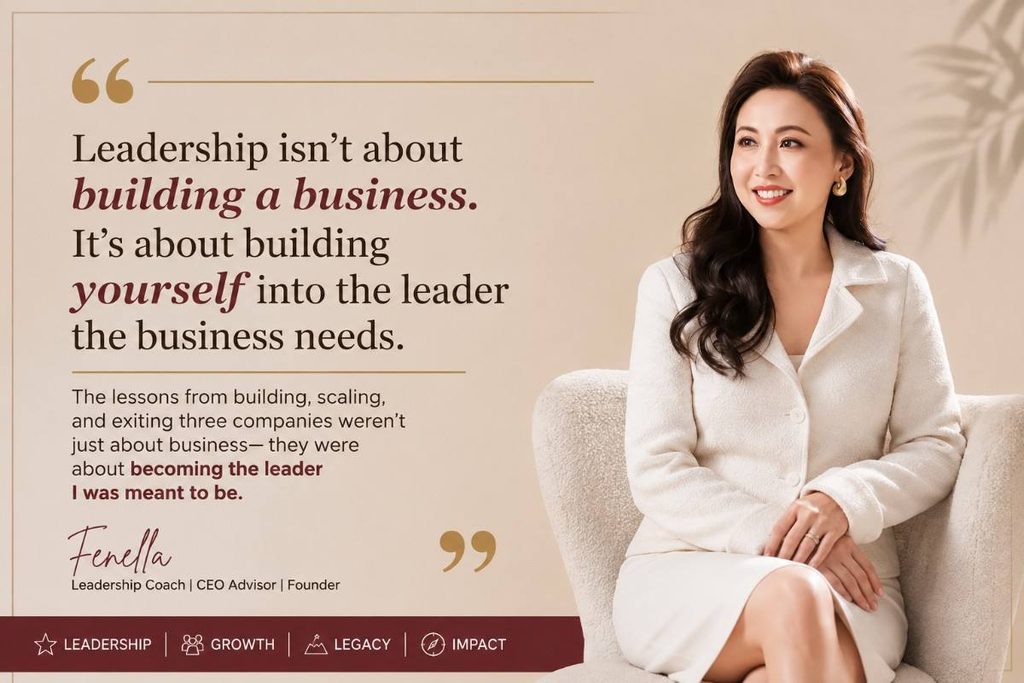
Fenella’s experience taught her that leadership is not about having complete control.
It is about creating clarity.
It is not about knowing every answer.
It is about having the judgment to ask better questions.
It is not about becoming indispensable.
It is about building people and organizations capable of succeeding without depending on you for every decision.
And it is not simply about growing the company.
It is about growing yourself alongside it.
The greatest leadership lessons from building a business are often learned when the obvious answers disappear—when growth creates new problems, when old approaches stop working, and when the leader has to evolve before the organization can.
That is where real leadership development happens.
Today, Fenella brings the perspective gained from building, scaling, and exiting three companies to her work with CEOs, founders, and senior executives through Leader Transcend.
Her experience has shown her that leaders don’t always need someone to tell them what to do.
Sometimes they need someone who can help them see what they cannot see themselves.
Because after three exits, one truth stands above all the others:
The business can only grow as far as the leader is willing and able to grow.
And sometimes, the lessons you wish you had learned sooner become the lessons you are best equipped to help someone else learn today. For additional insights into effective leadership and executive development, explore the Harvard Business Review’s leadership resources for research-backed perspectives on leading teams, managing change, and developing as a leader.
Conclusion: The Leader Must Grow With the Business
Building, scaling, and exiting three companies taught Fenella Kim that business success is never just about strategy, revenue, or growth. It is also about the person making the decisions, building the team, navigating uncertainty, and learning when to step back.
The most valuable leadership lessons from building a business often come from the moments that challenge you most—when growth changes what the organization needs, when old approaches stop working, and when you realize that the next stage requires you to become a different kind of leader.
For CEOs and founders navigating their own growth journey, CEO Coaching can provide a confidential space to step back, challenge assumptions, and think through complex leadership and business decisions. For broader business challenges involving strategy, performance, accountability, and organizational growth, Business Coaching can help connect the needs of the leader with the needs of the organization.
Leaders looking to strengthen their capabilities as their responsibilities evolve can also explore Leadership Development Coaching, while those seeking a confidential environment to examine executive-level challenges may benefit from Executive Coaching.
The journey doesn’t end when a company succeeds or an exit is completed. Every experience becomes part of the leadership perspective you carry into whatever comes next.
The greatest lesson may be the simplest:
As the business grows, the leader must grow with it.
And sometimes, the lessons you wish you had learned years ago become the very lessons that allow you to help another leader move forward with greater clarity, confidence, and perspective.