
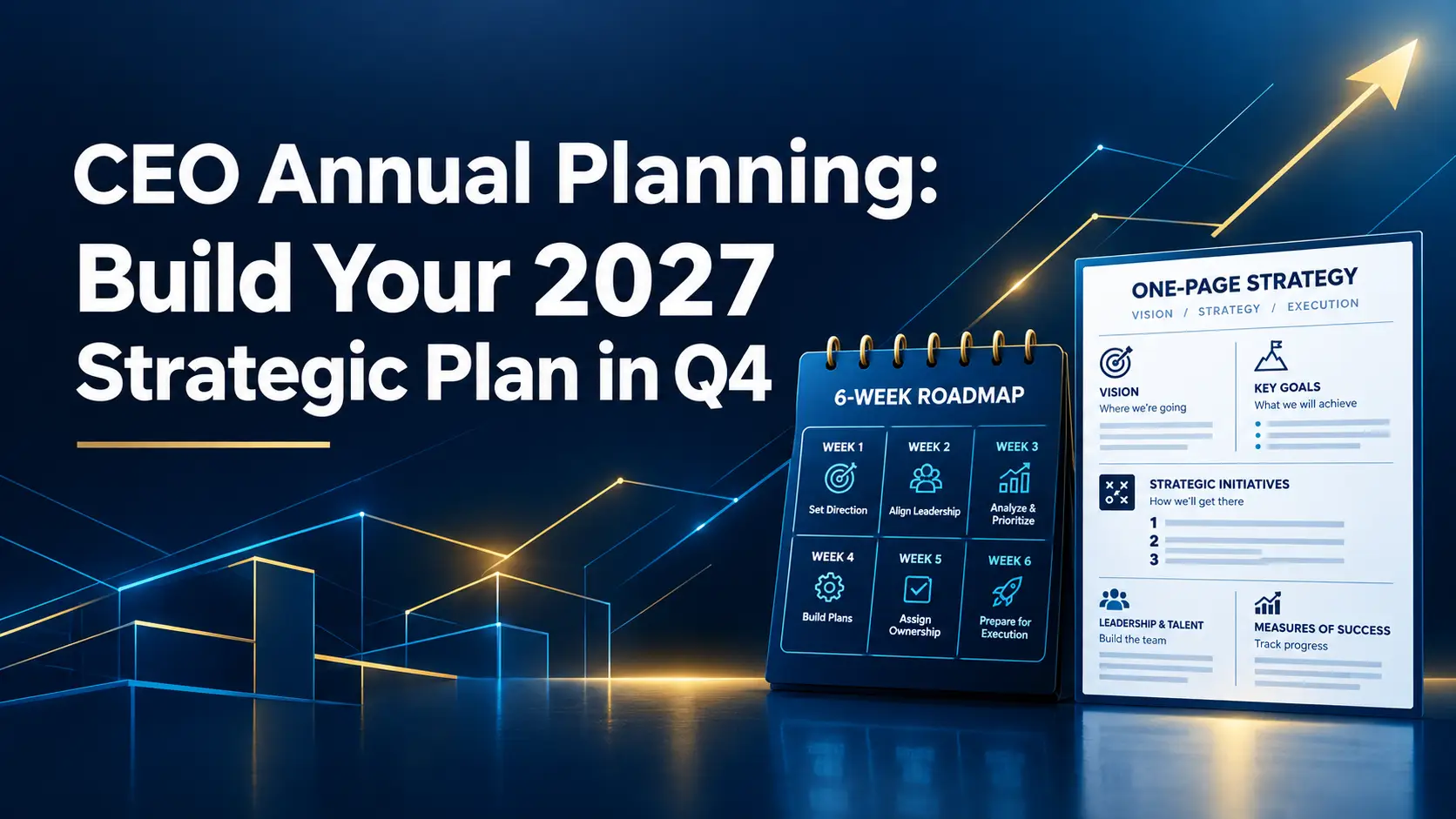
Most CEOs don’t fail at planning because they lack ideas. They fail because planning gets squeezed into one rushed offsite in December, right between holiday parties and year-end close. A better strategic planning process spreads the work across six focused weeks, so each decision has time to settle before the next one depends on it.
This guide lays out that calendar for the 2026 fourth quarter. It’s built for owners and CEOs of companies roughly $5M to $100M in revenue, where the CEO still carries most of the strategy but has a leadership team ready to own execution.
The schedule below starts the week of October 26 and wraps by December 11, leaving the Thanksgiving week (November 23–27) as a buffer. Use early October to block calendars and gather numbers.
The Six-Week Strategic Planning Process
Week 1 (Oct 26–30): Look back honestly
Goal: Get an unvarnished read on 2026 before anyone starts talking about 2027.
Questions to answer:
- Which of this year’s priorities did we actually finish? Which quietly died?
- Where did our forecast miss, and why?
- What did customers, employees and the market tell us that we didn’t expect?
Output: A two-page “2026 in review” with year-to-date financials, a projected full-year finish, and a short list of lessons. Keep it factual. Blame belongs nowhere in this document.
Week 2 (Nov 2–6): Scan the outside world
Goal: Understand the forces that will shape your next 12–36 months.
Questions to answer:
- What are our top three competitors doing differently?
- Which customer segments are growing, shrinking or changing how they buy?
- What economic, labor, regulatory or technology shifts could help or hurt us? (AI adoption belongs on most lists this year.)
Output: A one-page external scan with opportunities and threats ranked by likely impact. Many CEOs stress-test this page with a peer group of other business owners, who will tell you what you’re missing. See how that works on our CEO Board page.
Week 3 (Nov 9–13): Reset direction
Goal: Confirm or adjust where the company is heading over three years.
Questions to answer:
- Does our three-year picture still hold? What has changed?
- What will we deliberately stop doing?
- If we could only win at one thing in 2027, what would it be?
Output: A revised three-year target (revenue, profit, headcount, one strategic marker) and a short “stop doing” list. This is the heart of how to create a strategic plan that actually changes behavior: subtraction is harder than addition.
Week 4 (Nov 16–20): Choose the few priorities
Goal: Turn direction into three to five company priorities for 2027.
Questions to answer:
- Which priorities move us toward the three-year target fastest?
- Who owns each one? (One name per priority, not a committee.)
- What does “done” look like by December 31, 2027, and by the end of each quarter?
Output: A priority list with owners and measurable year-end results. If you have more than five, you don’t have priorities yet.
Thanksgiving week (Nov 23–27): no planning meetings. Let ideas sit.
Week 5 (Nov 30–Dec 4): Put numbers and people behind it
Goal: Make sure the budget and the org chart can carry the plan.
Questions to answer:
- Does the 2027 budget fund the priorities, or only last year’s habits?
- What roles do we need to hire, change or eliminate?
- Where are the single points of failure on the leadership team?
Output: A draft 2027 budget tied to each priority, plus a hiring and capability plan. Your CFO or outside accountant should pressure-test the assumptions now, not in February.
Week 6 (Dec 7–11): Commit and communicate
Goal: Lock the plan and decide how it will be shared and tracked.
Questions to answer:
- Can every leader explain the plan in two minutes?
- What will we review monthly and quarterly, and in which meeting?
- What’s the message to the whole company in January?
Output: The final one-page plan (template below), a Q1 2027 action list for each owner, and a meeting rhythm on the calendar for the year.
The One-Page 2027 Plan Template
A strong annual business planning process ends with a document short enough to pin to a wall. Here’s the layout:
| Section | What goes here | Example entry |
|---|---|---|
| Purpose | Why the company exists, one sentence | “Keep Long Island’s mid-size manufacturers running” |
| Three-year target (2029) | Revenue, profit, one strategic marker | $40M revenue, 12% EBITDA, 30% recurring revenue |
| 2027 targets | Revenue, gross margin, net profit, cash | $28M / 34% / 9% / 60 days cash |
| Top priorities (3–5) | Priority, owner, year-end result | “Launch service contracts — VP Ops — 150 signed” |
| Stop doing | What you’re dropping | “Custom jobs under $10K” |
| Key numbers to watch | 4–6 leading indicators | Quote-to-close rate, on-time delivery |
| Q1 actions | First 90 days per priority | “Price model approved by Feb 15” |
| Risks and responses | Top three risks, early warning signs | “Key customer >20% of sales: diversify pipeline” |
| Review rhythm | When and where you check progress | Monthly leadership meeting, quarterly offsite |
The example entries are illustrations only. Replace them with your own numbers.
Common Traps in Q4 Planning
Even a well-scheduled plan can go sideways. These are the patterns that show up most often:
- Planning as forecasting. Projecting this year’s line items forward 8% is a budget, not a strategy. The direction and “stop doing” work in Week 3 is what makes it strategic.
- Too many priorities. Twelve priorities means none get resourced. Three to five is the range most frameworks recommend.
- The CEO writes it alone. If the leadership team didn’t shape it, they won’t own it. Draft together, even if you make the final calls.
- Skipping the uncomfortable conversation. If a leader can’t carry their priority, the plan will expose that by March. Better to address it in Week 5.
- No review rhythm. Plans written in December and reread the next December change nothing. Put the monthly and quarterly reviews on the calendar before the year starts.
- Ignoring the outside view. Leadership teams share the same blind spots. An outside facilitator, advisor or peer group can ask the question nobody inside will. Our Executive Leadership & Business Transformation Strategy page explains how outside perspective fits into a plan.
Q4 planning doesn’t need to be heroic. It needs to start early, move in order, and end with a plan your team can repeat from memory. Start October 26 and you’ll walk into January with decisions made, not still debated.
Want an outside sounding board for your 2027 plan? Book a confidential conversation with Fenella Kim to talk through your priorities before you lock them in.